
 Stone Blind
Quotes from the Book
Perhaps it’s a little reminder that the word museum means ‘home of the Muses’.
5
The distinction that only sciences are useful and only arts are spirit-enhancing is a nonsensical one. I couldn't write much without scientists designing my computer. And some of them must want to read about Greek myth after a long day at work. These Muses always remind me that scientists and artists should disregard the idiotic attempts to separate us. We are all nerds, in the end.
4
As is always the way with Ovid, his capacity for irony is so subtle and comprehensive that it is difficult to know how sincere or cheeky he is being at any given moment.
4
But I can’t help wondering if there is some sort of recognition for the idea that female gods–who held power and autonomy that female humans were not permitted to have–might well not want a male partner.
4
We like to be able to separate heroes, villains, and victims. It’s convenient for a simple narrative, but it isn’t always reflective of the truth.
3
The more time you spend examining these stories of Hera’s bad behaviour, the more reasons you tend to be able to find for why she might be behaving unreasonably, or why someone else is the guilty party but blaming Hera is so convenient. It is a misogynist narrative as old as time itself, and never out of fashion:
3
the trope of the jealous husband is less pervasive in Greek myth than that of the jealous wife.
3
Actually, he says, the opposite is true. People will come to depend on writing, which is external, and stop using memory, which is internal. In fact, writing will make us forgetful. It is typical of Plato–using the character of his tricksy mentor, Socrates–to construct a written argument dismissing the value of writing.
3
Coming home is not just a geographical act; it's a question of being recognized for who you really are.
2
When you're in love, you're at war.
2
From Persephone’s perspective, these two deities are – as the Greek text makes plain – essentially the same. One god rapes her, the other agrees to it.
2
There really is nothing like Greek myth for reminding us that the countryside is rarely the blissful idyll for young women that it is for young men and gods. More frequently it is the source of sexual threat and constant anxiety.
2
So this is my answer to that question prompted by Xenophanes. When women make art like men do, their goddesses look divine.
2
Not only did the ancient Greeks seem to have modelled gods in their mortal image, but they apparently chose their worst selves as the template.
2
The poem is probably Ovid’s smutty guide to urban adultery, the Ars Amatoria–Art of Love–in which he tells his readers how to flirt with smart young city women, and how to take things quite a bit further than that. This jokey guide was at odds with the ostensible morality reforms which Augustus had ushered in after becoming emperor.
2
But even if his sympathies are not with Arachne in this moment, he can still imagine that from her perspective these gods are nothing but rapists. She has been described to us as excessively arrogant about her own skills, even if her confidence is well-founded. And she has been shown to be short-tempered with an interfering old woman. But these aren’t the characteristics of a fantasist or a fool. She isn’t out of her mind, like poor Ajax. We can’t simply dismiss her opinions as those coming from a disordered mind. Whether Ovid shares her views is unimportant. What matters is that he is perfectly aware of her feelings about the pain inflicted by these gods in their cruelty, and his version of Arachne is given the space to express it. Look at the great gifts the gods have given you, Athene’s tapestry proclaims. Arachne’s response is very detailed in its execution, but very simple in its message: the price is too high.
2
It’s fascinating that fully half of these six major goddesses have sworn off sex and marriage, given that they were worshipped during times when ordinary women had little choice about marriage, and almost no opportunity to reject it as a way of life. Perhaps the only thing we can read into this mismatch is that gods occupy a different plane from mortals and so would live unimaginable lives, and that being unmarried is as natural for a goddess (and unnatural for a mortal)
2
So memory was a crucial skill for a poet like Hesiod or Homer, who would perform his work rather than publish it.
2
Calliope, Muse of epic poetry; Clio, Muse of history; Thalia, Muse of comedy; Terpsichore, Muse of dance; Melpomene, Muse of tragedy. Clio holds a scroll to represent history, and Melpomene carries a tragedy mask.
2
No life matters as much as her daughter's life. And if you rashly decide to go against her, she will crush you like a bug.
1
There is no quicker way to be robbed of power than to lose your capacity to speak.
1
Look at the great gifts the gods have given you, Athene's tapestry proclaims. Arachne's response is very detailed in its execution, but very simple in its message: the price is too high.
1
We know that love and desire can play havoc with our lives, but we are human and complicated.
1
No one can claim to have produced any work without [the Muses'] help: the very fact that it exists proves they smiled on us. If they don't accede to our request, there is nothing to bear witness to the refusal. Just a blank page, an empty stage, a silent lyre.
1
Music is not just a gift from goddess to mortal; it is also a way to celebrate the divine, another kind of temple.
1
We create gods that reflect us and the way we see ourselves.
1
Heroes need villains, though Greek gods were often capable of being both at once: supporter of one mortal and destroyer of another.
1
And so I find myself thinking that of all the goddesses in this book, the Furies – not in their role of vengeance-goddesses but in the sense of collective, societal shame that they also personify, shame at breaking your word or behaving cruelly and dishonestly – might be the ones I would most like to see restored to a modern pantheon.
1
If we have learned nothing else from myths, folklore, and fairy tales, we should at least know this. If an old woman approaches you and asks for anything, or suggests anything, you always, always say yes, and thank you very much for asking. There is an almost zero chance that she is an actual old lady and not a goddess, a witch, or an enchantress in disguise. You either change your offending behaviour immediately or – and this is the best-case scenario – you find yourself stuck in a castle full of singing furniture, with one erratic houseplant your only hope of salvation.
1
I am often asked why Greek tragedy retains such a hold on us today, and I always give the same answer: because the unit of currency in tragedy is a human being. No matter what else has changed across thousands of years, I think that remains true.
1
Watch on YouTube
About Natalie Haynes
We have collected 119 quotes from 4 books by Natalie Haynes on BookQuoters.
More about the author →More by Natalie Haynes
About the book
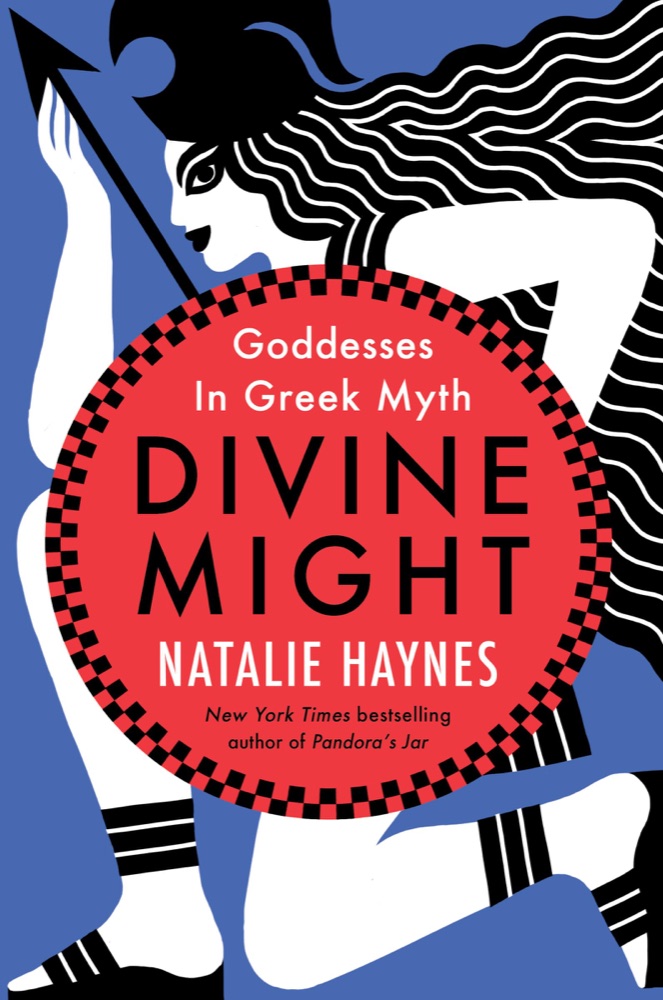
New York Times bestselling author Natalie Haynes returns to the world of ancient Greek myth in this scintillating follow-up to Pandora’s Jar. Few writers today have reshaped our view of the ancient Greek myths more than revered bestselling author Natalie Haynes. Divine Might is a female-centered look at Olympus and the Furies, focusing on the goddesses whose prowess, passions, jealousies, and desires rival those of their male kin, Infused with Haynes’s engaging charm and irrepressible wit, Divine Might is a refreshing take on the legends and stories we thought we knew.
Book details
- First published
- 2023
- Author
- Natalie Haynes
- Genre
- Nonfiction
- Goodreads rating
- 3.94 (12k ratings)
Keep reading
 Pandora's Jar: Women in the Greek Myths
 Mythos - The Greek Myths Retold
 The Penelopiad
 The Last Song of Penelope
 Mythology
 Great Goddesses - Life Lessons from Myths and Monsters
 The Ruin of Angels
 Lavinia
 Percy Jackson's Greek Heroes
 Medusa's Sisters
 The Memoirs of Cleopatra
 A Thousand Ships
 Women and Other Monsters: Building a New Mythology
 Clytemnestra
 Phaedrus
 The Lost Sisterhood
 Sunbringer
 Grief Lessons: Four Plays by Euripides
 The Hymn to Dionysus
 Babylonia
 The Power of Myth
 Percy Jackson's Greek Gods
 Tress of the Emerald Sea
 The Greek Way
 The Hundred Thousand Kingdoms
 Persian Letters
 Gods of Jade and Shadow
 Troy
Troy
 The Hero's Journey: Joseph Campbell on His Life & Work
 The Atlas Six
 Age of Myth
 The Immortals of Meluha
Stone Blind
The Immortals of Meluha
Stone Blind
 The Killing Moon
 Cassandra Speaks: When Women Are the Storytellers, the Human Story Changes
 Three Parts Dead
 Elizabeth Finch
 The Grace of Kings
 The Bacchae
 A Short History of Myth
 The Gospel of Loki
 Agamemnon
 Metamorphoses
 The Hero With a Thousand Faces
 Medea
Medea
 The Norse Myths
 The King Must Die
 Styxx
Styxx
 After Sappho
 What Is Not Yours Is Not Yours
 City of Stairs
 Because You Love to Hate Me: 13 Tales of Villainy
 Skinny Legs and All
 Muse of Nightmares
 A Tale of Love and Darkness
 House of Chains
 The Monster Baru Cormorant
 Too Like the Lightning
 Voices
 The Rebel Angels