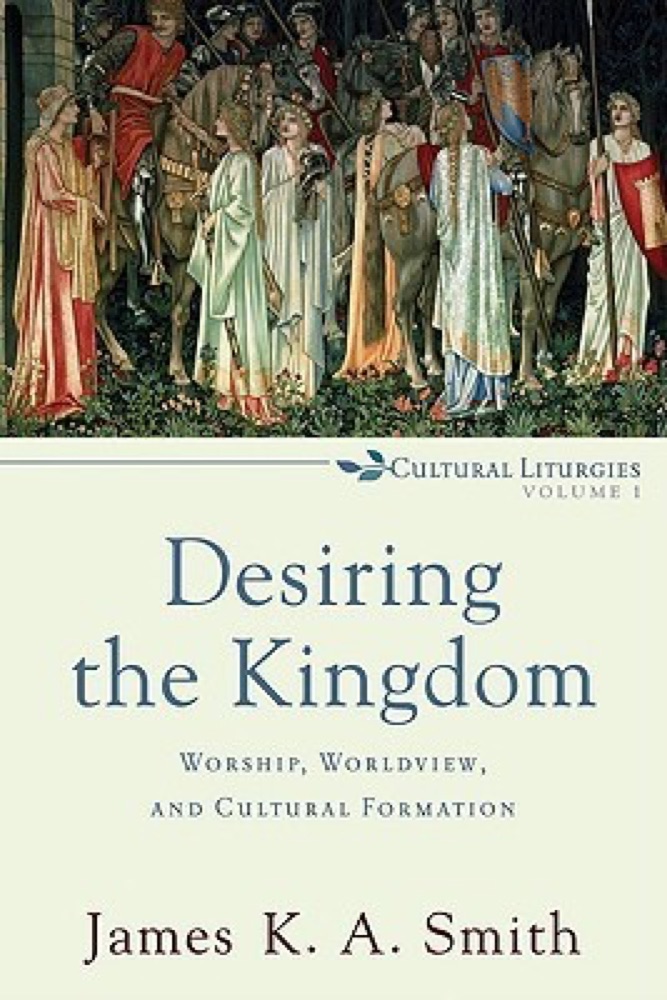
 Desiring the Kingdom: Worship, Worldview, and Cultural Formation
Quotes from the Book
Jesus is a teacher who doesn’t just inform our intellect but forms our very loves. He isn’t content to simply deposit new ideas into your mind; he is after nothing less than your wants, your loves, your longings.
18
We have created youth ministry that confuses extroversion with faithfulness. We have effectively communicated to young people that sincerely following Jesus is synonymous with being 'fired up' for Jesus, with being excited for Jesus, as if discipleship were synonymous with fostering an exuberant, perky, cheerful, hurray-for-Jesus disposition like what we might find in the glee club or at a pep rally.
18
Antoine de Saint-Exupéry captures this well: “If you want to build a ship, don’t drum up people to collect wood and don’t assign them tasks and work, but rather teach them to long for the endless immensity of the sea.
16
Worship works from the top down, you might say. In worship we don’t just come to show God our devotion and give him our praise; we are called to worship because in this encounter God (re)makes and molds us top-down. Worship is the arena in which God recalibrates our hearts, reforms our desires, and rehabituates our loves. Worship isn’t just something we do; it is where God does something to us. Worship is the heart of discipleship because it is the gymnasium in which God retrains our hearts.
12
Your deepest desire,” he observes, “is the one manifested by your daily life and habits.”6 This is because our action—our doing—bubbles up from our loves, which, as we’ve observed, are habits we’ve acquired through the practices we’re immersed in. That means the formation of my loves and desires can be happening “under the hood” of consciousness. I might be learning to love a telos that I’m not even aware of and that nonetheless governs my life in unconscious ways.
11
Jesus’s command to follow him is a command to align our loves and longings with his—to want what God wants, to desire what God desires, to hunger and thirst after God and crave a world where he is all in all—a vision encapsulated by the shorthand “the kingdom of God.
9
The orientation of the heart happens from the bottom up, through the formation of our habits of desire. Learning to love (God) takes practice.
8
Our wants and longings and desires are at the core of our identity, the wellspring from which our actions and behavior flow.
7
Discipleship, we might say, is a way to curate your heart, to be attentive to and intentional about what you love.
7
As Blaise Pascal put it in his famous wager: “You have to wager. It is not up to you, you are already committed.”7 You can’t not bet your life on something. You can’t not be headed somewhere. We live leaning forward, bent on arriving at the place we long for.
5
Liturgy,” as I’m using the word, is a shorthand term for those rituals that are loaded with an ultimate Story about who we are and what we’re for. They carry within them a kind of ultimate orientation. To return to our metaphor above, think of these liturgies as calibration technologies: they bend the needle of our hearts.
4
Learning” virtue—becoming virtuous—is more like practicing scales on the piano than learning music theory: the goal is, in a sense, for your fingers to learn the scales so they can then play “naturally,” as it were. Learning here isn’t just information acquisition; it’s more like inscribing something into the very fiber of your being. Thus
4
Worship is the arena in which God recalibrates our hearts, reforms our desires, and rehabituates our loves. Worship isn’t just something we do; it is where God does something to us. Worship is the heart of discipleship because it is the gymnasium in which God retrains our hearts. Form
3
too often we look for the Spirit in the extraordinary when God has promised to be present in the ordinary.
3
The great Reformer Martin Luther once said, “Whatever your heart clings to and confides in, that is really your god.
2
if you are what you love and if love is a virtue, then love is a habit. This means that our most fundamental orientation to the world—the longings and desires that orient us toward some version of the good life—is shaped and configured by imitation and practice. This has important implications for how we approach Christian formation and discipleship.
2
He meets us where we are, as creatures of habit who are shaped by practices, and invites us into a community of practice that is the very body of his Son. Liturgy is the way we learn to 'put on' Christ.
2
You can't think your way into new hungers.
2
Similarly, if I am going to be a teacher of virtue, I need to be a virtuous teacher. If I hope to invite students into a formative educational project, then I, too, need to relinquish any myth of independence, autonomy, and self-sufficiency and recognize that my own formation is never final. Virtue is not a one-time accomplishment; it requires a maintenance program.
2
It’s like we have moral muscles that are trained in the same way our biological muscles are trained when we practice a golf swing or piano scales. Now
2
For example: never underestimate the formative power of the family supper table. This vanishing liturgy is a powerful site of formation. Most of the time it will be hard to keep the cathedral in view, especially when dinner is the primary occasion for sibling bickering. Yet even then, members of your little tribe are learning to love their neighbor. And your children are learning something about the faithful promises of a covenant-keeping Lord in the simple routine of that daily promise of dinner together. Then
2
It is crucial for us to recognize that our ultimate loves, longings, desires, and cravings are learned. And because love is a habit, our hearts are calibrated through imitating exemplars and being immersed in practices that, over time, index our hearts to a certain end.
1
The reminder for us is this: if the heart is like a compass, an erotic homing device, then we need to (regularly) calibrate our hearts, tuning them to be directed to the Creator, our magnetic north.
1
We learn to love, then, not primarily by acquiring information about what we should love but rather through practices that form the habits of how we love.
1
The place we unconsciously strive toward is what ancient philosophers of habit called our telos--our goal, our end. But the telos we live toward is not something we primarily know or believe or think about; rather, our telos is what we want, what we long for, what we crave. It is less an ideal that we have ideas out and more a vision of "the good life" that we deisre
1
You might have Bible verses on the wall in every room of the house and yet the unspoken rituals reinforce self-centeredness rather than sacrifice. Thus
1
We aren’t really motivated by abstract ideas or pushed by rules and duties. Instead some panoramic tableau of what looks like flourishing has an alluring power that attracts
1
But one of the unintended consequences of the Protestant Reformation, Taylor argues, was a disenchantment of the world. Critical of the ways such an enchanted, sacramental understanding of the world had lapsed into sheer superstition, the later Reformers emphasized the simple hearing of the Word, the message of the gospel, and the arid simplicity of Christian worship. The result was a process of excarnation—of disembodying the Christian faith, turning it into a “heady” affair that could be boiled down to a message and grasped with the mind. To use a phrase that we considered above, this was Christianity reduced to something for brains-on-a-stick. The
1
worship is not primarily a venue for innovative creativity but a place for discerning reception and faithful repetition. That
1
The drama of redemption told in the Scriptures is enacted in worship in a way that makes it "sticky". Study and memorization are important, but there is a unique, imagination-forming power in the communal, repeated, and poetic cadences of historic Christian worship.
Watch on YouTube
About James K.A. Smith
We have collected 59 quotes from 2 books by James K.A. Smith on BookQuoters.
More about the author →More by James K.A. Smith
Desiring the Kingdom: Worship, Worldview, and Cultural Formation
About the book
You are what you love. But you might not love what you think.
In this book, award-winning author James K. A. Smith shows that who and what we worship fundamentally shape our hearts. And while we desire to shape culture, we are not often aware of how culture shapes us. We might not realize the ways our hearts are being taught to love rival gods instead of the One for whom we were made. Smith helps readers recognize the formative power of culture and the transformative possibilities of Christian practices. He explains that worship is the "imagination station" that incubates our loves and longings so that our cultural endeavors are indexed toward God and his kingdom. This is why the church and worshiping in a local community of believers should be the hub and heart of Christian formation and discipleship.
Following the publication of his influential work Desiring the Kingdom, Smith re
Book details
- First published
- 2016
- Author
- James K.A. Smith
- Genre
- Nonfiction
- Goodreads rating
- 4.10 (9k ratings)
Keep reading
Desiring the Kingdom: Worship, Worldview, and Cultural Formation
 Renovation of the Heart: Putting On the Character of Christ
 Celebration of Discipline: The Path to Spiritual Growth
 Christ Plays in Ten Thousand Places: A Conversation in Spiritual Theology
 Liturgy of the Ordinary: Sacred Practices in Everyday Life
 The Life You've Always Wanted: Spiritual Disciplines for Ordinary People
 The Deeply Formed Life: Five Transformative Values to Root Us in the Way of Jesus
 The Common Rule: Habits of Purpose for an Age of Distraction
 The Wisdom Jesus: Transforming Heart and Mind
 Practicing the Way: Be with Jesus, Become Like Him, Do As He Did
 A Long Obedience in the Same Direction: Discipleship in an Instant Society
 The Holy Longing: The Search for a Christian Spirituality
 The Grand Weaver: How God Shapes Us through the Events in Our Lives
 The Spirit of the Disciplines: Understanding How God Changes Lives
 The Sacred Romance: Drawing Closer to the Heart of God
 The Cloister Walk
 Gospel: Recovering the Power that Made Christianity Revolutionary
 The Divine Conspiracy: Rediscovering Our Hidden Life in God
 Worship Matters: Leading Others to Encounter the Greatness of God
 Barking to the Choir: The Power of Radical Kinship
 Rediscover Catholicism
 To Hell with the Hustle
 Having a Mary Heart in a Martha World: Finding Intimacy with God in the Busyness of Life
 In His Image: 10 Ways God Calls Us to Reflect His Character
 The Quotidian Mysteries: Laundry, Liturgy and Women's Work
 Instruments in the Redeemer's Hands: People in Need of Change Helping People in Need of Change
 The Divine Dance: The Trinity and Your Transformation
 Disciplines of a Godly Man
 No Man Is an Island
 The Sacred Romance Drawing Closer To The Heart Of God
 Everything Belongs: The Gift of Contemplative Prayer
 The Journey Home
 Contemplative Prayer
 Think: The Life of the Mind and the Love of God
 A Little Book on the Christian Life
 The Me I Want to Be: Becoming God's Best Version of You
 Wholehearted Faith
 The God Who Weeps: How Mormonism Makes Sense of Life
 New Morning Mercies: A Daily Gospel Devotional
 Tattoos on the Heart: The Power of Boundless Compassion
 The Lifegiving Home: Creating a Place of Belonging and Becoming
 What We Talk about When We Talk about God
 A Return to Love: Reflections on the Principles of "A Course in Miracles"
 Sacred Marriage: Celebrating Marriage as a Spiritual Discipline
 Becoming Wise: An Inquiry into the Mystery and Art of Living
 Sitting at the Feet of Rabbi Jesus: How the Jewishness of Jesus Can Transform Your Faith
 Wild Goose Chase: Reclaim the Adventure of Pursuing God
 Freedom of Simplicity: Finding Harmony in a Complex World
 Amazing Grace: A Vocabulary of Faith
 Simply Christian
 The Message Remix
 The Pursuit of God: The Human Thirst for the Divine
 Desiring God: Meditations of a Christian Hedonist
 Jesus Among Other Gods: The Absolute Claims of the Christian Message
 The Secret Thoughts of an Unlikely Convert: An English Professor's Journey Into Christian Faith
 Time for God
 Love Wins Low Price CD: Love Wins Low Price CD
 The Sermon on the Mount: The Key to Success in Life