
 Breathing Underwater: Spirituality and the 12 Steps
Quotes from the Book
Knowing without loving is frankly dangerous for the soul and for society. You'll critique most everything you encounter and even have the hubris to call this mode of reflexive cynicism "thinking" (whereas it's really your ego's narcissistic reaction to the moment). You'll position things to quickly as inferior or superior, "with me" or "against me," and most of the time you'll be wrong.
18
Remember, mystery isn’t something that you cannot understand—it is something that you can endlessly understand! There is no point at which you can say, “I’ve got it.” Always and forever, mystery gets you!
12
Love is not something you do; love is someone you are. It is your True Self.8 Love is where you came from and love is where you’re going. It’s not something you can buy. It’s not something you can attain. It is the presence of God within you, called the Holy Spirit—or what some theologians name uncreated grace.
10
Circling around” is all we can do. Our speaking of God is a search for similes, analogies, and metaphors. All theological language is an approximation, offered tentatively in holy awe. That’s the best human language can achieve. We can say, “It’s like—it’s similar to…,” but we can never say, “It is…” because we are in the realm of beyond, of transcendence, of mystery. And we must—absolutely must—maintain a fundamental humility before the Great Mystery. If we do not, religion always worships itself and its formulations and never God.
10
Our starting place was always original goodness,10 not original sin. This makes our ending place—and everything in between—possessing an inherent capacity for goodness, truth, and beauty.
9
The energy in the universe is not in the planets, or in the protons or neutrons, but in the relationship between them.
8
We always become what we behold; the presence that we practice matters.
6
We’ve turned faith into a right to certitude when, in fact, this Trinitarian mystery is whispering quite the opposite: we have to live in exquisite, terrible humility before reality.
6
The Christian God’s power comes through his powerlessness and humility. Our God is much more properly called all-vulnerable than almighty, which we should have understood by the constant metaphor of “Lamb of God” found throughout the New Testament. But unfortunately, for the vast majority, he is still “the man upstairs,” a substantive noun more than an active verb. In my opinion, this failure is at the basis of the vast expansion of atheism, agnosticism, and practical atheism we see in the West today. “If God is almighty, then I do not like the way this almighty God is running the world,” most modern people seem to be saying. They do not know that the Trinitarian revolution never took root! We still have a largely pagan image of God.
6
And we must—absolutely must—maintain a fundamental humility before the Great Mystery. If we do not, religion always worships itself and its formulations and never God.
6
God does not decide to love, therefore, and God’s love can never be determined by the worthiness or unworthiness of the object. But God is Love itself.4 God cannot not love, because love is the nature of God’s very being.
5
You rest in God, not in outcomes.
3
In my experience, healthily vulnerable people use every occasion to expand, change, and grow. Yet it is a risky position to live undefended, in a kind of constant openness to the other—because it would mean others could sometimes actually wound you (from vulnus, “wound”). But only if we choose to take this risk do we also allow the exact opposite possibility: the other might also gift you, free you, and even love you. But it is a felt risk every time. Every time.
2
You are in a position of total powerlessness, and your ego is fighting it. All you can do is surrender and enter into this dance of unhindered dialogue, this circle of praise, this web of communion that we call the Blessed Trinity.
2
We are here to witness the creation and to abet it. We are here to notice each thing so each thing gets noticed. Together we notice not only each mountain shadow and each stone on the beach but, especially, we notice the beautiful faces and complex natures of each other.… Otherwise, creation would be playing to an empty house.
2
As I said, this Spirit has two jobs. First, she creates diversity, as exemplified in the metaphor of wind—just breathing out ever-new life in endlessly diverse forms. But then the Spirit has another job: that of the Great Connector—of all those very diverse things! All this pluriform life, the Spirit keeps in harmony and “mutual deference”267—“so there shall be one Christ, loving Himself,” as Augustine daringly put it.
2
To know the Lord and his ways,” as the Jewish prophets put it,250 has very little to do with intelligence and very much to do with a wonderful mixture of confidence and surrender. People who live in this way tend to be the calmest and happiest people I know. They draw their life from the inside out.
2
Human strength is defined in asserting boundaries. God, it seems, is in the business of dissolving boundaries. So we enter into paradox—what’s Three is one and what’s One is three. We just can’t resolve that, and so we confuse unity with uniformity.
2
We are never an object to God. God cannot but love God’s image in us.
1
At the risk of sounding like I am making a serious overstatement, I think the common Christian image of God, despite Jesus, is still largely “pagan” (not that pagans are bad people, by the way!) and untransformed.
1
Abba is the word that Jesus used to connote safety and endearment. It is actually a child’s word, closest to Papa or Daddy. But unfortunately, it suffers today from centuries of being heard (and used) inside patriarchal cultures, implicitly validating a hierarchical worldview.
1
Our speaking of God is a search for similes, analogies, and metaphors. All theological language is an approximation, offered tentatively in holy awe. That’s the best human language can achieve. We can say, “It’s like—it’s similar to…,” but we can never say, “It is…” because we are in the realm of beyond, of transcendence, of mystery. And we must—absolutely must—maintain a fundamental humility before the Great Mystery. If we do not, religion always worships itself and its formulations and never God.
1
When the self is surrendered—when we’re not too tied to our own agenda, anger, fear, or desire to make things happen our way—we are truly open to love. But be aware of the heart’s propensity to clench and close.
1
...mystery isn't something that you cannot understand -- it is something that you can endlessly understand!
1
Everything you have ever seen with your eyes is the self-emptying of God into multitudinous physical and visible forms. In other words, Infinity is forever limiting itself into finite expressions, and this could even be called the “suffering” of God. The Christ learned this self-emptying, or kenosis , 183 from his eternal life in the Trinity. It is not just Jesus who suffers, but the cross is the visible symbol of what is always going on inside of God!
1
Trinity. It wasn’t until the third century that Tertullian (150–240), sometimes called “the founder of Western Christian theology,” first coined this word Trinity from the Latin trinitas, meaning “triad,” or trinus, meaning “threefold.” Again, the word itself is not found in the Bible; it took history awhile to find a proper word for this always-elusive “rubber band.
1
They’ve gotten so used to these gatherings not being meaningful that they no longer know how to allow them to touch their heart or change their mind. The Holy Spirit is again the Missing Person of the Blessed Trinity.
1
Watch on YouTube
About Richard Rohr
We have collected 116 quotes from 4 books by Richard Rohr on BookQuoters.
More about the author →More by Richard Rohr
Breathing Underwater: Spirituality and the 12 Steps
 Everything Belongs: The Gift of Contemplative Prayer
About the book
Invitation to a Dance
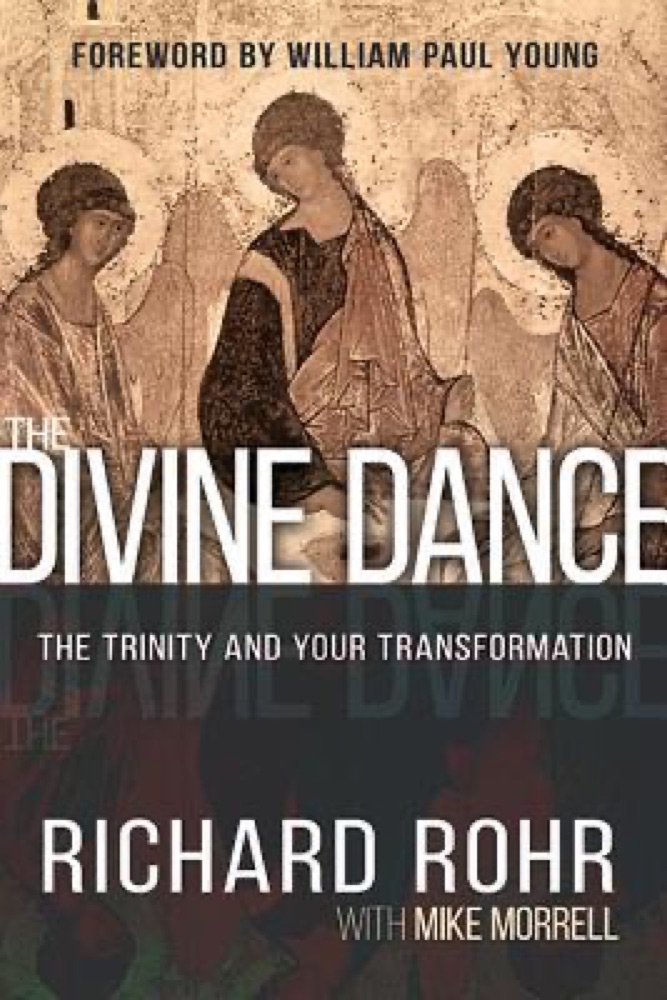
The Trinity is supposed to be the central, foundational doctrine of our entire Christian belief system, yet we're often told that we shouldn't attempt to understand it because it is a "mystery." Should we presume to try to breach this mystery? If we could, how would it transform our relationship with God and renew our lives?
The word Trinity is not found in the New Testament—it wasn't until the third century that early Christian father Tertullian coined it—but the idea of Father, Son, and Holy Spirit was present in Jesus' life and teachings and from the very beginning of the Christian experience.
In the pages of this book, internationally recognized teacher Richard Rohr circles around this most paradoxical idea as he explores the nature of God—circling around being an apt metaphor for this mystery we're trying to apprehend. Early Christians who came to b
Book details
- First published
- 2016
- Author
- Richard Rohr
- Genre
- Nonfiction
- Goodreads rating
- 4.21 (4k ratings)
Keep reading
 The Orthodox Way
 Christ Plays in Ten Thousand Places: A Conversation in Spiritual Theology
 The Divine Conspiracy: Rediscovering Our Hidden Life in God
 My Bright Abyss: Meditation of a Modern Believer
Everything Belongs: The Gift of Contemplative Prayer
My Bright Abyss: Meditation of a Modern Believer
Everything Belongs: The Gift of Contemplative Prayer
 What We Talk about When We Talk about God
 Jesus Among Other Gods: The Absolute Claims of the Christian Message
 The Knowledge of the Holy
 The Reason for God: Belief in an Age of Skepticism
 None Like Him: 10 Ways God Is Different from Us
 Renovation of the Heart: Putting On the Character of Christ
 The Crucible of Doubt: Reflections On the Quest for Faith
 Simply Christian
 The Grand Weaver: How God Shapes Us through the Events in Our Lives
 New Seeds of Contemplation
 The Wisdom Jesus: Transforming Heart and Mind
 Celebration of Discipline: The Path to Spiritual Growth
 Think: The Life of the Mind and the Love of God
 Studies in the Sermon on the Mount
 King's Cross: The Story of the World in the Life of Jesus
 Tattoos on the Heart: The Power of Boundless Compassion
 No Man Is an Island
 The Holiness of God
 The Pursuit of God: The Human Thirst for the Divine
 The World's Religions
 My Utmost for His Highest
 It's Not What You Think: Why Christianity is About So Much More Than Going to Heaven When You Die
 Knowing God
 Amazing Grace: A Vocabulary of Faith
 The Furious Longing of God
 Abba's Child: The Cry of the Heart for Intimate Belonging
 Mere Christianity
 God in Search of Man: A Philosophy of Judaism
 Wild Goose Chase: Reclaim the Adventure of Pursuing God
 Velvet Elvis: Repainting the Christian Faith
 The Explicit Gospel
 The Message Remix
 Beautiful Outlaw: Experiencing the Playful, Disruptive, Extravagant Personality of Jesus
 The God Who Weeps: How Mormonism Makes Sense of Life
 Practicing the Way: Be with Jesus, Become Like Him, Do As He Did
 Hearing God: Developing a Conversational Relationship with God
 Humble Roots: How Humility Grounds and Nourishes Your Soul
 Jesus of Nazareth: The Infancy Narratives
 Emotionally Healthy Spirituality: Unleash A Revolution In Your Life in Christ
 The Attributes of God: A Journey Into the Father's Heart
 In His Image: 10 Ways God Calls Us to Reflect His Character
 Love Wins Low Price CD: Love Wins Low Price CD
 We Who Wrestle with God: Perceptions of the Divine
 The Me I Want to Be: Becoming God's Best Version of You
 A Return to Love: Reflections on the Principles of "A Course in Miracles"
 Waking the Dead: The Glory of a Heart Fully Alive
 Miracles: What They Are, Why They Happen, and How They Can Change Your Life
 Barking to the Choir: The Power of Radical Kinship
 Girl Meets God
 Humility: True Greatness
 The Perennial Philosophy
 Thou Art That: Transforming Religious Metaphor
 What's So Amazing About Grace?
 A History of God: The 4,000-Year Quest of Judaism, Christianity, and Islam
 Encounters with Jesus: Unexpected Answers to Life's Biggest Questions