 Travels with Herodotus
Quotes from the Book
Two lusts breed in the soul of man: the lust for aggresion, and the lust for telling lies. If one will not allow himself to wrong others, he will wrong himself. If he doesn't come across anyone to lie to, he will lie to himself in his own thoughts.
His August Majesty chided the bureaucrats for failing to understand a simple principle: the principle of the second bag. Because the people never revolt just because they have to carry a heavy load, or because of exploitation. They don't know life without exploitation, they don't even know that such a life exists. How can they desire what they cannot imagine? The people will rvolt only when, in a single movement, someone tries to throw a second burden, a second heavy bag, onto their backs. The peasant will fall face down into the mud - and then spring up and grab an ax. He'll grab an ax, my gracious sir, not because he simply can't sustain this new burden - he could carry it - he will rise because he feels that, in throwing the second burden onto his back suddenly and stealthily, you have tried to cheat him, you have treated him like an unthinking animal, you have trampled what remains of his already strangled dignity, taken him for an idiot who doesn't see, feel, or understand. A man doesn't seize an ax in defense of his wallet, but in defense of his dignity, and that, dear sir, is why His Majesty scolded the clerks. For their own convenience and vanity, instead of adding the burden bit by bit, in little bags, they tried to heave a whole big sack on at once.
Because it was enough for one of those favorites of His Distinguished Highness to issue a thoughtless decree. These young smart alecks see it, and they immediately imagine some fatal result and come running to the rescue. They start trying to mend things, straighten things out, patch things up and untangle them. And so instead of using their energy to build their own vision of the future, instead of trying to put their irresponsible, destructive fantasies into action, our malcontents had to roll up their sleeves and start untangling what the minsters had knotted up. And there's always a lot of work to untangling! So they untangle and untangle, drenched in sweat, wearing their nerves to shreds, running around, patching things up here and there, and in all this rush and overwork, in this whirlwind, their fantasies slowly evaporate from their hot heads.
His Highness worked on the assumption that even the most loyal press should not be given in abundance, because that might create a habit of reading, and from there it is only a single step to the habit of thinking, and it is well known what inconveniences, vexations, troubles, and worries thinking causes.
A całą tę sprawę, tak spokojnie i godnie poprowadzoną, minister uznał za sukces, zaś nasza prasa określiła jako zwycięstwo. Tak zawsze jakoś minister kierował, że wszystko na sukces wychodziło i dobrze było, a baliśmy się, że gdyby ministra onego nie stało, wnet by smętkiem powiało, co się potem sprawdziło, kiedy nam go ubyło.
Observing the behavior of individual fowl in a henhouse, we note that birds lower in rank are pecked by, and give way to, birds of higher rank. In an ideal case, there exists a linear order of rank with a top hen who pecks all the others. Those in the middle ranks peck those below them but respect all the hens above them. At the bottom there is a drudge who has to take it from everyone. (Adolf Remane, Vertebrates and Their Ways)
Mr. Kapuchitsky, do you know what money means in a poor country? Money in a poor country and money in a rich country are two different things. In a rich country, money is a piece of paper with which you buy goods on the market. You are only a customer. Even a millionaire is only a customer. He may purchase more, but he remains a customer, nothing more. And in a poor country? In a poor country, money is a wonderful, thick hedge, dazzling and always blooming, which separates you from everything else. Through that hedge you do not see creeping poverty, you do not smell the stench of misery, and you do not hear the voices of the human dregs. But at the same time you know that all of that exists, and you feel proud because of your hedge. You have money; that means you have wings. You are the bird of paradise that everyone admires.
2
No więc w rok po tym powstaniu w Godżam (...) spotkało mnie osobliwe nieszczęście, gdyż syn mój, Hailu, w tych przygnębiających latach student uniwersytetu, zaczął myśleć. Tak jest, zaczął myśleć, a muszę objaśnić cię, przyjacielu, że myślenie było w tamtych czasach dotkliwą niedogodnością, a nawet kłopotliwą ułomnością i jaśnie wysoki pan w swojej nieustającej trosce o dobro i wygodę podwładnych nigdy nie zaniedbywał starań, aby ich przed tą niedogodnością i ułomnością chronić. Wszak po cóż mieli tracić czas, który powinni oddawać sprawie rozwoju, zakłócać spokój wewnętrzny i nabijać głowy wszelką nieprawomyślnością? Nic przyzwoitego i łagodnego nie mogło wyniknąć z faktu, że ktoś postanowił myśleć albo nieopatrznie i wyzywająco wdał się w towarzystwo tych, którzy myśleli. A taką, niestety, nieostrożność popełnił mój lekkomyślny syn, co jako pierwsza zauważyła moja żona, której instynkt matczyny podpowiedział, że nad naszym domem gromadzą się ciężkie chmury, i która pewnego dnia powiada mi, że chyba Hailu zaczął myśleć, ponieważ wyraźnie posmutniał.
Usually it is said that periodic droughts cause bad crops and therefore starvation. But it is the elites of starving countries that propagate this idea. It is a false idea. The unjust or mistaken allocation of funds and national property is the most frequent source of hunger. There was a lot of grain in Ethiopia, but it had first been hidden by the rich and then thrown on the market at a doubled price, inaccessible to peasants and the poor.
After all, what is a dollar but paper? A bullet can save your life. Bullets make weapons more significant, and that makes you more significant. A man's life - what is that worth? Another man exists only to the degree that he stands in your way. Life doesn't mean much, but it's better to take it from the enemy before he has time to deliver a blow.
The event that hastened the confrontation between the army and the Palace was the starvation in the northern provinces. Usually it is said that periodic droughts cause bad crops and therefore starvation. But it is the elites of starving countries that propagate this idea. It is a false idea. The unjust or mistaken allocation of funds and national property is the most frequent source of hunger. There was a lot of grain in Ethiopia, but it had first been hidden by the rich and then thrown on the market at a doubled price, inaccessible to peasants and the poor. Figures about the hundreds of thousands who starved next to abundantly stocked granaries were published. On the orders of local dignitaries, the police finished off whole clans of still-living human skeletons. This situation of intense evil, of horror, of desperate absurdity, became the signal for the conspiring officers to go to work. The mutiny involved all the divisions in turn, and it was probably the army that had been the main prop of Imperial power. After a short period of bewilderment, shock, and hesitation, H. S. began to realize that he was losing his most important instrument.
Why did our fathers impose such strict rules on us, recommending that mortification of the flesh be practiced unceasingly? It is because man is by nature a bad creature who takes damning pleasure out of giving in to temptations, especially the temptations of disobedience, possessiveness, and licentiousness. Two lusts breed in the soul of man: the lust for aggression, and the lust for telling lies. If one will not allow himself to wrong others, he will wrong himself. If he doesn’t come across anyone to lie to, he will lie to himself in his own thoughts. Sweet to man is the bread of untruths, says the Book of Proverbs, and then with sand his mouth is filled up.
Since the cost of loyalty was going up, there was an urgent need to increase income, and that’s why the Finance Ministry ordered the peasants to pay higher taxes. Today I am free to say that it was His Unrivaled Majesty’s decision, but because the Emperor, as a gracious benefactor, could not issue vexatious or plaguing decrees, any proclamation that put a new burden on the shoulders of the people was issued in the name of some ministry. If the people could not shoulder that burden and started a rebellion, His Majesty scolded the ministry and replaced the minister—although he never did so immediately, to avoid creating the humiliating impression that the monarch allows the unbridled mob to put his Palace in order. On the contrary, when he saw the need to demonstrate monarchical supremacy he would raise the most disliked officials to higher positions, as if to say, “Get an eyeload of who’s really in charge here, of who makes the impossible possible!” His Noble Majesty asserted his force and authority by benevolently needling his subjects.
In the second half of August the officers arrest the last of H. S.’s circle. They still don’t touch the Emperor, because they need time to prepare public opinion: the capital must understand why the monarch is being removed. The officers know about the magical element in popular thinking, and about the dangers it contains. The magical aspect is that the highest one is endowed, often unconsciously, with divine characteristics. The supreme one is wise and noble, unblemished and kindly. Only the dignitaries are bad; they cause all the misery. Moreover, if the one on the top knew what his people were up to, he would immediately repair the damage and life would be better. Unfortunately, these crafty villains pull the wool over their master’s eyes, and that is why life is so hard, so low and miserable. This is magical thinking because, in reality, in an autocratic system it is precisely the one on the top who is the primary cause of what happens. He knows what is going on, and if he doesn’t know, it’s because he doesn’t want to know. It was no accident that the majority of the people around the Emperor were mean and servile. Meanness and servility were the conditions of ennoblement, the criteria by which the monarch chose his favorites, rewarded them, bestowed privileges on them. Not one step was taken, not one word said, without his knowledge and consent. Everyone spoke with his voice, even if they said diverse things, because he himself said diverse things. The condition for remaining in the Emperor’s circle was practicing the cult of the Emperor, and whoever grew weak and lost eagerness in the practice of this cult lost his place, dropped out, disappeared. Haile Selassie lived among shadows of himself, for what was the Imperial suite if not a multiplication of the Emperor’s shadow? Who were gentlemen like Aklilu, Gebre-Egzy, Admassu Retta, aside from being H. S.’s ministers? Nobodies. But it was precisely such people the Emperor wanted around him. Only they could satisfy his vanity, his self-love, his passion for the stage and the mirror, for gestures and the pedestal.
The Hour of the Ministers was devoted to Imperial matters, but who cares about Imperial matters when the treasure chest is open and the favorites and chosen ones are swarming around it like ants! No one wants to go away empty-handed, without a gift, without an envelope, without a promotion, without having cashed in. Sometimes His Highness would answer such greediness with a kindly scolding, but he never became angry, since he knew that it was because of the open purse that they pressed around him and served him more humbly. Our Emperor knew that one who is satiated will defend his own contentedness, and where else could one be satiated but in the Palace?
About Ryszard Kapuściński
We have collected 93 quotes from 4 books by Ryszard Kapuściński on BookQuoters.
More about the author →More by Ryszard Kapuściński
About the book
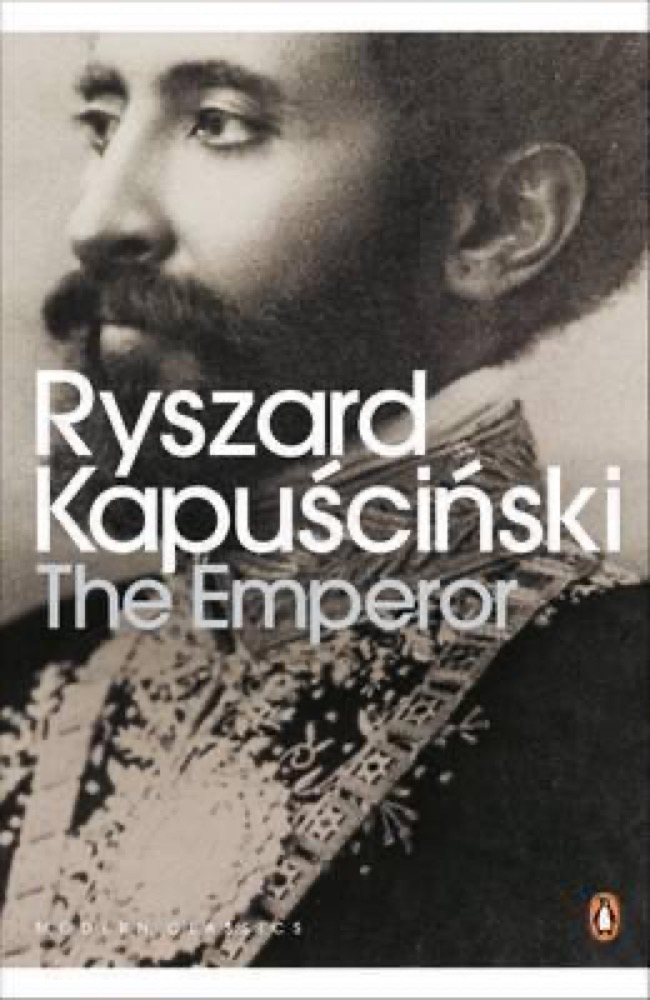
Haile Selassie, King of Kings, Elect of God, Lion of Judah, His Most Puissant Majesty and Distinguished Highness the Emperor of Ethiopia, reigned from 1930 until he was overthrown by the army in 1974. While the fighting still raged, Ryszard Kapuscinski, Poland's leading foreign correspondent, traveled to Ethiopia to seek out and interview Selassie's servants and closest associates on how the Emperor had ruled and why he fell. This "sensitive, powerful. . .history" (The New York Review of Books) is Kapuscinski's rendition of their accounts—humorous, frightening, sad, grotesque—of a man living amidst nearly unimaginable pomp and luxury while his people teetered between hunger and starvation.
Book details
- First published
- 1978
- Author
- Ryszard Kapuściński
- Genre
- History
- Goodreads rating
- 4.08 (10k ratings) →
Keep reading
 The War of the Poor
 The Napoleon of Notting Hill
 God Emperor of Dune
 Resurrection
 A Drop of Corruption
 The Gulag Archipelago 1918-1956
 The Autobiography of Eleanor Roosevelt
 The Mask of Dimitrios
 Persian Letters
 Radio Free Albemuth
 Darkness at Noon
 The Enchantress of Florence
 The Anti-Christ
 Heretics
 The Once and Future King
 The Politics of Obedience: The Discourse of Voluntary Servitude
 The Ides of March
 The Western Lands
 Letters and Papers from Prison
 Imperium
 The Robe
 The Hands of the Emperor
 What's Wrong with the World
 Everything Flows
 Reflections on the Revolution in France
 The Will to Power
 The Lily and The Lion
 Beyond
 The Story of My Experiments With Truth
 Auto-da-Fé
 Dust of Dreams
 Empire
 A Connecticut Yankee in King Arthur's Court
 A History of the World in 100 Objects
 Witness
 Heretics of Dune
 The Captive Mind
 The Secret Agent
 Utopia
 The People of the Abyss
 The Will to Battle
 River of Smoke
 The Log from the Sea of Cortez
 Joseph Anton: A Memoir
 A Collection of Essays
 Daybreak: Thoughts on the Prejudices of Morality
 The Histories
 Black Lamb and Grey Falcon
 The Truth: Stage Adaptation
 The Iron Heel
 House Atreides
 Parable of the Talents
 Academ's Fury
 Cocaine
 Eifelheim
 Reaper's Gale
 The Soul of Man Under Socialism
 The History of Tom Jones, a Foundling
 The Shadow of the Sun