
 The Corrections
Quotes from the Book
At forty-five, I feel grateful almost daily to be the adult I wished I could be when I was seventeen. I work on my arm strength at the gym; I've become pretty good with tools. At the same time, almost daily, I lose battles with the seventeen-year-old who's still inside me. I eat half a box of Oreos for lunch, I binge on TV, I make sweeping moral judgments. I run around in torn jeans, I drink martinis on a Tuesday night, I stare at beer-commercial cleavage. I define as uncool any group to which I can't belong. I feel the urge to key Range Rovers and slash their tires; I pretend I'm never going to die. You never stop waiting for the real story to start, because the only real story, in the end, is that you die.
37
I wanted all of her and resented other boys for wanting any part of her.
32
Adolescence is best enjoyed without self-consciousness, but self-consciousness, unfortunately, is its leading symptom. Even when something important happens to you, even when your heart's getting crushed or exalted, even when you're absorbed in building the foundations of a personality, there comes these moments when you're aware that what's happening is not the real story. Unless you actually die, the real story is still ahead of you. This alone, this cruel mixture of consciousness and irrelevance, this built-in hollowness, is enough to account for how pissed off you are. You're miserable and ashamed if you don't believe your adolescent troubles matter, but you're stupid if you do.
13
I had started keeping a journal, and I was discovering that I didn't need school in order to experience the misery of appearances. I could manufacture excruciating embarrassment in the privacy of my bedroom, simply by reading what I'd written in the journal the day before. Its pages faithfully mirrored my fraudulence and pomposity and immaturity. Reading it made me desperate to change myself, to sound less idiotic. As George Benson had stressed in Then Joy Breaks Through, the experience of growth and self-realization, even of ecstatic joy, were natural processes available to believers and nonbelievers alike. And so I declared private war on stagnation and committed myself privately to personal growth. The Authentic Relationship I wanted now was with the written page.
13
I had a Viking sense of entitlement to whatever provisions I could plunder.
9
Birds were like dinosaurs' better selves. They had short lives and long summers. We all should be so lucky as to leave behind such heirs.
8
She pondered the arrangements of the paintings on a wall like a writer pondered commas.
7
It's something to be anxious about," Manley said, "if you want to be anxious about something.
6
Even then, when the hike was perfect, I would wonder, 'Now what?' And take a picture. Take another picture. Like a man with a photogenic girlfriend he didn't love.
6
The advisors, on the other hand, were like older brothers and sisters. My favorite was Bill Symes, who'd been a founding member of Fellowship in 1967. He was in his early twenties now and studying religion at Webster University. He had shoulders like a two-oxen yoke, a ponytail as thick as a pony's tail, and feet requiring the largest size of Earth Shoes. He was a good musician, a passionate attacker of steel acoustical guitar strings. He liked to walk into Burger King and loudly order two Whoppers with no meat. If he was losing a Spades game, he would take a card out of his hand, tell the other players, "Play this suit!" and then lick the card and stick it to his forehead facing out. In discussions, he liked to lean into other people's space and bark at them. He said, "You better deal with that!" He said, "Sounds to me like you've got a problem that you're not talking about!" He said, "You know what? I don't think you believe one word of what you just said to me!" He said, "Any resistance will be met with an aggressive response!" If you hesitated when he moved to hug you, he backed away and spread his arms wide and goggled at you with raised eyebrows, as if to say, "Hello? Are you going to hug me, or what?" If he wasn't playing guitar he was reading Jung, and if he wasn't reading Jung he was birdwatching, and if he wasn't birdwatching he was practicing tai chi, and if you came up to him during his practice and asked him how he would defend himself if you tried to mug him with a gun, he would demonstrate, in dreamy Eastern motion, how to remove a wallet from a back pocket and hand it over. Listening to the radio in his VW Bug, he might suddenly cry out, "I want to hear... 'La Grange' by ZZ Top!" and slap the dashboard. The radio would then play "La Grange.
5
For three years, all through junior high, my social death was grossly overdetermined. I had a large vocabulary, a giddily squeaking voice, horn-rimmed glasses, poor arm strength, too-obvious approval from my teachers, irresistible urges to shout unfunny puns, a near-eidetic acquaintance with J.R.R. Tolkien, a big chemistry lab in my basement, a penchant for intimately insulting any unfamiliar girl unwise enough to speak to me, and so on.
5
Our visual cortexes are wired to quickly recognize faces and then quickly subtract massive amounts of detail from them, zeroing in on their essential message: Is this person happy? Angry? Fearful? Individual faces may vary greatly, but a smirk on one is a lot like a smirk on another. Smirks are conceptual, not pictorial. Our brains are like cartoonists - and cartoonists are like our brains, simplifying and exaggerating, subordinating facial detail to abstract comic concepts.
5
What lived on-in me- was the discomfort of how completely I'd outgrown the novel I'd once been so happy to live in
4
Only I still had a problem. The problem was my parents. Of the many things I was afraid of in those days - spiders, insomnia, fish hooks, school dances, hardball, heights, bees, urinals, puberty, music teachers, dogs, the school cafeteria, censure, older teenagers, jellyfish, locker rooms, boomerangs, popular girls, the high dive - I was probably most afraid of my parents.
4
Birds were what became of dinosaurs. Those mountains of flesh whose petrified bones were on display at the Museum of Natural History had done some brilliant retooling over the ages and could now be found living in the form of orioles in the sycamores across the street. As solutions to the problem of earthly existence, the dinosaurs had been pretty great, but blue-headed vireos and yellow warblers and white-throated sparrows - feather-light, hollow-boned, full of song were even greater. Birds were like dinosaurs' better selves. They had short lives and long summers. We all should be so lucky as to leave behind such heirs.
3
Over the balustrade I could see the dark trees of Webster Groves and the more distant TV-tower lights that marked the boundaries of my childhood. A night wind coming across the football practice field carried the smell of thawed winter earth, the great sorrowful world-smell of being alive beneath a sky.
3
My first hero was Thomas Edison, whose adult life had consisted entirely of free time.
3
I am a firm believer in family life. I feel that the home is the foundation of true happiness...much more the foundation than the church (or temple) or the school can ever be.
2
She, for her part, was accustomed to my leavings and didn't complain too much. But she still felt about me what she'd always felt, which was what I wouldn't really feel about her until after she was gone. "I hate it when Daylight Savings Time starts while you're here," she told me while we were driving to the airport, "because it means I have an hour less with you.
2
It was this motley band of modest peeps and plovers on the beach who reminded me of the human beings I loved best - the ones who didn't fit in. These birds may or may not have been capable of emotion, but the way they looked, beleaguered there, few in number, my outcast friends, was how I felt. I'd been told that it was bad to anthropomorphize, but I could no longer remember why. It was, in any case, anthropomorphic only to see yourself in other species, not to see them in yourself. To be hungry all the time, to be mad for sex, to not believe in global warming, to be shortsighted, to live without thought of your grandchildren, to spend half your life on personal grooming, to be perpetually on guard, to be compulsive, to be habit-bound, to be avid, to be unimpressed with humanity, to prefer your own kind: these were all ways of being like a bird. Later in the evening, in posh, necropolitan Naples, on a sidewalk outside a hotel whose elevator doors were decorated with huge blowups of cute children and the monosyllabic injunction SMILE, I spotted two disaffected teenagers, two little chicks, in full Goth plumage, and I wished that I could introduce them to the brownish-gray misfits on the beach.
2
It was this other side of Avery - the fact that he so visibly had an other side - that was helping me finally understand all three of the dimensions in Kafka: that a man could be a sweet, sympathetic, comically needy victim and a lascivious, self-aggrandizing, grudge-bearing bore, and also, crucially, a third thing: a flickering consciousness, a simultaneity of culpable urge and poignant self-reproach, a person in process.
2
Part of why kids like this scared me was that they seemed authentic.
2
Her house was the heavy (but not indefinitely heavy) and sturdy (but not everlasting) God that she'd loved and served and been sustained by.
2
I had a nightmare about the Averys’ sweet-tempered German shepherd, Ina. In the dream, as I was sitting on the floor in the Averys’ living room, the dog walked up to me and began to insult me. She said I was a frivolous, cynical, attention-seeking “fag” whose entire life had been phony. I answered her frivolously and cynically and chucked her under the chin. She grinned at me with malice, as if to make clear that she understood me to the core. Then she sank her teeth into my arm. As I fell over backward, she went for my throat.
2
I had a private, intense relationship with Snoopy, the cartoon beagle. He was a solitary not-animal animal who lived among larger creatures of a different species, which was more or less my feeling in my own house.
1
The country as a whole had become so hostile to the have-nots that large numbers of the have-nots themselves now voted against their own economic interests.
1
Always, in the past, I’d felt like a failure at the task of being satisfied by nature’s beauty. Hiking in the West, my wife and I had sometimes found our way to summits unruined by other hikers, but even then, when the hike was perfect, I would wonder, “Now what?” And take a picture. Take another picture. Like a man with a photogenic girlfriend he didn’t love. As if, unable to be satisfied myself, I at least might impress somebody else later on. And when the picture-taking finally came to feel just too pointless, I took mental pictures. I enlisted my wife to agree that such-and-such vista was incredible, I imagined myself in a movie with this vista in the background and
1
Watch on YouTube
About Jonathan Franzen
We have collected 155 quotes from 6 books by Jonathan Franzen on BookQuoters.
More about the author →More by Jonathan Franzen
All books by Jonathan Franzen →

About the book
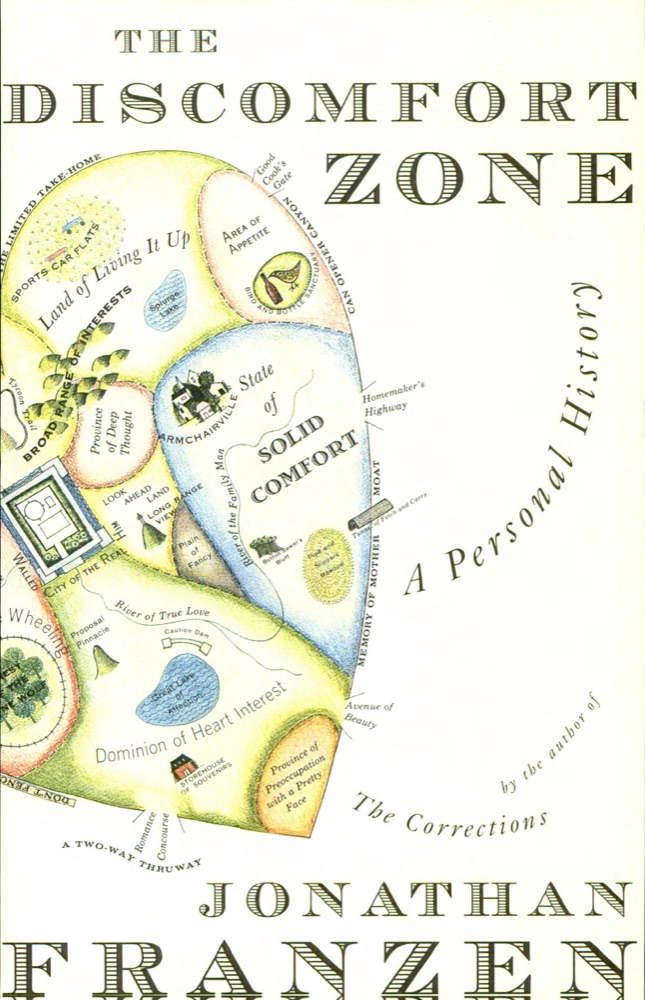
Jonathan Franzen arrived late, and last, in a family of boys in Webster Groves, Missouri. The Discomfort Zone is his intimate memoir of his growth from a "small and fundamentally ridiculous person," through an adolescence both excruciating and strangely happy, into an adult with embarrassing and unexpected passions. It's also a portrait of a middle-class family weathering the turbulence of the 1970s, and a vivid personal history of the decades in which America turned away from its midcentury idealism and became a more polarized society.The story Franzen tells here draws on elements as varied as the explosive dynamics of a Christian youth fellowship in the 1970s, the effects of Kafka's fiction on his protracted quest to lose his virginity, the elaborate pranks that he and his friends orchestrated from the roof of his high school, his self-inflicted travails in selling his mother's house a
Book details
- First published
- 2006
- Author
- Jonathan Franzen
- Genre
- Nonfiction
- Goodreads rating
- 3.42 (7k ratings)
Keep reading
 The Buddha of Suburbia
 Testament of Youth
 In the Woods
 Bluebeard's Egg
 Where Am I Now?
 The Likeness
 The Rachel Incident
 A Thousand Acres
 Sweet Tooth
 In the Heart of the Heart of the Country and Other Stories
 The Marvelous Misadventures of Ingrid Winter
 What I Was
 Min kamp 2
 Agatha Christie: An Autobiography
 The Folded Clock: A Diary
 The Kind Worth Killing
 Middlesex
 Singin' and Swingin' and Gettin' Merry Like Christmas
 The Rachel Papers
 The Story of a New Name
 Mother Mary Comes to Me
 Bad Blood
 A Home at the End of the World
 The Bedwetter: Stories of Courage, Redemption, and Pee
 When We Were Animals
 The Saturday Night Ghost Club
 Frenemies
 Fifth Business
 My Booky Wook
 The Sweet Hereafter
 Anagrams
 Notes on Your Sudden Disappearance
 Sag Harbor
 All Fours
 American on Purpose: The Improbable Adventures of an Unlikely Patriot
 Generation X: Tales for an Accelerated Culture
 Somebody's Daughter
 Underdog
 Afterparties
 Great House
 American Wife
 The Go-Between
 The Hazel Wood
 I Have Some Questions for You
 Those Who Leave and Those Who Stay
 Wonder Boys
 Too Much Happiness: Stories
 Look Me in the Eye
 Fire Shut Up in My Bones: A Memoir
 Scar Tissue
 The Broom of the System
 The Reluctant Fundamentalist
 Prime of Life
 Fun Home: A Family Tragicomic
 False Memory
 Terminal Boredom: Stories
 The Hour I First Believed
 A Children's Bible
 Dark Places
 The Bachman Books