
 Freedom
Quotes from the Book
And when the event, the big change in your life, is simply an insight—isn't that a strange thing? That absolutely nothing changes except that you see things differently and you're less fearful and less anxious and generally stronger as a result: isn't it amazing that a completely invisible thing in your head can feel realer than anything you've experienced before? You see things more clearly and you know that you're seeing them more clearly. And it comes to you that this is what it means to love life, this is all anybody who talks seriously about God is ever talking about. Moments like this.
The human species was given dominion over the earth and took the opportunity to exterminate other species and warm the atmosphere and generally ruin things in its own image, but it paid this price for its privileges: that the finite and specific animal body of this species contained a brain capable of conceiving the infinite and wishing to be infinite itself.
And meanwhile the sad truth was that not everyone could be extraordinary, not everyone could be extremely cool; because whom would this leave to be ordinary?
Fiction is a solution, the best solution, to the problem of existential solitude.
Without privacy there was no point in being an individual.
He couldn't figure out if she was immensely well adjusted or seriously messed up.
Life, in her experience, had a kind of velvet luster. You looked at yourself from one perspective and all you saw was weirdness. Move your head a little bit, though, and everything looked reasonably normal.
So, what, you got cigarette burns, too?" Gitanes said. Chip showed his palm, "It's nothing." "Self-inflicted. You pathetic American." "Different kind of prison" Chip said.
What you discovered about yourself in raising children wasn't always agreeable or attractive.
His tiredness hurt so much it kept him awake.
He wanted this someone to see how much he hurt.
Robin turned and looked straight into her. "What's life for?" "I don't know." "I don't either. But I don't think it's about winning.
It was a way of recognizing places of enchantment: people falling asleep like this.
Here was a torture that Greek inventors of the Feast and the Stone had omitted from their Hades: the Blanket of Self-Deception. A lovely warm blanket as far as it covered the soul in torment, but it never quite covered everything.
Elective ignorance was a great survival skill, perhaps the greatest.
she was so much a personality and so little anything else that even staring straight at her he had no idea what she really looked like.
And when the event, the big change in your life, is simply an insight-- isn't that a strange thing? That absolutely nothing changes except that you see things differently and you're less fearful and less anxious and generally stronger as a result: isn't it amazing that a completely invisible thing in your head can feel realer than anything you've experienced before?
Being dead's only a problem if you know you're dead, which you never do because you're dead!
She wondered: How could people respond to these images if images didn't secretly enjoy the same status as real things? Not that images were so powerful, but that the world was so weak. It could be read, certainly, in its weakness, as on days when the sun baked fallen apples in orchards and the valley smelled like cider, and cold nights when Jordan had driven Chadds Ford for dinner and the tires of her Chevrolet had crunched on the gravel driveway; but the world was fungible only as images. Nothing got inside the head without becoming pictures.
Oh, misanthropy and sourness. Gary wanted to enjoy being a man of wealth and leisure, but the country was making it none too easy. All around him, millions of newly minted American millionaires were engaged in the identical pursuit of feeling extraordinary - of buying the perfect Victorian, of skiing the virgin slope, of knowing the chef personally, of locating the beach that had no footprints. There were further tens of millions of young Americans who didn't have money but were nonetheless chasing the Perfect Cool. And meanwhile the sad truth was that not everyone could be extraordinary, not everyone could be extremely cool; because whom would this leave to be ordinary? Who would perform the thankless work of being comparatively uncool?
He'd lost track of what he wanted, and since who a person was what a person wanted, you could say that he'd lost track of himself.
He had a happy canine way of seeking approval without seeming insecure.
What made drugs perpetually so sexy was the opportunity to be other. Years after he'd figured out that pot only made him paranoid and sleepless, he still got hard-ons at the thought of smoking it. Still lusted for that jailbreak.
The problem was money and the indignities of life without it. Every stroller, cell phone, Yankees cap, and SUV he saw was a torment. He wasn't covetous, he wasn't envious. But without money he was hardly a man.
THE CORRECTION, when it finally came, was not an overnight bursting of a bubble but a much more gentle letdown, a year-long leakage of value from key financial markets, a contraction too gradual to generate headlines and too predictable to seriously hurt anybody but fools and the working poor.
She had to tell him, while she still had time, how wrong he’d been and how right she’d been. How wrong not to love her more, how wrong not to cherish her and have sex at every opportunity, how wrong not to trust her financial instincts, how wrong to have spent so much time at work and so little with the children, how wrong to have been so negative, how wrong to have been gloomy, how wrong to have run away from life, how wrong to have said no, again and again, instead of yes: she had to tell him all of this, every single day.
He was remembering the nights he'd sat upstairs with one or both of his boys or with his girl in the crook of his arm, their damp bath-smelling heads hard against his ribs as he read aloud to them from "Black Beauty" or "The Chronicles of Narnia". How his voice alone, its palpable resonance, had made them drowsy. These were evenings, and there were hundreds of them, maybe thousands, when nothing traumatic enough to leave a scar had befallen the nuclear unit. Evenings of plain vanilla closeness in his black leather chair; sweet evenings of doubt between the nights of bleak certainty. They came to him now, these forgotten counterexamples, because in the end, when you were falling into water, there was no solid thing to reach for but your children.
You encountered a misery near the end of the day and it took a while to gauge its full extent. Some miseries had sharp curvature and could be negotiated readily. Others had almost no curvature and you knew you'd be spending hours turning the corner. Great whopping-big planet-sized miseries.
And if the world refused to square with his version of reality then it was necessarily an uncaring world, a sour and sickening world, a penal colony, and he was doomed to be violently lonely in it. He bowed his head at the thought of how much strength a man would need to survive an entire life so lonely.
Did you know?
- The novel won the 2001 National Book Award for Fiction.
- It was a finalist for the 2002 Pulitzer Prize for Fiction and the PEN/Faulkner Award.
- It was selected for Oprah's Book Club in 2001, but Franzen was disinvited from her show after publicly expressing discomfort with the selection.
- Time magazine included it on its 2005 list of the 100 best English-language novels published since 1923.
- The controversy surrounding the Oprah selection is credited with boosting sales by roughly 150,000 copies.
- It won the 2002 James Tait Black Memorial Prize.
About Jonathan Franzen
Jonathan Franzen (born 1959) is an American novelist and essayist known for expansive social novels about American family life. His works include "The Corrections," "Freedom," and "Purity," and he is a recipient of the National Book Award for Fiction.
More about the author →More by Jonathan Franzen
All books by Jonathan Franzen →
About the book
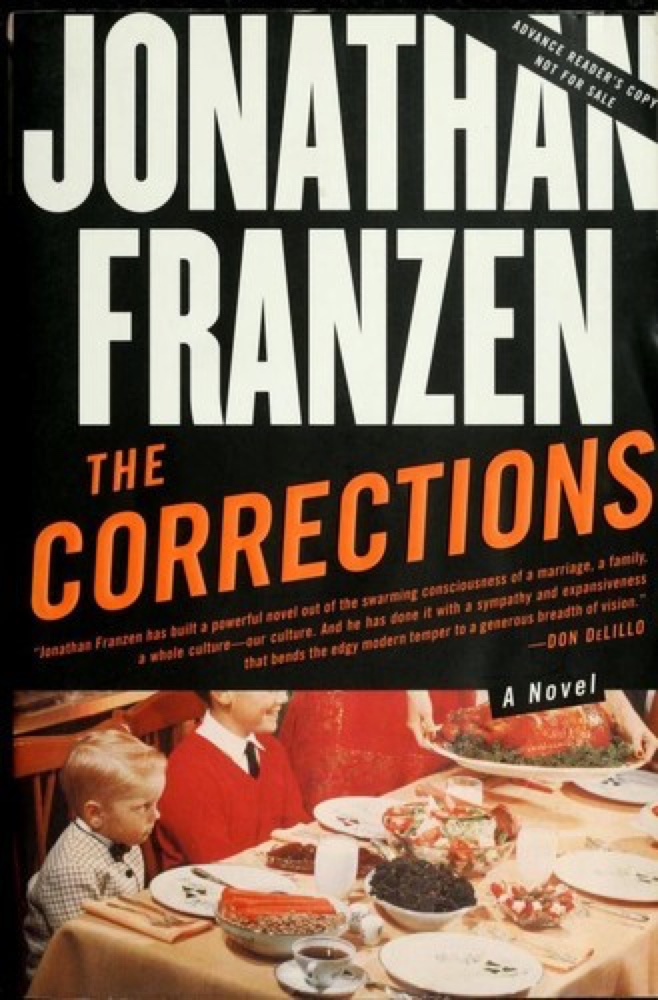
"The Corrections" is Jonathan Franzen's sprawling family novel about the Lamberts of the fictional Midwestern town of St. Jude. Alfred, a retired railroad engineer sinking into Parkinson's disease and dementia, and his wife Enid, fixated on staging one last family Christmas before he declines further, try to draw their three grown children home. Chip, a disgraced academic turned would-be screenwriter, Gary, a Philadelphia banker battling depression, and Denise, an accomplished chef, are each mired in private crises of their own as the reunion looms.
At its core the novel is a study of family dysfunction, aging, and the anxieties of late-twentieth-century American consumer life. Franzen threads each Lambert's storyline through questions of ambition, disappointment, and the effort to "correct" the courses of their lives, set against a backdrop of dot-com-era speculation, pharmaceuticals, and shifting cultural values. The book moves between comedy and pathos as it dissects the gap between the family's appearances and its interior turmoil.
Published in September 2001, "The Corrections" became one of the most acclaimed and widely discussed American novels of its era. It won the National Book Award for Fiction and was a Pulitzer Prize finalist, and it drew extra attention through a public dispute with Oprah Winfrey's Book Club. Its blend of intimate family drama and broad social satire helped cement Franzen's reputation as a major contemporary novelist.
Key characters
- Alfred LambertRetired railroad engineer suffering from Parkinson's disease and dementia; the family patriarch
- Enid LambertAlfred's wife, determined to gather the family for one final Christmas
- Gary LambertEldest son, a Philadelphia banker struggling with depression
- Chip LambertMiddle child, an unemployed former academic in New York
- Denise LambertYoungest child, an accomplished executive chef in Philadelphia
Book details
- First published
- 2001
- Length
- 568 pages
- Reading time
- 15 hours
- Author
- Jonathan Franzen
- Genre
- Fiction
- Goodreads rating
- 3.85 (202k ratings) →
- First line
- “The madness of an autumn prairie cold front coming through.”
Movie & TV adaptations
- IMDb
If you liked this, read…
- 1FreedomFranzen's later panoramic novel of a troubled American family
- 2American PastoralPhilip Roth's ambitious portrait of family, ambition, and American decline
- 3A Little LifeAnother sweeping contemporary novel of intertwined lives and private suffering
Keep reading
 A Spot of Bother
 The Story of a New Name
 The Casual Vacancy
 Too Much Happiness: Stories
Freedom
Too Much Happiness: Stories
Freedom
 The Post-Birthday World
 The Story of the Lost Child
 The Naked and the Dead
 False Memory
 The Brutal Telling
 Empire Falls
 Capital
 Little Monsters
 American Pastoral
 A Lion Among Men
 Revolutionary Road
 The Long Dark Tea-Time of the Soul
 A Fraction of the Whole
 The Adventures of Augie March
 Oblivion
 The Nest
 Another Country
 Of Human Bondage
 The Jewel in the Crown
 Call for the Dead
 The Likeness
 The Book of Strange New Things
 V.
V.
 Perfect
 Victory
 The Quick and the Dead
 A Fine Balance
 Purity
 The Great Mistake
 Juliet, Naked
 Hush
Hush
 A Rule Against Murder
 A Fatal Inversion
 The Magicians
 The Marriage Plot
 Mohawk
 Highly Illogical Behavior
 The Mandarins
 Gaudy Night
 Ragtime
 The Husband's Secret
 So Long, See You Tomorrow
 Sweet Tooth
 Martin Eden
 The Stone Diaries
 The Brooklyn Follies
 The Damnation Game
 The Heart of the Matter
 The Long Way Home
 The Human Stain
 Knots and Crosses
 Flight Behavior
 We All Looked Up
 The Round House
 The Twelve