 Women We Buried, Women We Burned: A Memoir
Quotes from the Book
This was a huge lesson for me—the only way out is through. You must allow pain in to free yourself from it.
24
Grief settles. It's not something you overcome. It's something that you live with. You adapt to it. Nothing about you is who you were. Nothing about how or what I used to think is important. The truth is that I don't remember who I was.
14
I have a vague memory of this one conversation we had in that room about a passage that Elvis had underlined. I started to call someone to help me remember it, but realized that there's no one left to call
11
When my brother died, I was hit with the realization that he was nowhere to be found on Earth. I could travel anywhere and never find him. No matter how far I flew, how far I drove, how far I walked, he was gone. I remember driving through Northern California and passing an immense expanse of empty farmland, and thinking that he wasn’t in there, either. He could never be found, no matter how hard I looked.
10
If you don’t have something to keep you focused, or some kind of purpose, it’s hard out there.
7
She mothers my daughter through me.
7
He was respectful, though—he wasn’t rude to people, he wasn’t an angry person, he didn’t live there. Some people full-on live in destruction, others buy some real estate and walk around in anger for a little while. My dad would just visit.
4
Then they took me home to Graceland.
4
Looking back, there was really only one thing I was sure of: that I was loved by my dad.
3
I believe that a body is just a body, and the spirit is ultimately inside of the physical shell, and I don’t think chemicals have anything to do with the spirit. They make the physical addiction to the body—but the root of the addiction comes from being really unhappy. That’s a spiritual problem.
3
My father was my mom’s biggest protector throughout her whole adult life. She had many friends that came and went, but he was there from when she was seventeen until the moment she died. He was the last person with her.
3
If I look back at everything, my whole life, I can just lose it. Try, fail, try, fail, good, bad, fail. I get really overwhelmed and start crying, looking at how fucked up my life has been. Sometimes it feels like there’s nothing left, no purpose. Like there’s nothing I want to accomplish anymore. No goal, no anything. Zero. I have three remaining children, so I fight it, I fight it, I fight it, I fight it, I fight it. But it’s fucking there, alive and well. It’s a lion’s roar and I have to shut it down, shut it up. I’m surprised I’m still alive. I can’t believe I’m still standing. It feels wrong to be alive without Ben.
2
Don't kill your best friend, he (Elvis) said. Words of wisdom.
2
In my family, there’s a long history of young girls becoming mothers—my great-grandmother, my grandmother, and my mother all had their first babies young, when they were just babies themselves.
2
Eventually, he calmed down, and someone said to me, “It’s okay, you can come out now, he wants to see you.” I thought, He wants to see me? I said, “Why was he so mad?” “Well,” someone said, “he ran out of water.” So, I grabbed four bottles of water and I walked into his room. “Somebody told me you didn’t have any water,” I said, and he just motioned for me to come give him a hug.
1
In California, when I was with my mother, I had a nanny named Yuki Koshimata. Yuki was a short Japanese woman, and she took really good care of me. She was always there—she wrote to me until the day she died. I would get cards every Christmas, every birthday, even after I got married and had children. Whenever we dropped Yuki off at her house for her weekend, or her time off, I would scream. I remember being in the car with my mom driving away and I would be screaming at the top of my lungs, watching us drive out of view of her. I was so attached to her.
1
Back then, everyone in Hollywood seemed to be an addict, but no one had a language for it.
1
I was so afraid to hear my mother’s voice - the physical connection we have to the voices of our loved ones is profound. I decided to lie in my bed because I know how heavy grief makes my body feel.
1
Once the gates closed, Graceland was like its own city, its own jurisdiction. My dad was the chief of police, and everybody was ranked. There were a few laws and rules, but mostly not.
1
Or that I'm so strong. That's the thing that I hear. Which makes me so crazy. Because that makes me go, 'what for though?
1
He could have said, “Chop both of your feet off,” and I would have done it.
1
I know that I acted like a princess sometimes. But it’s strange, because I was—am—filled with self-doubt. It was all very confusing.
1
After Ben Ben died, I knew my mom wouldn’t survive it for very long. She did not want to be here.
We had to keep the room at 55 degrees. I still didn’t know where I was going to bury him—Hawaii, Graceland, Hawaii, Graceland—so that was part of why it took so long. But I got so used to him, caring for him and keeping him there. I think it would scare the living fucking piss out of anybody else to have their son there like that. But not me. The normal process of death is: The person dies, they have an autopsy, viewing, funeral, buried, boom. It’s all over in a four- or five-day period, maybe a week if you’re lucky. But you don’t really have a chance to process it. I felt so fortunate that there was a way that I could still parent him, delay it a bit longer so that I could become okay with laying him to rest.
When Ben died, I thought it would be a matter of hours until my mother relapsed. But she surprised me and remained completely sober to honor him. She really wanted to get her life together and help others somehow. She wanted to be of service. But she was too broken. My mom had my brother in the house with us instead of keeping him at the morgue. They told us that if we could tend to the body, we could have him at home, so she kept him in our house for a while on dry ice. It was really important for my mom to have ample time to say goodbye to him, the same way she’d done with her dad. And I would go and sit in there with him.
He’d still come into my room now and then, but I would move or do something to make him think that I was waking up, then he’d run down the hallway back to my mom’s room, freak out, and stay away.
The first time Edwards came into my room in the middle of the night, drunk, kneeling, was years before. I think I was ten. I woke up to find him on his knees next to my bed, running his finger up my leg under the sheets, and if I moved, he stopped—so I moved. I was awake, but I was trying to be asleep. He said he was going to teach me what was going to happen when I get older. He was putting his hand on my chest and saying a man’s going to touch here, then he put his hand between my legs, and he said they’re going to touch you here. I think he gently kissed me and then left that night.
One night my mom made dinner, and when I cut into the chicken, it wasn’t cooked, so I said so. The next thing I know, Edwards flipped his plate so that it flew across the room and smashed into the wall. I threw my hands up as if to say, “What the fuck?” and at that he jumped up and started screaming gibberish and ran out of the room. When he got back, he was holding the end of the cord that attached to my record player—he’d cut it off with scissors. He was still yelling.
In the craziest turn of events, Edwards got a part in the movie Mommie Dearest, playing Joan Crawford’s lover. One day, while he was still making the movie, my mom came into my room, went through my closet, and was yelling at me because I had wire hangers: “Why are you using these? These come from the cleaners! These need to be exchanged for the nice ones, the plastic ones!” As she was yelling, we could hear laughter from down the hallway. “The irony!” Michael shouted. “This is too crazy that you’re actually yelling at your daughter about wire hangers and I’m in Mommie Dearest!” My mom realized that it was crazy and started laughing, too. I thought, This is my life now. You’re both fucking crazy.
By this point in my life, my mother’s role was just to be a chronic stop sign. She didn’t try to talk to me, hang out with me, be a friend. I was very much in love with my father’s side—they were wildly colorful people and I related to them in ways I couldn’t with my mother.
Did you know?
- The memoir was completed by Lisa Marie Presley's daughter, actress Riley Keough, after Presley's death in January 2023.
- Much of Presley's first-person narrative was drawn from audio recordings she had made for the book before she died.
- In the audiobook, Riley Keough narrates her own sections while actress Julia Roberts voices Lisa Marie Presley's passages.
- The book was selected for Oprah's Book Club.
- It became a New York Times bestseller and a #1 national bestseller, and topped Apple Books and Amazon U.S. charts shortly after release.
- The narrative blends two voices, framed by Keough as a mother and daughter communicating from this world to the one beyond.
About Lisa Marie Presley
About the book
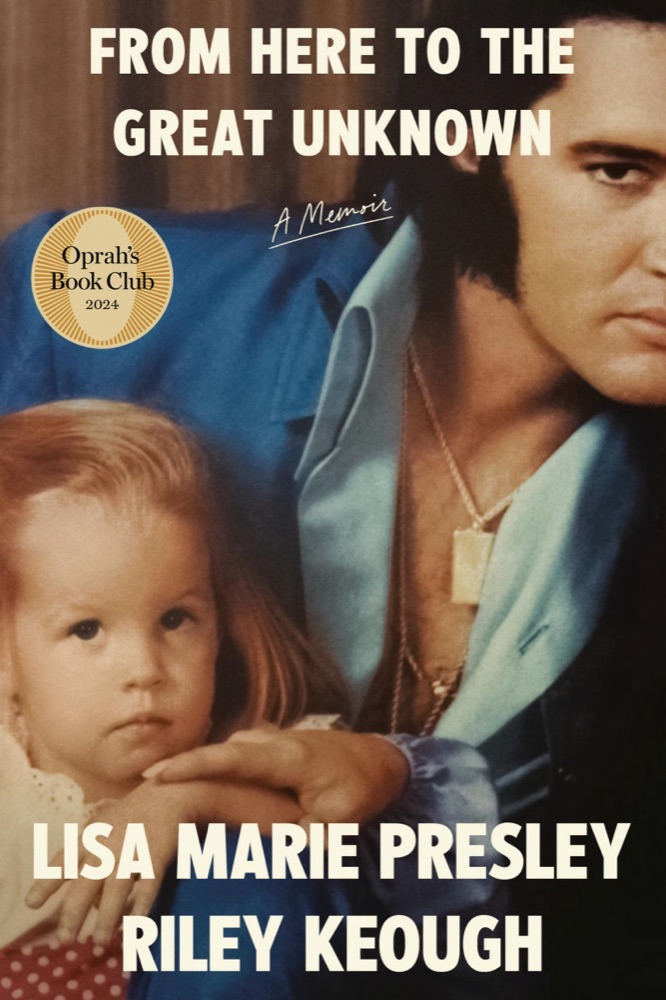
"From Here to the Great Unknown" is the memoir of Lisa Marie Presley, the only child of Elvis Presley, completed by her daughter, actress Riley Keough, after Lisa Marie's death in January 2023. Drawing on audio recordings Presley made for the project before she died, the book braids her own first-person recollections together with Keough's narration, tracing a life that began at Graceland and unfolded in the shadow of one of the most famous names in American music.
Across its pages the memoir takes up the themes of fame, family, grief, and addiction. Presley recounts her childhood with her father Elvis, her marriages, including her brief and heavily scrutinized marriage to Michael Jackson, her experience of motherhood, and her long struggle with substance abuse. Keough frames the resulting collaboration as a conversation between mother and daughter that continues across the boundary of death, an attempt to make her mother fully known in her own words.
The book was published in October 2024 and met with strong commercial success and broadly positive reviews. It was chosen as an Oprah's Book Club selection and became a New York Times and national bestseller. Critics noted its candor about addiction and loss; New York Times reviewer Elisabeth Egan highlighted how the recollections show Presley's determination to confront her demons, while other reviewers praised the unusual dual-voice structure created by Keough's completion of the project.
Book details
- First published
- 2024
- Length
- 304 pages
- Reading time
- 6 hours
- Author
- Lisa Marie Presley
- Genre
- Biography
- Goodreads rating
- 4.23 (113k ratings)
Critical reception
- Selected as an Oprah's Book Club pick.
- Became a New York Times bestseller and a #1 national bestseller.
- New York Times reviewer Elisabeth Egan praised how the recollections show how determined Presley was to confront her demons.
- Named a People Magazine Best Book of the Year.
Keep reading
Women We Buried, Women We Burned: A Memoir
 Bettyville: A Memoir
 Banyan Moon
 Open Book
 Notes on Your Sudden Disappearance
 The Color of Water: A Black Man's Tribute to His White Mother
 Crying in H Mart
 The Pale-Faced Lie
 The Death of Vivek Oji
 The House of My Mother: A Daughter's Quest for Freedom
 Em and The Big Hoom
 One True Thing
 Somebody's Daughter
 The World's Largest Man
 Men We Reaped
 When God Was a Rabbit
 Escape
 Spare
Spare
 Stray: Memoir of a Runaway
 A Living Remedy: A Memoir – A Daughter's Narrative of Adoption, Class Inequality, and Grief in America
 Tell No One
 The Mother-in-Law
 Burnt Sugar
 The Push
 What My Mother and I Don't Talk About: Fifteen Writers Break the Silence
 Summerlost
 Please Look After Mom
 Alice I Have Been
 Litani
 Summer Island
 All the Young Men: A Memoir of Love, AIDS, and Chosen Family in the American South
 Milk Fed
 Bastard Out of Carolina
 The God of Animals
 Glitter and Glue
 When You Were Here
 The First Bad Man
 The First Time She Drowned
 Wild Game: My Mother, Her Lover, and Me
 The Deeper the Water the Uglier the Fish
 The Quiet Room: A Journey Out of the Torment of Madness
 Just Ignore Him
 Good as Gone
 What Is the What
 The Best We Could Do
 The Beginning of After
 How to Say Goodbye in Robot
 Keep It in the Family
 Dinner at the Homesick Restaurant
 Long Bright River
 Inside Out
 What I Didn't Say
 Grief Is the Thing with Feathers
 My Name Is Mahtob: The Story that Began the Global Phenomenon Not Without My Daughter Continues
 Alive Day: A Memoir
 Mystic River
 Home
Home
 Broken Country