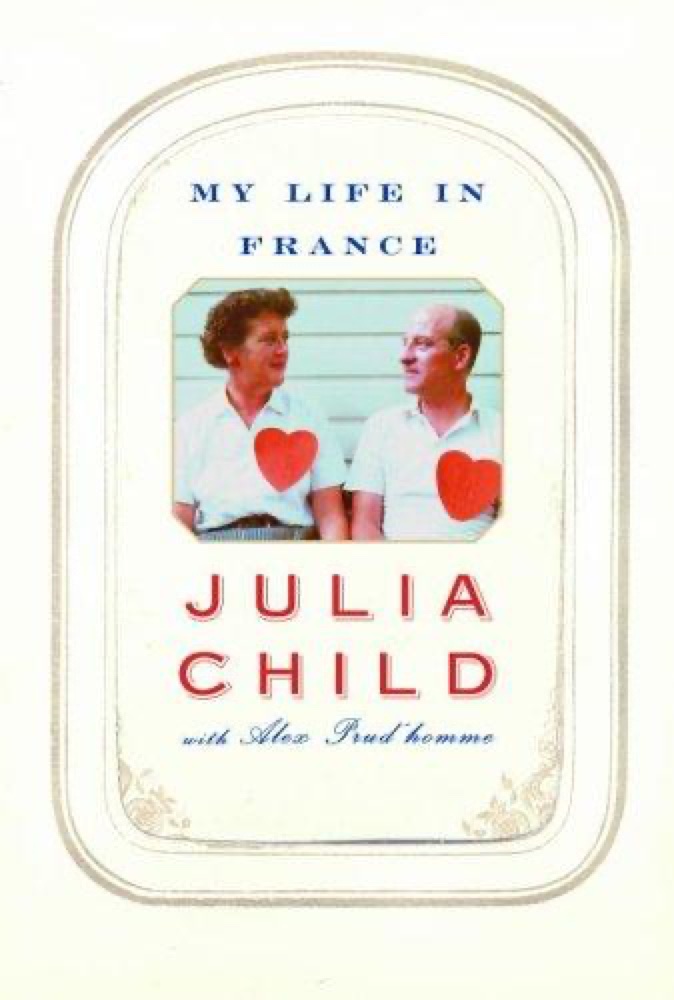

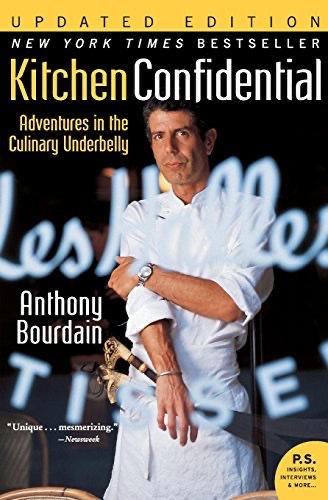
 Kitchen Confidential: Adventures in the Culinary Underbelly
Quotes from the Book
This is my invariable advice to people: Learn how to cook- try new recipes, learn from your mistakes, be fearless, and above all have fun!
...no one is born a great cook, one learns by doing.
...nothing is too much trouble if it turns out the way it should.
Remember, 'No one's more important than people'! In other words, friendship is the most important thing--not career or housework, or one's fatigue--and it needs to be tended and nurtured.
You never forget a beautiful thing that you have made,' [Chef Bugnard] said. 'Even after you eat it, it stays with you - always.
Maybe the cat has fallen into the stew, or the lettuce has frozen, or the cake has collapsed. Eh bien, tant pis. Usually one's cooking is better than one thinks it is. And if the food is truly vile, then the cook must simply grit her teeth and bear it with a smile, and learn from her mistakes.
One of the secrets, and pleasures, of cooking is to learn to correct something if it goes awry; and one of the lessons is to grin and bear it if it cannot be fixed.
Upon reflection, I decided I had three main weaknesses: I was confused (evidenced by a lack of facts, an inability to coordinate my thoughts, and an inability to verbalize my ideas); I had a lack of confidence, which cause me to back down from forcefully stated positions; and I was overly emotional at the expense of careful, 'scientific' though. I was thirty-seven years old and still discovering who I was.
Just speak very loudly and quickly, and state your position with utter conviction, as the French do, and you'll have a marvelous time!
But I was a pure romantic, and only operating with half my burners turned on.
The sweetness and generosity and politeness and gentleness and humanity of the French had shown me how lovely life can be if one takes time to be friendly.
I don't believe in twisting yourself into knots of excuses and explanations over the food you make. When one's hostess starts in with self-deprecations such as "Oh, I don't know how to cook...," or "Poor little me...," or "This may taste awful...," it is so dreadful to have to reassure her that everything is delicious and fine, whether it is or not. Besides, such admissions only draw attention to one's shortcomings (or self-perceived shortcomings), and make the other person think, "Yes, you're right, this really is an awful meal!" Maybe the cat has fallen into the stew, or the lettuce has frozen, or the cake has collapsed -- eh bien, tant pis! Usually one's cooking is better than one thinks it is. And if the food is truly vile, as my ersatz eggs Florentine surely were, then the cook must simply grit her teeth and bear it with a smile -- and learn from her mistakes.
In the blood-heat of pursuing the enemy, many people are forgetting what we are fighting for. We are fighting for our hard-won liberty and freedom; for our Constitution and the due processes of our laws; and for the right to differ in ideas, religion and politics. I am convinced that in your zeal to fight against our enemies, you, too, have forgotten what you are fighting for.
She was my first cat ever, and I thought she was marvelous.
...the waiters carried themselves with a quiet joy, as if their entire mission in life was to make their customers feel comfortable and well tended.
We ate the lunch with painful politeness and avoided discussing its taste. I made sure not to apologize for it. This was a rule of mine. I don't believe in twisting yourself into knots of excuses and explanations over the food you make... Usually one's cooking is better than one thinks it is. And if the food is vile,...then the cook must simply grit her teeth and bear it with a smile- and learn from her mistakes.
I admired the English immensely for all that they had endured, and they were certainly honorable, and stopped their cars for pedestrians, and called you “sir” and “madam,” and so on. But after a week there, I began to feel wild. It was those ruddy English faces, so held in by duty, the sense of “what is done” and “what is not done,” and always swigging tea and chirping, that made me want to scream like a hyena
There are only four great arts: music, painting, sculpture, and ornamental pastry- architecture being perhaps the least banal derivative of the latter.
It's easy to get the feeling that you know the language just because when you order a beer they don't bring you oysters. (Paul Child)
...operational proof...it's all theory until you see for yourself whether or not something works.
We are so bemused by our own petard, that we are unable to look at things objectively.
When I wasn't at school, I was experimenting at home, and became a bit of a Mad Scientist. I did hours of research on mayonnaise, for instance, and though no one else seemed to care about it, I thought it was utterly fascinating....By the end of my research, I believe, I had written more on the subject of mayonnaise than anyone in history.
I'm afraid that surprise, shock, and regret is the fate of authors when they finally see themselves on the page.
Illegitemus non carborundum est (“Don’t let the bastards grind you down”).
Good french cooking cannot be produced by a zombie cook.
Was it a sign of Creeping Decrepitude?
Standing up through the Citroen's open sunroof, my six-foot-three-inch, red-cheeked sister pointed a long, trembling finger at the perpetrator and with maximum indignation yelled: 'Ce merde-monsieur a justement crache dans ma derriere!' Her intended meaning is obvious, but what she said was, 'This shit-man just spat out into my butt!
...The more I learned the more I realized how very much one has to know before one is in-the-know at all.
If variety is the spice of life, then my life must be one of the spiciest you ever heard of. A curry of a life. -Paul Child
Watch on YouTube
About Julia Child
We have collected 29 quotes from 1 book by Julia Child on BookQuoters.
More about the author →Book details
- Author
- Julia Child
- Genre
- Nonfiction
- Goodreads rating
- 4.16 (94k ratings) →
Keep reading
Kitchen Confidential: Adventures in the Culinary Underbelly
 Julie and Julia: 365 Days, 524 Recipes, 1 Tiny Apartment Kitchen: How One Girl Risked Her Marriage, Her Job, and Her Sanity to Master the Art of Living
 Blood, Bones, and Butter: The Inadvertent Education of a Reluctant Chef
 Heartburn
 Me Talk Pretty One Day
 Fifth Business
 Fiesta
 Agatha Christie: An Autobiography
 Save Me the Plums: My Gourmet Memoir
 The Sharper Your Knife, the Less You Cry: Love, Laughter, and Tears at the World's Most Famous Cooking School
 The Art of Eating
 The Sea, the Sea
 The Dinner
 A Red Herring Without Mustard
 The Paris Novel
 Rosemary and Rue
 Eleanor Oliphant Is Completely Fine
 Rules of Civility
 My Booky Wook
 Second Helpings
 The Adventures of Augie March
 Riding the Elephant: A Memoir of Altercations, Humiliations, Hallucinations, and Observations
 Mansfield Park
 Cinnamon and Gunpowder
 The Dud Avocado
 The Rebel Angels
 If You Can't Take the Heat: Tales of Food, Feminism, and Fury
 The Sweetness at the Bottom of the Pie
 Shades of Grey
 Delicacy
 When You Are Engulfed in Flames
 The Likeness
 The Moonstone
 Min kamp 2
 How to Be Good
 Lunch in Paris: A Love Story, with Recipes
 The Provence Cure for the Brokenhearted
 Suddenly Royal
 32 Yolks: From My Mother's Table to Working the Line
 Agnes Grey
 Everyone Burns
 Excellent Women
 The Importance of Being Earnest
 Chocolat
 A Fraction of the Whole
 With the Fire on High
 A Year in Provence
 Almost French: Love and a New Life in Paris
 David Copperfield
 What Time the Sexton's Spade Doth Rust
 Different Seasons
 The Tropic of Serpents
 Cackle
 The Illustrated Man
 Life Itself
 Don't Get Too Comfortable: The Indignities of Coach Class, the Torments of Low Thread Count, the Never-Ending Quest for Artisanal Olive Oil, and Other First World Problems
 Saving Fish from Drowning
 Out of Oz
 Neither Here nor There: Travels in Europe
 The Edible Woman