
 Ghostwritten
Quotes from the Book
The world has never been fair, and cannot be made fair, and claims that it can are foolish or dishonest. It can be made fairer and attempts to make it less fair can be resisted. Optimistic realists seek improvement, not perfection.
12
I don't know where the idea of Vikings having horns on their helmets came from, but it's a brilliant one. In every possible way, other than the literal truth, they totally had horns on their helmets. Horned helmets was absolutely their vibe and I feel we all have a right to that deeper artistic truth. They had limited technology and manufacturing helmets was pretty tricky for them, I imagine, so putting horns on them wouldn't have been workable, and wouldn't ave increased the functionality of the helmets, but I swear they'd have given it a go if they'd thought of it.
8
Obviously she didn’t marry him when she was eight. That would have been barbaric. They waited until she was twelve.
7
He was predictable. That’s the key. It’s disappointing in a lover but, in a feudal overlord, it hits the spot.
7
Some say that all that is necessary for evil to triumph is for good men to do nothing. I find that an awkward principle because, in my view, allowing good men to do nothing is the purpose of civilization.
6
Dying was by far the most astute and successful thing King John did in his entire reign.
4
Gandalf is fictional. King Arthur is a lie.
3
Queen Mary was known as Bloody Mary because of the large number of people she killed. And also because of misogyny. She was the first properly crowned woman to rule as queen regnant, not just queen consort. You weren't supposed to be able to do this job if you were a woman, so a lot of people didn't like it. That may be why she gets the soubriquet 'bloody' when many of her male predecessors were responsible for more deaths - in battles as well as executions.
3
He reverted to the old and unsuccessful Anglo-Saxon Viking-repelling technique: paying them to go away. It’s what I did when we had mice.
3
When a pipe has burst, you need a plumber not a glittering-eyed futurologist saying, ‘What if we could construct a world where we didn’t need water …?
3
People found it much easier to believe in a rose-tinted view of the past than a utopian future. They still do: hence ‘Take Back Control’ and ‘Make America Great Again’.
3
The true roots of English kingship are therefore so far away from the Arthurian ideal it’s actually funny. The notion that pious legitimacy was the foundation of the institution is totally false. Everything those early kings possessed they, or their ancestors, had either stolen or demanded with menaces. The veneer of legitimacy was retrospectively applied in order to keep hold of all the power and wealth.
2
Violence is a constant, the religious views are just the accompanying spin.
2
I suppose calling a town ‘Bury King Edmund(s)’ would have sounded like incitement to insurrection, which, if you’ve ever been there, you’ll know is not the vibe of the place at all.
2
When you think of the word 'king' what image springs to mind? This might be a bad time to ask you. You're reading a book all about kings. I've been mentioning them like mad - people in crowns will be buzzing around your head like tweeting birds round a concussed cartoon character.
1
What’s so great about glory? It’s often gory. Edward III’s almost always was. Glory is overrated.
1
Did it change Edward? Well, as I keep saying, people don’t change, so no. But obviously a bit yes. I hope you’re pleased with the level of historical nuance you’re getting: no, but a bit yes. That’ll see anyone through A-Level.
1
He’d spent the intervening time going to France to sort out the details of his marriage to Philip IV’s daughter Isabella (the dowry, the accompanying treaty, is it okay that the bride’s twelve and the groom seems gay, that sort of thing), and demonstrating what a terrible king he was going to be.
1
Everyone else has a duty to pick one side or another like in a debate on Twitter. Resist it! They were both as bad as each other! The fact that they didn’t know it should only be added to their failings. I can’t forgive either of them for thinking that the question of which one of them ruled England was so colossally important that it was okay for everyone else in the country to have such a horrible time.
1
Their certainty that they were right is worth remembering because it means there’s probably stuff we’re certain is right that future ages will correctly judge to be monstrous. The fact that everybody is convinced of something is no guarantee that it isn’t evil horseshit.
1
What historians say happened is often just stated in comparison to what other historians previously said happened rather than in comparison to not knowing what happened at all.
1
Cnut returned the hostages, but only after he’d had their hands, ears and noses cut off. Can you imagine doing that? I really can’t and I don’t count myself a particularly nice person.
1
I’d say, is a Lesson We Can Learn from History. Possibly the only one: You Never Completely Know What’s About to Happen.
1
Come on, it’s the twenty-first century’, as if the passage of time inevitably brings with it ethical improvements. The pejorative word ‘dated’ shows how ingrained is our assumption that human civilization gets better over time. It probably has recently, technologically at least, but it’s not a given. Is assuming that things improve the best way of ensuring they will? I doubt it. A healthy fear of societal cataclysm may be a good technique for avoiding it.
1
I don’t mean to be a doom-monger but we could do with it now. A big threat to our current civilization is the persistent post-Victorian assumption of progress. This ‘Whig Interpretation of History’ has been regularly debunked ever since the term was coined by the historian Herbert Butterfield in 1931, a tough year for believers in things getting better. Still, most of us unreflectingly go along with it. You hear it in the way people rebuke each other for prejudiced remarks by saying ‘Come on, it’s the twenty-first century’, as if the passage of time inevitably brings with it ethical improvements. The pejorative word ‘dated’ shows how ingrained is our assumption that human civilization gets better over time. It probably has recently, technologically at least, but it’s not a given. Is assuming that things improve the best way of ensuring they will? I doubt it. A healthy fear of societal cataclysm may be a good technique for avoiding it.
1
The defeat of the Armada in 1588 was Elizabeth's high point. Things went downhill after that. Militarily the triumph against Spain was rather undermined the following year when Elizabeth sent her own massive Armada, commanded by Sir Francis Drake, to Spain and Portugal. This was annihilated too. So maybe God was neutral. Or Muslim.
1
They set about reversing all the changes that had been made since the break with Rome . . . The only thing that wasn't put back was the monasteries - this was deemed unworkable as the aristocracy, catholic and Protestant alike, had bought those lands from the crown, were really enjoying them and, if it came down to it, gave much more of a shit about their vast new properties than they did about the difference between the mass and holy communion. Weird, isn't it? People were willing to die for these religious differences, but they wouldn't sacrifice real estate.
1
A fictionalized version of one of these away-weekends is dramatized in the film The Lion in Winter, in which Eleanor is played by Katharine Hepburn and her husband by Peter O’Toole. It’s an interesting film. It’s set at Christmas and they have a Christmas tree in the castle but with no fairy lights. I can’t understand this as it wouldn’t have significantly worsened the anachronism but it would have looked nice and twinkly.
1
Fundamentally, this was a deal he was offering the leading nobility. It was mainly stuff about not charging exorbitant fees when a son inherited his father’s lands, and not forcing rich widows to remarry. The sort of thing the barons got stressed about.
1
Watch on YouTube
About David Mitchell
We have collected 246 quotes from 9 books by David Mitchell on BookQuoters.
More about the author →More by David Mitchell
All books by David Mitchell →

About the book
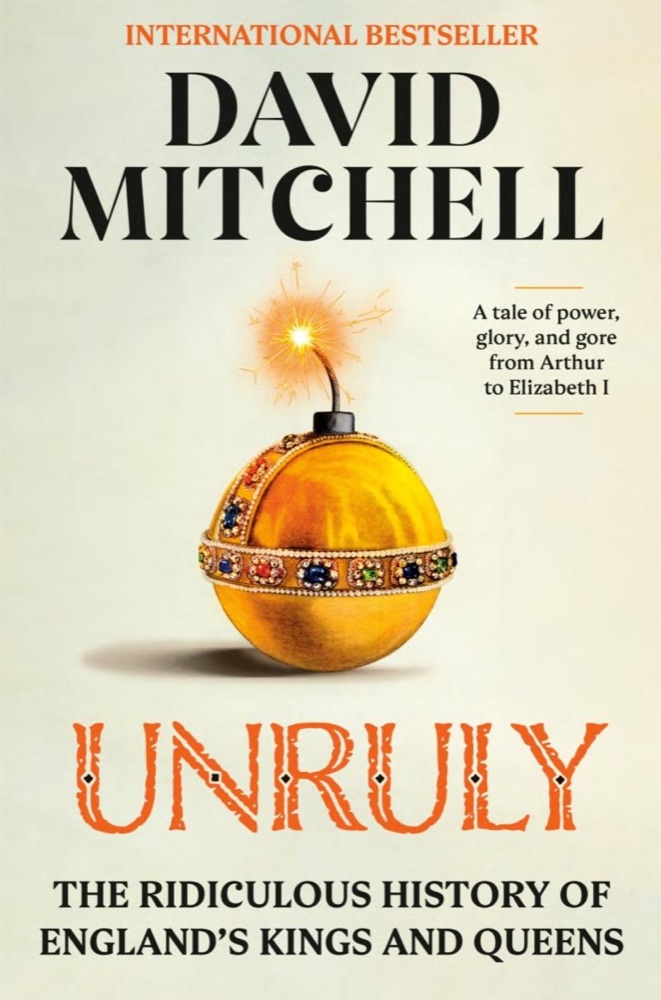
A rollicking history of England's earliest kings and queens, a story of narcissists, excessive beheadings, middle-management insurrection, uncivil wars, and more, from award-winning British actor and comedian David Mitchell
Think you know the kings and queens of England? Think again.
In Unruly , David Mitchell explores how early England’s monarchs, while acting as feared rulers firmly guiding their subjects’ destinies, were in reality a bunch of lucky bastards who were mostly as silly and weird in real life as they appear to us today in their portraits.
Taking us right back to King Arthur ( he didn’t exist), Mitchell tells the founding story of post-Roman England right up to the reign of Elizabeth I ( she dies), as the monarchy began to lose its power. It’s a tale of bizarre and curious ascensions, inadequate self-control, and at least one total Cnut, as the English evolved from
Book details
- First published
- 2023
- Author
- David Mitchell
- Genre
- History
- Goodreads rating
- 4.11 (35k ratings)
Keep reading
 Thirteen
 Wolf Hall
 The Once and Future King
 The Will to Battle
 The Sunne in Splendour
 Interesting Times: The Play
 Reaper's Gale
 The Last Kingdom
 Empire
 The Book of Air and Shadows
 The Truth: Stage Adaptation
 The Confusion
 Death of Kings
 The Last Watch
 A History of the World in 100 Objects
 God Emperor of Dune
 Too Like the Lightning
 The Mirror & the Light
 A Connecticut Yankee in King Arthur's Court
 The Rise of Silas Lapham
 Beyond
 Arguably: Selected Essays
 Interesting Times
 Bring Up the Bodies
 Unseen Academicals
 Hogfather
 The Napoleon of Notting Hill
 The Daughter of Time
 The Absolute Book
 Claudius the God and His Wife Messalina
 Lords of the North
 Children of Ash and Elm: A History of the Vikings
 Skinny Legs and All
 Get Well Soon: History's Worst Plagues and the Heroes Who Fought Them
 The Letters of J.R.R. Tolkien
 The Eyes of the Dragon
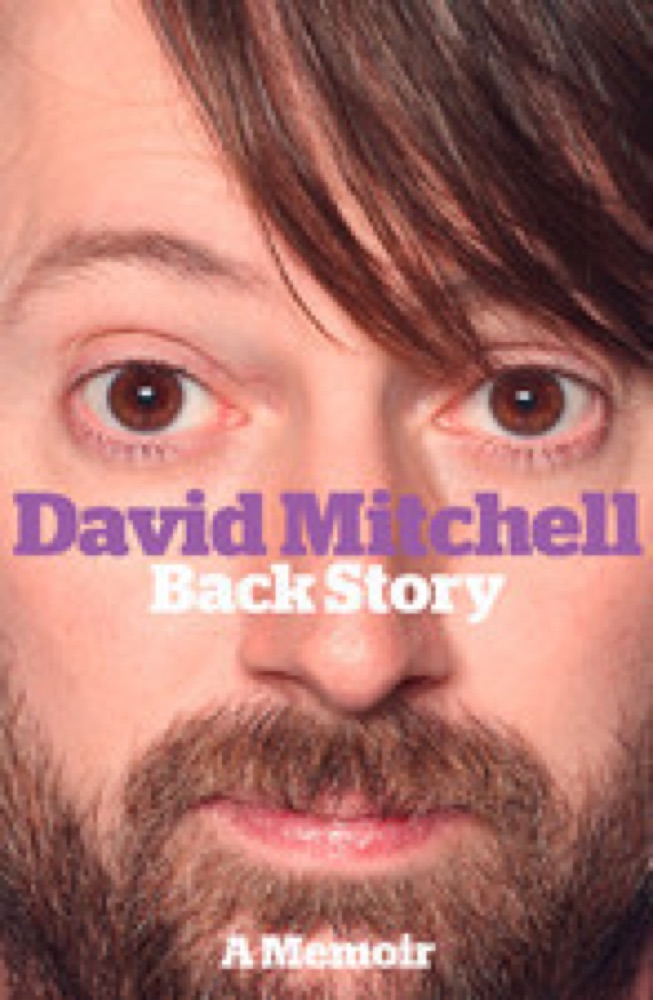 Back Story
 Saevus Corax Deals with the Dead
 Heretics
 Decline and Fall
 The Fencing Master
 The Bedlam Stacks
 The Gods Themselves
 The Manticore
 Gnomon
 Enchantment
 Utopia
 Prelude to Foundation
 The Fry Chronicles
 What's Wrong with the World
 The Sunlit Man
 The Hundred Thousand Kingdoms
 The Better Angels of Our Nature: Why Violence Has Declined
 The Histories
 A Distant Mirror: The Calamitous 14th Century
 The Grace of Kings
 The Game of Kings
 The Fear Institute
 Europe: A History
 The Book of Merlyn