

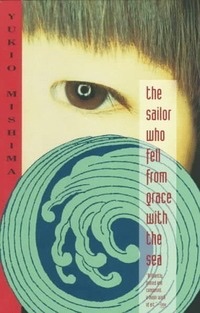
 The Sailor Who Fell from Grace with the Sea
Quotes from the Book
Young people get the foolish idea that what is new for them must be new for everybody else too. No matter how unconventional they get, they're just repeating what others before them have done.
273
Kazu, now that she thought of it, realized that for all her headstrong temperament, she had never loved a man younger than herself. A young man has such a surplus of spiritual and physical gifts that he is likely to be cocksure of himself, particularly when dealing with an older woman, and there is no telling how swelled up with self-importance he may become. Besides, Kazu felt a physical repugnance for youth. A woman is more keenly aware than a man of the shocking disharmony between a young man's spiritual and physical qualities, and Kazu had never met a young man who wore his youth well. She was moreover repelled by the sleekness of a young man's skin.
4
When I think how in the past couple of years your confidence in your knowledge of people has been shattered, how you have obtained in place of peace of mind only uncertainty, and in place of happiness a new, painful knowledge, how you ended at the place where you thought you would begin, and began at the place you had ended ... how you have been able to secure your present, peaceful uncertainty by sacrificing everything, my nature is such that I feel less sympathy than respect.
1
Tous les actes de ce genre auxquels elle se livrait, sa manière de semer l'argent, étaient le résultat d'un froid calcul dans l'esprit de Kazu; toutes les manifestations de sa bonté avaient un seul but: s'assurer des voix de l'élection. C'était là sa pensée dominante; toutefois il n'entrait pas dans ses calculs de toucher les gens par la passion qu'elle mettait à payer de sa personne. Lorsqu'elle entendait des auditeurs dire qu'ils étaient réellement sensibles à un tel sacrifice de soi, elle riait intérieurement. D'un autre côté, quand on critiquait ses actions en déclarant qu'elles ne procédaient pas d'un enthousiasme réel mais d'un calcul, elle était furieuse d'être ainsi méconnue. Ceci suffit à montrer combien la psychologie de Kazu était compliquée. Bien qu'elle ne se fût jamais préoccupée de cette question, il se trouvait que les méthodes qu'employait Kazu pour s'assurer des votes étaient, malgré la simplicité de leur hypocrisie, parmi les facteurs les plus importants de sa popularité. Dans ce qu'elle prenait pour des calculs de sa part il y avait une sorte de sincérité, surtout de la sincérité à l'égard du peuple. Quel que fût le mobile de ses actes, son abnégation et son dévouement avaient le privilège de la faire aimer par les masses. En fait, Kazu n'avait pas une grande confiance dans son détachement. Ses stratagèmes qui sautaient aux yeux, ses tentatives effrénées pour duper les gens, la répétition éhontée et obstinée de ses ruses, déjouaient la vigilance des esprits simples. Plus elle essayait de tirer avantage de la foule, plus la foule l'aimait. On pouvait parler en cachette derrière elle, là où elle allait, mais elle partait en laissant une popularité croissante. Lorsque Kazu se rendait chez les femmes du quartier de Kôtô vêtue en cuisinière, elle se figurait qu'elle était une grande dame qui s'habillait en cuisinière pour mieux duper les gens en se mêlant à eux. Cependant personne ne s'y trompait: le costume d'une cuisinière allait très bien à Kazu!
1
Quivering like a piece of fruit inside a dish of jello, he waited impatiently for the moment when the gelatine would kindly harden. It seemed to him that the coagulation of the world would have to be completed before he could look up to the blue sky with an easy mind and admire to his heart’s content the sunrise and sunset and the rustling of the treetops. Noguchi, like many other retired politicians, had wished to save “poetry” for his declining years. He had never had the leisure to appreciate that desiccated storage food, nor did he expect that it would taste good, but to such men as Noguchi, poetry lay hidden not in poetry itself so much as in an untroubled craving for poetry; poetry in fact symbolized the unshakable stability of the world. Poetry would make its appearance—indeed, would have to appear—when there was no further danger of the world changing, when one knew that there would be no further assaults of uncertainty, hopes, or ambitions. At such a time, he expected, the moral constraint of a lifetime and the armor of logic would melt and dissolve into poetry, like a column of white smoke rising in the autumn sky.
1
Watch on YouTube
About Yukio Mishima
We have collected 198 quotes from 11 books by Yukio Mishima on BookQuoters.
More about the author →More by Yukio Mishima
The Sailor Who Fell from Grace with the Sea
 Spring Snow
 The Temple of the Golden Pavilion
 The Sound of Waves
About the book
Reissued along side The Sound of the Waves plus three classics works by Junichiro Tanizaki.
Book details
- First published
- 1960
- Author
- Yukio Mishima
- Genre
- Fiction
- Goodreads rating
- 3.70 (3k ratings)
Keep reading
 Confessions of a Mask
Spring Snow
Confessions of a Mask
Spring Snow
 Girl with Curious Hair
 In Search of Lost Time
 Identity
 And Then
 The Post-Birthday World
 Childhood, Boyhood, Youth
 The Notebooks of Malte Laurids Brigge
 Thirst for Love
 The Devil in the Flesh
 The Manticore
 Summertime
 Kokoro
 Oblomov
 Those Who Leave and Those Who Stay
 Just Above My Head
 The Elementary Particles
 Selected Stories
 The Volcano Lover: A Romance
 Eyeless in Gaza
 Sexus
Sexus
 Selected Stories of Anton Chekhov
 Too Much Happiness: Stories
 The Golden Notebook
 The Three-Cornered World
 The Swan Thieves
 V.
V.
 Audition
 An Artist of the Floating World
 Men Without Women
 The Interpretation of Murder
 The Possibility of an Island
 The Joke
 The Complete Short Stories
 Gertrude
 The Fall
 Death in Venice and Other Tales
 Christmas Holiday
 The Empusium
 Farewell Waltz
 Seven Types of Ambiguity
 Suite Française
 The Good Soldier
 Swann's Way
 The Stories of Vladimir Nabokov
 Asymmetry
 Blue Bamboo: Japanese Tales of Fantasy
 The Complete Stories
 The Story of the Lost Child
 Testament of Youth
 Sixty Stories
 Min kamp 2
 The Kreutzer Sonata
 Villa Incognito
 Anthropology of an American Girl
 The Man Without Qualities
 The Fall of Babel
 Dream Count
 Life with Picasso