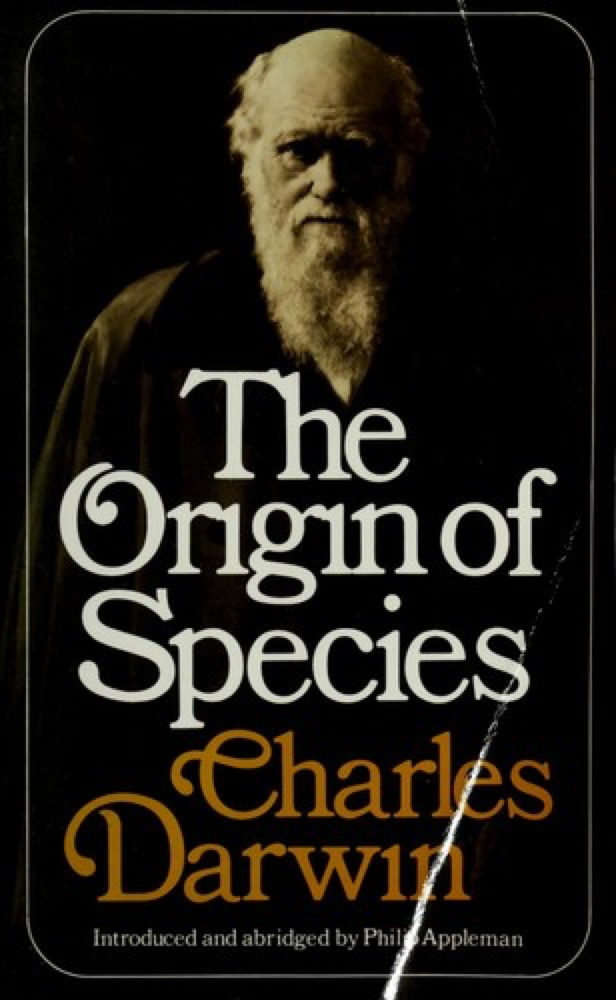
 The Origin of Species
Quotes from the Book
If I had my life to live over again, I would have made a rule to read some poetry and listen to some music at least once every week.
3k
A man who dares to waste one hour of time has not discovered the value of life.
2.9k
...Whilst on board the Beagle I was quite orthodox, and I remember being heartily laughed at by several of the officers... for quoting the Bible as an unanswerable authority on some point of morality... But I had gradually come by this time, i.e., 1836 to 1839, to see that the Old Testament from its manifestly false history of the world, with the Tower of Babel, the rainbow at sign, &c., &c., and from its attributing to God the feelings of a revengeful tyrant, was no more to be trusted than the sacred books of the Hindoos, or the beliefs of any barbarian. ...By further reflecting that the clearest evidence would be requisite to make any sane man believe in the miracles by which Christianity is supported, (and that the more we know of the fixed laws of nature the more incredible do miracles become), that the men at that time were ignorant and credulous to a degree almost uncomprehensible by us, that the Gospels cannot be proved to have been written simultaneously with the events, that they differ in many important details, far too important, as it seemed to me, to be admitted as the usual inaccuracies of eyewitnesses; by such reflections as these, which I give not as having the least novelty or value, but as they influenced me, I gradually came to disbelieve in Christianity as a divine revelation. The fact that many false religions have spread over large portions of the earth like wild-fire had some weight with me. Beautiful as is the morality of the New Testament, it can be hardly denied that its perfection depends in part on the interpretation which we now put on metaphors and allegories. But I was very unwilling to give up my belief... Thus disbelief crept over me at a very slow rate, but was at last complete. The rate was so slow that I felt no distress, and have never since doubted even for a single second that my conclusion was correct. I can indeed hardly see how anyone ought to wish Christianity to be true; for if so the plain language of the text seems to show that the men who do not believe, and this would include my Father, Brother and almost all of my friends, will be everlastingly punished. And this is a damnable doctrine.
182
...But I own that I cannot see as plainly as others do, and as I should wish to do, evidence of design and beneficence on all sides of us. There seems to me too much misery in the world. I cannot persuade myself that a beneficent and omnipotent God would have designedly created the Ichneumonidæ with the express intention of their feeding within the living bodies of Caterpillars, or that a cat should play with mice... I feel most deeply that the whole subject is too profound for the human intellect. A dog might as well speculate on the mind of Newton. Let each man hope and believe what he can.
118
The loss of these tastes [for poetry and music] is a loss of happiness, and may possibly be injurious to the intellect, and more probably to the moral character, by enfeebling the emotional part of our nature.
31
if I had to live my life again, I would have made a rule to read some poetry and listen to some music at least once every week;
10
My books have sold largely in England, have been translated into many languages, and passed through several editions in foreign countries. I have heard it said that the success of a work abroad is the best test of its enduring value. I doubt whether this is at all trustworthy; but judged by this standard my name ought to last for a few years.
9
[Reason tells me of the] extreme difficulty or rather impossibility of conceiving this immense and wonderful universe, including man with his capability of looking far backwards and far into futurity, as the result of blind chance or necessity. When thus reflecting I feel compelled to look to a First Cause having an intelligent mind in some degree analogous to that of man; and I deserve to be called a Theist.
8
Linnaeus and Cuvier have been my two gods, though in very different ways, but they were mere schoolboys to old Aristotle.
8
Therefore my success as a man of science, whatever this may have amounted to, has been determined, as far as I can judge, by complex and diversified mental qualities and conditions. Of these, the most important have been—the love of science—unbounded patience in long reflecting over any subject—industry in observing and collecting facts—and a fair share of invention as well as of common sense. With such moderate abilities as I possess, it is truly surprising that I should have influenced to a considerable extent the belief of scientific men on some important points.
5
love of science—unbounded patience in long reflecting over any subject—industry in observing and collecting facts—and a fair share of invention as well as of common sense. With such moderate abilities as I possess, it is truly surprising that I should have influenced to a considerable extent the belief of scientific men on some important points.
5
What an extraordinary thing it is, Mr. Darwin seems to spend hours in cracking a horse-whip in his room, for I often hear the crack when I pass under his windows.
5
I have steadily endeavoured to keep my mind free, so as to give up any hypothesis, however much beloved (and I cannot resist forming one on every subject), as soon as facts are shown to be opposed to it.
4
It was evident that such facts as these, as well as many others, could only be explained on the supposition that species gradually become modified; and the subject haunted me.
4
Nevertheless it is probable that the hearing rather early in life such views maintained and praised may have favoured my upholding them under a different form in my 'Origin of Species.
4
On the other hand, novels which are works of the imagination, though not of a very high order, have been for years a wonderful relief and pleasure to me, and I often bless all novelists. A surprising number have been read aloud to me, and I like all if moderately good, and if they do not end unhappily—against which a law ought to be passed.
2
I received the proceedings of one of the meetings, in which it seemed that the shape of my head had been the subject of a public discussion, and one of the speakers declared that I had the bump of reverence developed enough for ten priests.
2
...it appears to me, the doing what little one can to increase the general stock of knowledge is as respectable an object of life, as one can in any likelyhood pursue.
2
On the other hand, I am not very sceptical,—a frame of mind which I believe to be injurious to the progress of science. A good deal of scepticism in a scientific man is advisable to avoid much loss of time, but I have met with not a few men, who, I feel sure, have often thus been deterred from experiment or observations, which would have proved directly or indirectly serviceable.
1
I remember a funny dinner at my brother's, where, amongst a few others, were Babbage and Lyell, both of whom liked to talk. Carlyle, however, silenced every one by haranguing during the whole dinner on the advantages of silence. After dinner Babbage, in his grimmest manner, thanked Carlyle for his very interesting lecture on silence.
1
he doubted whether any one with my nose could possess sufficient energy and determination for the voyage. But I think he was afterwards well satisfied that my nose had spoken falsely.
1
Watch on YouTube
About Charles Darwin
We have collected 99 quotes from 4 books by Charles Darwin on BookQuoters.
More about the author →More by Charles Darwin
About the book
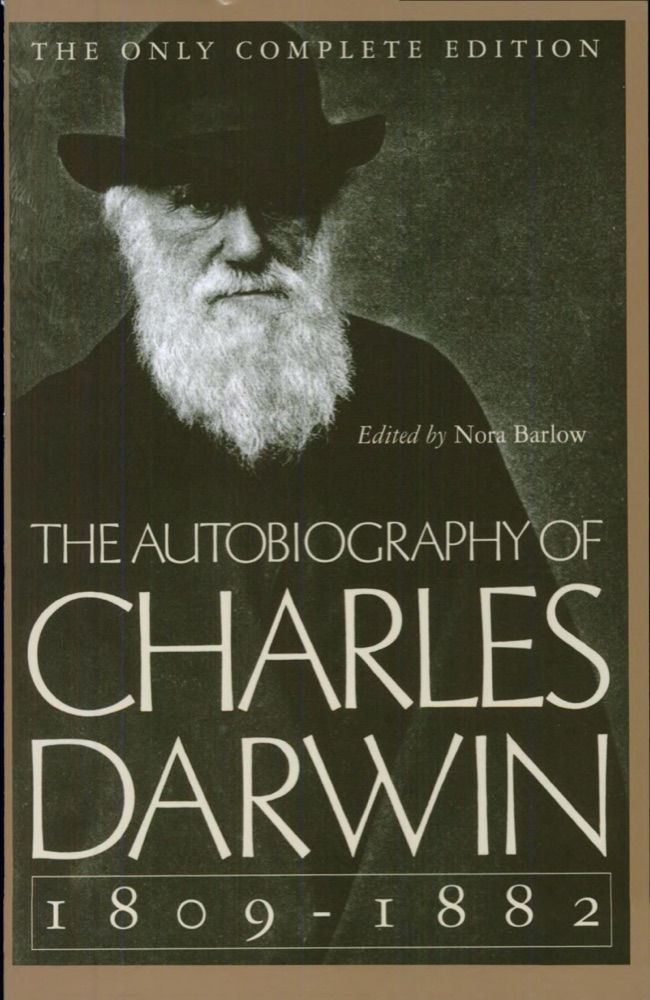
Charles Darwin's Autobiography was first published in 1887, five years after his death. It was a bowdlerized edition: Darwin's family, attempting to protect his posthumous reputation, had deleted all the passages they considered too personal or controversial. The present complete edition did not appear until 1959, one hundred years after the publication of The Origin of Species. Upon its appearance, Loren Eiseley wrote:
"No man can pretend to know Darwin who does not know his autobiography. Here, for the first time since his death, it is presented complete and unexpurgated, as it exists in the family archives. It will prove invaluable to biographers and cast new light on the personality of one of the world's greatest scientists. Nora Barlow, Darwin's granddaughter, has proved herself a superb editor. Her own annotations make fascinating reading."
The daring and restless mind, the i
Book details
- First published
- 1887
- Author
- Charles Darwin
- Genre
- Biography
- Goodreads rating
- 3.84 (3k ratings)
Keep reading
 The Autobiography of Bertrand Russell
 The Autobiography of Benjamin Franklin
 The Tropic of Serpents
 The Pleasure of Finding Things Out: The Best Short Works of Richard P. Feynman
 Surprised by Joy: The Shape of My Early Life
 Sherlock Holmes
 A Study in Scarlet
 The Life and Opinions of Tristram Shandy, Gentleman
 The Story of My Experiments With Truth
 The Complete Sherlock Holmes
 An Appetite for Wonder: The Making of a Scientist
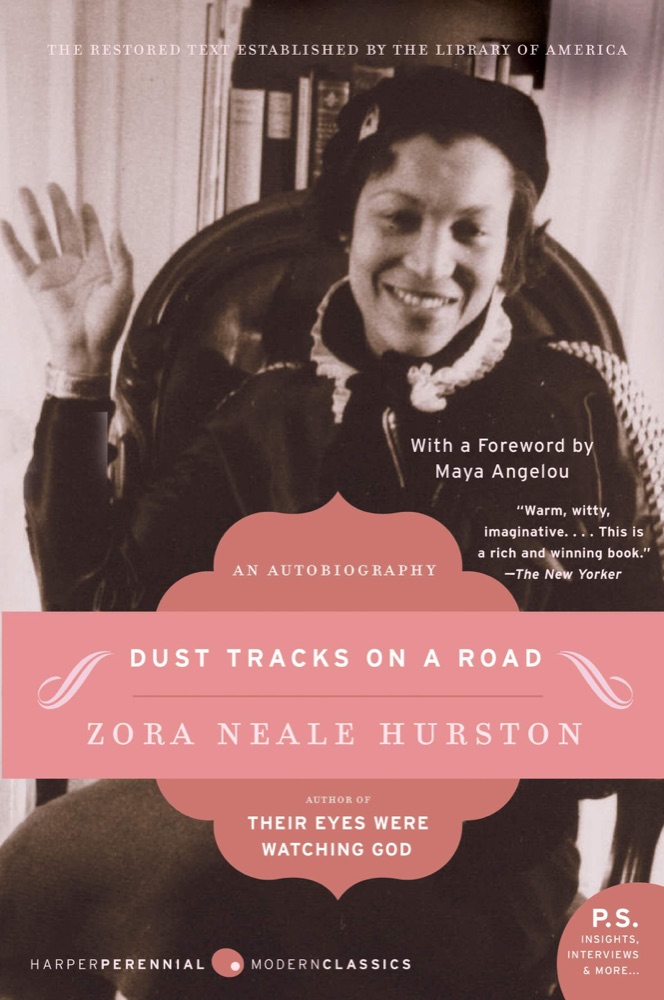 Dust Tracks on a Road
 Humboldt's Gift
 Fifth Business
 An Instance of the Fingerpost
 Erewhon
 Living with a Wild God: A Nonbeliever's Search for the Truth about Everything
 An Essay Concerning Human Understanding
 The Log from the Sea of Cortez
 Memoirs of Hadrian
 The Manticore
 Confessions of an English Opium Eater
 The Varieties of Religious Experience
 The Essays of Ralph Waldo Emerson
 Journey to the Center of the Earth
 The Letters of J.R.R. Tolkien
 Confessions
 Agnes Grey
 Human, All Too Human
 The Stories of Vladimir Nabokov
 The Story of My Life
 Walden and other writings
 The Magic Mountain
 The World As I See It
 The Last Samurai
 Armadale
 Notes from Underground
 Discourse on Method and Meditations on First Philosophy
 Gulliver's Travels
 Agatha Christie: An Autobiography
 A Confession
 Testament of Youth
 A Treatise of Human Nature
 The Adventures of Augie March
 The Gay Science
 Gould's Book of Fish: A Novel in Twelve Fish
 The Club of Queer Trades
 The Fall
 The Professor's House
 Wittgenstein's Mistress
 Flaubert's Parrot
 An Enquiry Concerning Human Understanding
 Foundation and Empire
 The Spinoza Problem
 The Ascent of Man
 Our Hideous Progeny
 The Salmon of Doubt
 Jailbird
 David Copperfield