
 Ash
Ash
Quotes from the Book
Haven’t you ever wondered what it would be like to have nothing keeping you attached to the ground?
80
She’s having a hard time right now because you’re not what she expected. But we’re never what our parents expected. They have to learn that lesson.
78
Here was her mother sitting down across from her, reaching for her hands and chafing them as if she were frozen. She felt the rub of her mother’s wedding ring against her skin, and her mother’s face swam into focus, her brown eyes full of the sharp worry of love, and Lily thought, You will never look at me like this again.
63
Are you like the girls in the book too? Because I think I am.
49
She wondered where Kath was. She wondered if Kath could sense her, sitting here on this train as it took her away. Perhaps it was possible, if she closed her eyes and sent out her thoughts along the steel track like a message along a telegraph wire. I love you. I love you. The train swayed gently beneath her, and she leaned against the window to feel the cool glass against her cheek, and she was sure that Kath had heard her, she was sure.
39
Perhaps that was the most perverse part of this: the inside-outness of everything, as if denial would make it go away, when it only made the pain in her chest tighten, when it only made her emotions clearer.
35
It wasn’t like chocolate, Lily thought. It was like finding water after a drought. She couldn’t drink enough, and her thirst made her ashamed, and the shame made her angry.
30
How am I supposed to know?” she asked instead. “What’s it supposed to be like?” Lana and Claire traded tiny smiles, and Claire asked gently, “What’s what supposed to be like?” Lily slumped back against the sofa, feeling boneless and muddled. “Falling in love, I guess.” “You’ll know,” Claire said. “It’s unmistakable.” (How she could recognize Kath at the other end of a crowded Galileo hallway by the way she walked.) “It’s like . . . well, it’s like falling,” Lana said. “Falling, or floating, or sinking.” (Every time they kissed.) “You won’t know which way is up.” “It’s like having a fever.” (The way the world seemed to narrow down to the tips of Kath’s fingers.) “It’s like being drunk—drunk for days.
30
Now she was confused, as if she’d been reading a book that had several pages removed, but hadn’t realized the pages were gone until this moment.
20
An unfamiliar emotion swelled inside her at this image. A strangely sharp pang for a place she had never visited. For a people she resembled but did not know.
19
The word felt dangerous, and also powerful, as if uttering it would summon someone or something
17
They had hugged each other quickly, and Lily realized then and there that they'd never be able to kiss goodbye in public. (A tightening in her chest as she reluctantly turned away.)
15
To all the butches and femmes, past, present, and future.
14
Perhaps one day she’d get used to the way it made her feel: dislocated and dazed, never quite certain if the other half of her would stay offstage as directed. But tonight she felt as if she were constantly on the edge of saying or doing something wrong, and the effort of keeping that unwelcome half silent was making her sick.
7
The hurt felt real - much more real than the entire afternoon of staying silent. So she lay on the hard wooden floor between her brothers' beds and let that ache fill her.
6
A few hours at home and the Telegraph Club seemed more like a fantasy than a real thing. This troubled her. It felt as if someone had taken an eraser to her memory - to her very self - and rubbed at it, then blown away the remains.
6
Did that mean that she had always been destined to come here? To this city and this land so far from her home?
6
And yet she couldn’t say the word the book had used to describe those kinds of girls: lesbian. The word felt dangerous, and also powerful, as if uttering it would summon someone or something—a policeman to arrest them for saying that word, or even worse, a real-life lesbian herself.
4
It wasn't Lily who was the figurine in a diorama; it was her mother. Her mother was going round and round on that track, hearing only what she wanted to hear.
4
She felt a queer giddiness overtaking her, as if her body might float up from the ground because she was so buoyant with this lightness, this love.
4
She didn't understand the shrinking feeling inside her, as if she shouldn't be caught looking at those girls.
4
It’s not a mistake,” Lily said miserably. Her mother strode across the kitchen and slapped her. Lily jerked backward, shocked. Her mother hadn’t hit her in years—since she was eight or nine—and she instantly felt like that child again, cowering in fear of another strike. With the terror came a crippling guilt and the belief that she must have done something awful, that she deserved this punishment.
4
It also revealed the naked expanse of her back, the bones of her spine like a map for someone’s fingers.
4
At each intersection she cast skittish glances at the women waiting for the light to change, wondering if she was one of them too, or her, or her.
4
She knew that what she had read in Strange Season was not only scandalous, it was perverse. She should feel dirtied by reading it; she should feel guilty for being thrilled by it. The problem was, she didn’t. She felt as if she had finally cracked the last part of a code she had been puzzling over for so long that she couldn’t remember when she had started deciphering it. She felt exhilarated.
4
Wake up. You are here.
4
The sensation of having already met someone, or what the French called deja vu, the feeling of having already seen something. There was probably a scientific explanation for it, but the older she got, the more she was inclined to give ino the the feeling that these moments were glimpses into a world greater than this physical one. It was as if there were cycles that repeated themselves over and over, but most people never saw the repetition; they were too deeply enmeshed in their own path to see.
3
As if summer had bloomed inside the club and wrapped her in its lazy heat
3
She could almost see the curve of the earth on the oceans horizon. Or she imagined that she could. And it gave her a physical sense of how far away from home she had traveled. Yes, she truly had come that far. No, she really wasn’t going home anytime soon. There was a strange sense of freedom in those thoughts. They left her free to be here, in this place, right now.
3
Did you know?
- The novel won the 2021 National Book Award for Young People's Literature.
- It was the first time a young adult book with an LGBTQ woman as the main protagonist won the National Book Award in that category.
- The story is set in San Francisco's Chinatown in 1954, during the Red Scare.
- The Telegraph Club of the title is a lesbian bar in the city.
- A companion novel, A Scatter of Light, was published in October 2022 and is set in the same connected universe.
- The book received a Michael L. Printz Honor as well as the Stonewall Book Award.
About Malinda Lo
Malinda Lo is an American author of young adult fiction known for centering LGBTQ and Asian American characters. Her debut novel Ash was a finalist for several awards, and Last Night at the Telegraph Club won the National Book Award for Young People's Literature.
More about the author →More by Malinda Lo
Ash
About the book
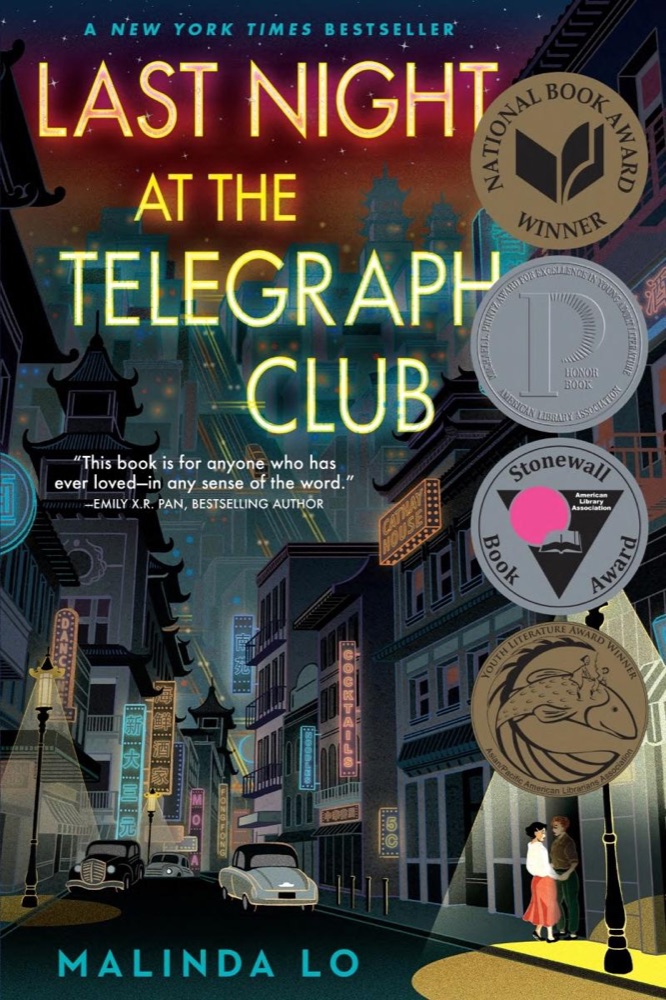
Set in San Francisco's Chinatown in 1954, Last Night at the Telegraph Club follows seventeen-year-old Lily Hu, the daughter of Chinese immigrants, as she falls in love with a classmate named Kathleen Miller. Drawn to a lesbian bar called the Telegraph Club, the two girls risk everything to be together at a time and place where their love is dangerous, both for being queer and for the suspicion that Red Scare paranoia casts over Chinese American families.
The novel braids together coming-of-age, first love, and identity against a tightly researched historical backdrop. It explores the intersections of sexuality, race, and family expectation, depicting how Lily must navigate her desires alongside her obligations to her community and the political pressures bearing down on Chinese Americans during the McCarthy era.
Widely praised for its historical texture and emotional sincerity, the book won the 2021 National Book Award for Young People's Literature, the Stonewall Book Award, and the Asian/Pacific American Award for Literature, and was named a Michael L. Printz Honor book. Critics noted its significance as a landmark work of intersectional, lesbian, historical young adult fiction.
Key characters
- Lily HuSeventeen-year-old Chinese American protagonist exploring her identity and sexuality
- Kathleen MillerLily's classmate and love interest
Book details
- First published
- 2021
- Length
- 416 pages
- Reading time
- 6 hours
- Author
- Malinda Lo
- Genre
- Historical
- Goodreads rating
- 4.19 (125k ratings)
Critical reception
- Won the 2021 National Book Award for Young People's Literature.
- Kirkus Reviews called it the intersectional, lesbian, historical teen novel many readers had been waiting for.
- Publishers Weekly praised how the author conjures 1950s San Francisco while exploring identity and love.
Series & reading order
- 1 Last Night at the Telegraph Club
- 2 A Scatter of Light
Keep reading
 The Paying Guests
 Ink Blood Sister Scribe
 The Safekeep
 Briefly, A Delicious Life
 Horrid
 My Brilliant Friend
 Salt Slow
 Veronica
 The Price of Salt
 The Awakening and Selected Stories
 Last Night in Montreal
 The Fever
 Brooklyn
 Her Fearful Symmetry
 Like Life: Stories
 The Broken Girls
 After Leaving Mr. Mackenzie
 When Christmas Comes
 Consequences
 Olive Kitteridge
 Birds of America
 Baby Teeth
 Crudo
Crudo
 The Story Sisters
 When We Lost Our Heads
 A Slow Fire Burning
 Summer Island
 What Is Not Yours Is Not Yours
 Cold Enough for Snow
 The Memory Keeper's Daughter
 White is for Witching
 Milk Blood Heat
 The Sirens
 Instructions for a Heatwave
 The Years
 The Letter
 Upright Women Wanted
 A Dangerous Place
 Under the Skin
 And I Do Not Forgive You: Stories & Other Revenges
 Tangerine
 The Guest
 The Girl Who Chased the Moon
 Darling Girls
 The Vegetarian
 Magpie
 The Red Garden
 The Wings of the Dove
 The Awakening
 Dare Me
 Still Life with Bread Crumbs
 Hateship, Friendship, Courtship, Loveship, Marriage: Stories
 Lost in Translation
 The Truth About Melody Browne
 Tipping the Velvet
 Girl, Serpent, Thorn
 The Second Summer of the Sisterhood
 The Rose and the Beast: Fairy Tales Retold
 Being a Witch, and Other Things I Didn't Ask For
 The Reluctant Heiress