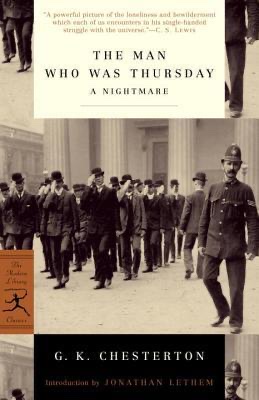
 The Man Who Was Thursday
Quotes from the Book
Modern intelligence won't accept anything on authority. But it will accept anything without authority.
24
But it's my reading of human nature that a man will cheat in his trade, but not in his hobby.
5
You know I always liked you," said Fisher, quietly, "but I also respect you, which is not always the same thing. You may possibly guess that I like a good many people I don't respect. Perhaps it is my tragedy, perhaps it is my fault. But you are very different, and I promise you this: that I will never try to keep you as somebody to be liked, at the price of your not being respected.
5
We’re all really dependent in nearly everything, and we all make a fuss about being independent in something.
4
I know too much," he said. "That's what's the matter with me. That's what's the matter with all of us, and the whole show; we know too much. Too much about one another; too much about ourselves.
3
Harold March was the sort of man who knows everything about politics, and nothing about politicians. He also knew a great deal about art, letters, philosophy, and general culture; about almost everything, indeed, except the world he was living in.
3
Something lay in the shadow at the foot of the ridge, as stiff as the stick of the fallen rocket; and the man who knew too much knew what is worth knowing.
3
Believe me, you never know the best about men till you know the worst about them.
3
Besides, if we want poor people to respect property we must give them some property to respect.
3
I know too much," said Horne Fisher, "and all the wrong things.
3
They had all that forgetfulness of history that goes everywhere with the extension of education.
2
the schoolboy had something of the stolid air of a young duke doing the grand tour, while his elderly relative was reduced to the position of a courier, who nevertheless had to pay for everything like a patron.
2
He was undoubtedly a gentleman of honorable pedigree and of many accomplishments, but two of his accomplishments emerged from all the rest. He had a talent for appearing when he was not wanted and a talent for disappearing when he was wanted, especially when he was wanted by the police. It may be added that his disappearances were more dangerous than his appearances.
2
God alone knows what the conscience can survive, or how a man who has lost his honor will still try to save his soul.
2
There nearly always is method in madness. It's what drives men mad, being methodical. And he never goes on sitting there after sunset, with the whole place getting dark.
2
Splendid," replied the man by the well. But the first man pronounced the word as a young man might say it about a woman, and the second as an old man might say it about the weather, not without sincerity, but certainly without fervor.
2
I am the man who knows too much to know anything, or, at any rate, to do anything,
2
You've got to understand one of the tricks of the modern mind, a tendency that most people obey without noticing it. In the village or suburb outside there's an inn with the sign of St. George and the Dragon. Now suppose I went about telling everybody that this was only a corruption of King George and the Dragoon. Scores of people would believe it, without any inquiry, from a vague feeling that it's probable because it's prosaic. It turns something romantic and legendary into something recent and ordinary. And that somehow makes it sound rational, though it is unsupported by reason. Of course some people would have the sense to remember having seen St. George in old Italian pictures and French romances, but a good many wouldn't think about it at all. They would just swallow the skepticism because it was skepticism. Modern intelligence won't accept anything on authority. But it will accept anything without authority. That's exactly what has happened here.
2
And when he became conscious of a human figure dark against the silver stream, sitting on a large boulder and looking rather like a large bird, it was perhaps with some of the premonitions proper to a man who meets the strangest friendship of his life.
2
Despite the almost aggressive touch of luxury in the fur coat, it soon became apparent that Sir Walter's large leonine head was for use as well as ornament, and he considered the matter soberly and sanely enough.
1
He also knew a great deal about art, letters, philosophy, and general culture; about almost everything, indeed, except the world he was living in.
1
Do you know what that means?" he cried. "It means that God himself may hold a candle to show me your infernal face.
1
Hang it all! what is a man ashamed of nowadays?
1
Gentlemen used to lie just as schoolboys lie, because they hung together and partly to help one another out.
1
All his actions had something at once ambitious and conscientious; he drank no wine, but was slightly intoxicated with words. And his face and phrases were on the front page of all the newspapers just then, because he was contesting the safe seat of Sir Francis Verner in the great by-election in the west.
1
The sun has set," said Horne Fisher, in the same terrible tones, "and he will never see it rise again.
1
He was only one of those young men who cannot support the burden of consciousness unless they are doing something, and whose conceptions of doing something are limited to a game of some kind.
1
Nobody sees anything except in the dark," said the magician.
1
Everything is different in the dark,
1
I've known a good many magicians myself in India—mango plant and all. But the Indian ones are all frauds, I'll swear.
1
Watch on YouTube
About G.K. Chesterton
We have collected 364 quotes from 14 books by G.K. Chesterton on BookQuoters.
More about the author →More by G.K. Chesterton
All books by G.K. Chesterton →
About the book
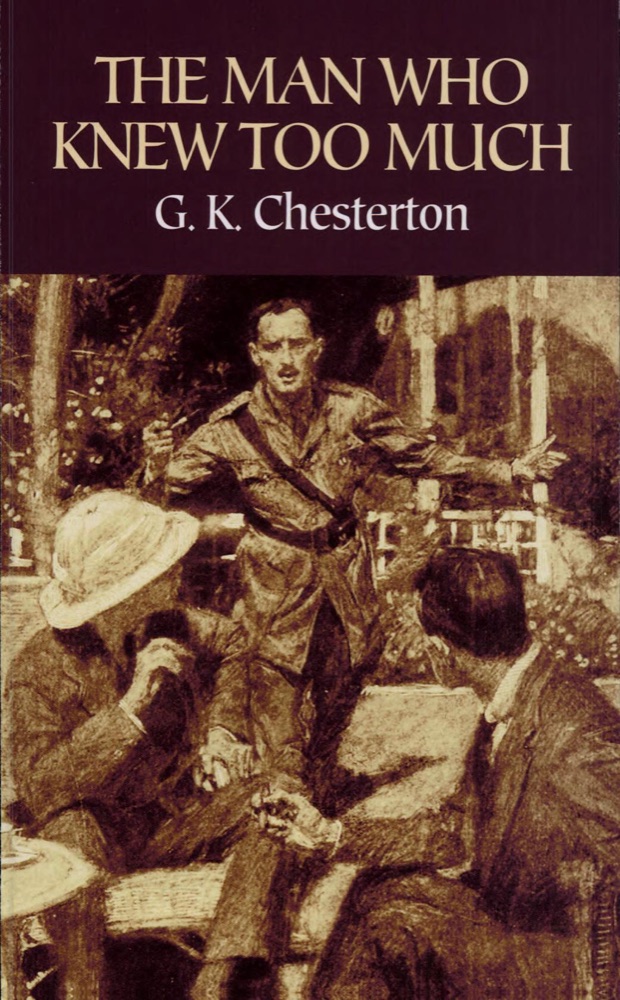
A prolific and popular writer, G. K. Chesterton (1874–1936) is best known as the creator of detective-priest Father Brown (even though Chesterton's mystery stories constitute only a small fraction of his writings). The eight adventures in this classic British mystery trace the activities of Horne Fisher, the man who knew too much, and his trusted friend Harold March. Although Horne's keen mind and powerful deductive gifts make him a natural sleuth, his inquiries have a way of developing moral complications. Notable for their wit and sense of wonder, these tales offer an evocative portrait of upper-crust society in pre–World War I England.
Book details
- First published
- 1922
- Author
- G.K. Chesterton
- Genre
- Mystery
- Goodreads rating
- 3.59 (7k ratings)
Keep reading
 Call for the Dead
 The Invisible Man
 The Ministry of Fear
 Authority
 Hard Times
 Tinker Tailor Soldier Spy
 Dead Souls
 The Victim
 The Lost World
 Felix Holt: The Radical
 Mort
Mort
 A Dance to the Music of Time: 1st Movement
 The Tiger in the Smoke
 The Memoirs of Sherlock Holmes
 The Mysterious Mr. Quin
 Gaudy Night
 Crime and Punishment
 Arrowsmith
 The Complete Essays
 Falls the Shadow
 Jonathan Strange & Mr Norrell
 The Honourable Schoolboy
 Silas Marner
 The Complete Father Brown
 Dodger
 Barnaby Rudge
 Victory
 Ragtime
 Strangers on a Train
 An Instance of the Fingerpost
 The Eyes of the Dragon
 The Long Dark Tea-Time of the Soul
 The Idiot
 A Study in Scarlet
 The Luminaries
The Man Who Was Thursday
The Luminaries
The Man Who Was Thursday
 Zuleika Dobson
 The Jewel in the Crown
 Fathers and Sons
 The Untouchable
 The Liar
 Adventures of Huckleberry Finn
 That Hideous Strength
 Interesting Times
 The Known World
 The Virginian
 The Naked and the Dead
 The Magician's Nephew
 The Napoleon of Notting Hill
 Phineas Finn
 Second Foundation
 A Time of Torment
 Bleak House
 The Truth: Stage Adaptation
 The Wolf in Winter
 A Connecticut Yankee in King Arthur's Court
 Foundation and Empire
 The Daughter of Time
 Stone's Fall