
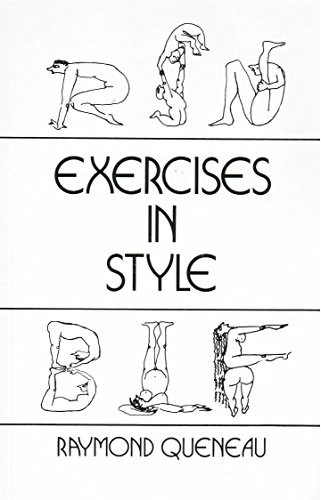
 Exercises in Style
Quotes from the Book
Being or nothing, that is the question. Ascending, descending, coming, going, a man does so much that in the end he disappears.
Why," he was saying, "why should one not tolerate this life, since so little suffices to deprive one of it? So little brings it into being, so little brightens it, so little blights it, so little bears it away. Otherwise, who would tolerate the blows of fate and the humiliations of a successful career, the swindling of grocers, the prices of butchers, the water of milkmen, the irritation of parents, the fury of teachers, the bawling of sergeant-majors, the turpitude of the beasts, the lamentations of the dead-beats, the silence of infinite space, the smell of cauliflower or the passivity of the wooden horses on a merry-g0-round, were it not for his knowledge that the bad and proliferative behaviour of certain minute cells (gesture) or the trajectory of a bullet traced by an involuntary, irresponsible, anonymous individual might unexpectedly come and cause all these cares to evaporate into the blue heavens.
–Alors tu t’es bien amusée ? –Comme ça. –T’as vu le métro ? –Non. –Alors, qu’est-ce que t’as fait ? –J’ai vieilli
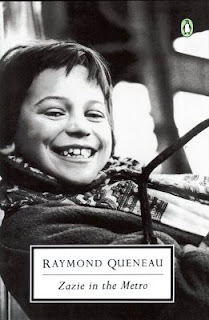
– Tonton Gabriel, dit Zazie paisiblement, tu m'as pas encore espliqué si tu étais un hormosessuel ou pas, primo, et deuzio où t'avais été pêcher toutes les belles choses en langue forestière que tu dégoisais tout à l'heure? Réponds. – T'en as dla suite dans les idées pour une mouflette, observa Gabriel languissamment.
L’essere o il nulla, ecco il problema. Salire, scendere, andare, venire; tanto fa l’uomo che alla fine sparisce. Un tàssi lo reca, un metró lo porta via, la torre non ci bada, e il Pàntheon neppure. Parigi è solo un sogno, Gabriel è solo un’ombra (incantevole), Zazie il sogno d’un’ombra (o di un incubo) e tutta questa storia il sogno di un sogno, l’ombra di un’ombra, poco più di un delirio scritto a macchina da un romanziere idiota (oh! mi scusi). Laggiù, oltre, un po’ oltre, Place de la République, si accatastano tombe dei parigini che furono, che salirono e scesero scale, andarono e vennero per le vie e tanto fecero che alla fine sparirono. Un forcipe li introdusse, un carro funebre li porta via e la torre si arrugginisce e il Pàntheon si screpola più presto di quanto le ossa dei morti fin troppo presenti non si dissolvano nell’humus della città tutto impregnato di affanni. Ma sono vivo, io, e qui s’arresta la mia scienza perché del tassimane sparito nel suo trespolo a tassametro o di mia nipote sospesa a trecento metri nell’atmosfera o della mia sposa, la dolce Marceline, rimasta presso il focolare domestico, in questo preciso momento io non so, e qui non so, se non questo, endecasillabicamente: eccoli quasi morti perché assenti.
There's as many fish in the sea as ever came out of it. Fright though you are, you won't have any trouble in hooking another boy-friend.
Watch on YouTube
About Raymond Queneau
We have collected 8 quotes from 2 books by Raymond Queneau on BookQuoters.
More about the author →More by Raymond Queneau
Exercises in Style
Book details
- Author
- Raymond Queneau
- Genre
- Classics
- Goodreads rating
- 3.64 (10k ratings) →
Keep reading
 If Only It Were True
 Paris Spleen
 Platform
 Nadja
Nadja
 The Charioteer
 The Man Who Laughs
 Brodeck
 Gargantua and Pantagruel
 Death on the Installment Plan
 The Art of Breathing
 Phaedo
 Antigone
 The Floating Opera
 The Assistant
 The Words: The Autobiography of Jean-Paul Sartre
 The Last of the Wine
 The Mystery of the Blue Train
 The Mystery of Edwin Drood
 Notes of a Dirty Old Man
 Doctor Glas
 To Have and Have Not
 Half Wild
 Monsieur Ibrahim and the Flowers of the Qur'an
 Soul Mountain
 Micromegas
 Snow White
 The Professor
 Angelmaker
 Dear Theo
 Timbuktu
 The Complete Stories
 Vision in White
 Ocean Sea
 Foam of the Daze: L'Ecume Des Jours
 The Third Policeman
 The Double
 The Complete Short Stories
 Tonio Kröger
 Maurice
 Catch the Rabbit
 The Infernal Devices: Clockwork Angel
 Transparent Things
 The Possibility of an Island
 Hunting and Gathering
 Mr Palomar
 Auto-da-Fé
 Selected Poems
 The Adolescent
 The Cherry Orchard
 Stranger Than Fanfiction
 Without Feathers
 The Illustrated Man
 The Aleph and Other Stories
 Lizard
 A Season in Hell
 South of No North
 Bel-Ami
 The Castle
 S.
S.