
 The Imperfectionists
Quotes from the Book
Books," he said, "are like mushrooms. They grow when you are not looking. Books increase by rule of compound interest: one interest leads to another interest, and this compounds into third. Next, you have so much interest there is no space in closet.
66
People kept their books, she thought, not because they were likely to read them again but because these objects contained the past--the texture of being oneself at a particular place, at a particular time, each volume a piece of one's intellect, whether the work itself had been loved or despised or had induced a snooze on page forty.
28
What strikes me,” Sarah continued, “is that men are such savages—they don’t fold their clothes, they pee on the toilet seat, they barely wash—yet when it comes to their views on women they’re suddenly so concerned about how everything looks. Each barbarian becomes an aesthete about the female body, all of a sudden expecting perfection.
5
He was a man who formed opinions as he spoke them, or perhaps afterward, requiring him to ramble at length to grasp what he believed.
3
Remembering is the most overrated thing. Forgetting is far superior.
3
The purpose of clothing, as best he could tell, was to keep one unembarrassed and at the right temperature. If an outfit served that purpose for a respectable period—twenty years, say—and at the lowest price available, then it was successful.
3
In teen years, people yearned to be liked; in their twenties, to be impressive; in their thirties, to be needed
2
People did not see the world for what it was but for what they were.
1
I wanted to show, as Tooly's life enfolds [in The Rise & Fall of Great Powers], how one's earliest stories condition how one encounters the world: what one expects of strangers, whether one counts on justice, whether one veers into cynicism or veers back again.
1
Xavi never did see the end of the Iraq War; he died at the peak of the pandemonium there, though he’d stopped caring, having receded from the world in stages: aware of just the hospice, then just his room, then his bed, then his body, then nothing.
1
Unlike in books, there was no concluding page on the Internet, just a limitless chain that left her tired, tense, up too late.
1
Venn was like a devilish older sibling, offering that brotherly combination of wholly unreliable and utterly trustworthy.
1
I don't mind insanity, as long as it's reasonable.
The relations that counted were those of choice, which made friendship the supreme bond, one that either party could sever, and all the more valuable for its precariousness.
Fogg’s most salient quality as an employee was his ability to be present while she fetched a sandwich. Beyond this, he contributed little that could be quantified.
Veto is like if you make big sandwich—careful and nice you make it—and I come over and eat sandwich. No question asked. This is how veto works.
Books increase by rule of compound interest: one interest leads to another interest, and this compounds into third.
Everyone’s their own nation, with their own blog. Because everybody has something important to say; everybody’s putting out press releases on what they ate for breakfast. It’s the era of self-importance.
Thought you were going to be in touch. Where were you?" "Where? There aren't places anymore, duck," he responded. "No locations now, just individuals. You didn't hear? Everyone's their own nation, with their own blog. Because everybody has something important to say; everybody's putting out press releases on what they ate for breakfast. It's the era of self-importance. Everyone's their own world. Doesn't matter where people are. Or where I was." "Nicely dodged.
But is good to meet fellow intellectual," he continued. "I celebrate occasion with small drink. Unfortunate, I am impossibility to move." "Why?" "Because I find myself in sitting position.
Now I help you find her." He stood up from behind the table, smoothed down his tie. "I sit for too long. My leg goes to bed." "To sleep?" "Thank you, small person. At rare time, I am making mistake in English-language speaking, so thanks for accurate fixation. Now we find Sarah. You follow. Stay near. There are trivial beings everywhere.
Will you have kids?" "You make such an attractive case for the reproductive plunge. I don't know, Duncan. Childhood is so exhausting." "As a parent?" "I mean as the child. Not sure it's fair to drop somebody else into life without giving them a choice in the matter." "You'll find it's kind of tough to canvass the opinion of sperm." "I prefer asking the eggs—they're more articulate. Anyway, aren't you the guy who's always bemoaning the future of humanity? Saying how the worst jerks always have millions of babies, meaning the world gets worse every generation?" "Exactly why decent people need to have kids.
People, it turns out, aren’t a product of their own time. They’re a product of the time before theirs
Who's Johnnie Walker?" "It's a drink. For grown-ups." "Is it nice?" "Makes you drunk." "What's it like being drunk?" "Like being awake and asleep at the same time." "Sounds nice." "It was meant to sound terrible," he said looking down his glasses at her. "You get sick and stagger around. People actually vomit sometimes.
Four years ago, he'd nearly married. But his girlfriend went to do theater in London and met a new man there. They'd stayed friends, till she sent photos of her newborn. "When you open the baby-photo email," Fogg said, "it's like your friends waving goodbye.
Watch on YouTube
About Tom Rachman
We have collected 53 quotes from 2 books by Tom Rachman on BookQuoters.
More about the author →More by Tom Rachman
The Imperfectionists
About the book
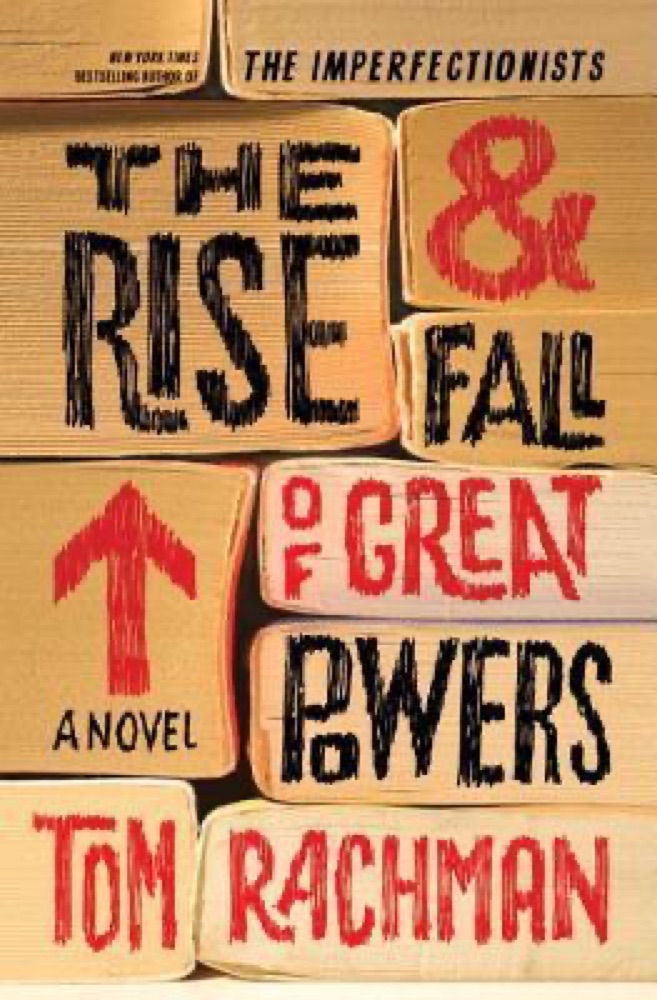
The Rise & Fall of Great Powers begins in a dusty bookshop. What follows is an abduction, heated political debate, glimpses into strangers’ homes, and travel around the globe. It’s a novel of curious personalities, mystery, and lots of books: volumes that the characters collect, covet, steal.
Tooly Zylberberg, owner of a bookshop in the Welsh countryside, spends most of her life reading. Yet there’s one tale that never made sense: her own life. In childhood, she was spirited away from home, then raised around Asia, Europe and the United States. But who were the people who brought her up? And what ever happened to them?
There was Humphrey, a curmudgeon from Russia; there was the charming but tempestuous Sarah, who hailed from Kenya; and there was Venn, the charismatic leader who transformed Tooly forever. Until, quite suddenly, he vanished.
Years later, she has lost hope of ever
Book details
- First published
- 2014
- Author
- Tom Rachman
- Genre
- Fiction
- Goodreads rating
- 3.65 (8k ratings)
Keep reading
 Purity
 The Post-Birthday World
 Too Much Happiness: Stories
 Orient
 Table for Two
 Out of Oz
 NW
NW
 Speedboat
 The Brooklyn Follies
 Sixty Stories
 The Great Mistake
 A Map of Days
 Ragtime
 Gliff
Gliff
 Point Omega
 The Woman Who Died a Lot
 The Hour I First Believed
 Familiaris
 TransAtlantic
 Welcome to Braggsville
 Asymmetry
 The Story of the Lost Child
 A Fraction of the Whole
 Old Babes in the Wood: Stories
 Essays of E.B. White
 Winter
 Dream Count
 Varina
 We All Looked Up
 Past Imperfect
 The Book of Love
 Arm of the Sphinx
 Senlin Ascends
 Call for the Dead
 Authority
 The Cat's Table
 Fall; or, Dodge in Hell
 Red Mars
 The Fall of Babel
 Empire Falls
 The Testaments
 V.
V.
 The Quick and the Dead
 No One Is Talking About This
 The Gone-Away World
 Leviathan
 Enchantment
 Where Things Come Back
 Influx
 Leonard and Hungry Paul
 Another Country
 Lexicon
 Skinny Legs and All
 State of Wonder
 Rabbit Redux
 Canada
 Trust
Trust
 If It Bleeds
 The Diamond Age
 The Mandibles: A Family, 2029–2047