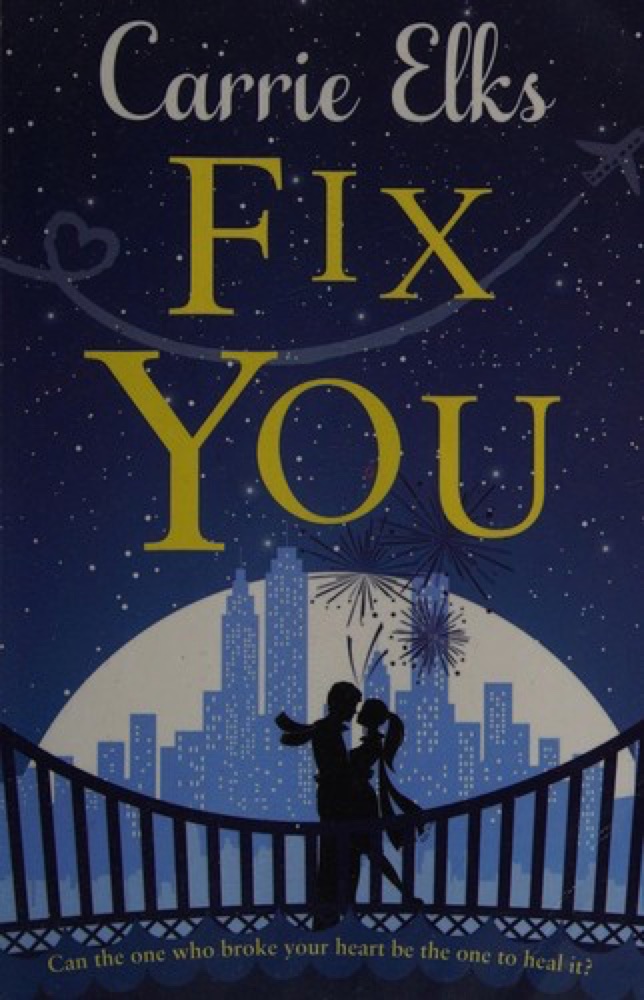

“Because it’s only ever been you.”
― Carrie Elks, quote from Fix You
“He burned with the need to hug her. But since their reconciliation they’d kept each other at arm’s length, as if they were both aware that to step into the murky waters of physical contact would break down the delicate dam they’d created.”
― Carrie Elks, quote from Fix You
“Richard.” Her voice was surprisingly strong. She could do this. She could tell him the truth, and then get the hell out of here.
Back on a plane.
Back home.
Back to him.
“Richard, we had a baby.”
― Carrie Elks, quote from Fix You
“It never ends, does it? Just when you think the hardest part is over, something else comes up to take its place.”
― Carrie Elks, quote from Fix You
“PS: Does room 101 contain your worst fear?”
― Carrie Elks, quote from Fix You
“They’d both made separate deals with the devil, promising not to step over the invisible line if it allowed them to be in each other’s lives. They’d made the mistake once before of trying to be lovers, and look how that turned out.”
― Carrie Elks, quote from Fix You
“Hanna’s quirkiness endeared her to him.”
― Carrie Elks, quote from Fix You
“He was the sun and she was in orbit; circling, attracted to him. Everything about him made her burn.”
― Carrie Elks, quote from Fix You
“Twenty thousand days and nights in one place, each layered and trapped and folded on top of the last, the creases in her hands, the aches between her vertebrae. Embryo, seed coat, endosperm: What is a seed if not the purest kind of memory, a link to every generation that has gone before it?”
― Anthony Doerr, quote from Memory Wall
“A regime that wraps itself in the flag of truth fears truth most of all, for if its story is falsified to the slightest degree, its authority is gone.”
― Orson Scott Card, quote from Pathfinder
“...my little blurb wasn't going to win me any speaker-of-the-year awards, but at least I hadn't tripped and fallen off the stage, crushing and killing three elderly jazz fans.”
― Jordan Sonnenblick, quote from Notes from the Midnight Driver
“A pen went scribbling along. When it tried to write love, it broke.”
― Rumi, quote from The Book of Love: Poems of Ecstasy and Longing
“Certainty is an unrealistic and unattainable ideal.
We need to have pastors who are schooled in apologetics and engaged intellectually with our culture so as to shepherd their flock amidst the wolves.
People who simply ride the roller coaster of emotional experience are cheating themselves out of a deeper and richer Christian faith by neglecting the intellectual side of that faith. They know little of the riches of deep understanding of Christian truth, of the confidence inspired by the discovery that one’s faith is logical and fits the facts of experience, and of the stability brought to one’s life by the conviction that one’s faith is objectively true.
God could not possibly have intended that reason should be the faculty to lead us to faith, for faith cannot hang indefinitely in suspense while reason cautiously weighs and reweighs arguments. The Scriptures teach, on the contrary, that the way to God is by means of the heart, not by means of the intellect.
When a person refuses to come to Christ, it is never just because of lack of evidence or because of intellectual difficulties: at root, he refuses to come because he willingly ignores and rejects the drawing of God’s Spirit on his heart. unbelief is at root a spiritual, not an intellectual, problem. Sometimes an unbeliever will throw up an intellectual smoke screen so that he can avoid personal, existential involvement with the gospel. In such a case, further argumentation may be futile and counterproductive, and we need to be sensitive to moments when apologetics is and is not appropriate.
A person who knows that Christianity is true on the basis of the witness of the Spirit may also have a sound apologetic which reinforces or confirms for him the Spirit’s witness, but it does not serve as the basis of his belief.
As long as reason is a minister of the Christian faith, Christians should employ it.
It should not surprise us if most people find our apologetic unconvincing. But that does not mean that our apologetic is ineffective; it may only mean that many people are closed-minded.
Without a divine lawgiver, there can be no objective right and wrong, only our culturally and personally relative, subjective judgments. This means that it is impossible to condemn war, oppression, or crime as evil. Nor can one praise brotherhood, equality, and love as good. For in a universe without God, good and evil do not exist—there is only the bare valueless fact of existence, and there is no one to say that you are right and I am wrong.
No atheist or agnostic really lives consistently with his worldview. In some way he affirms meaning, value, or purpose without an adequate basis. It is our job to discover those areas and lovingly show him where those beliefs are groundless.
We are witnesses to a mighty struggle for the mind and soul of America in our day, and Christians cannot be indifferent to it.
If moral values are gradually discovered, not invented, then our gradual and fallible apprehension of the moral realm no more undermines the objective reality of that realm than our gradual, fallible apprehension of the physical world undermines the objectivity of that realm.
God has given evidence sufficiently clear for those with an open heart, but sufficiently vague so as not to compel those whose hearts are closed.
Because of the need for instruction and personal devotion, these writings must have been copied many times, which increases the chances of preserving the original text. In fact, no other ancient work is available in so many copies and languages, and yet all these various versions agree in content. The text has also remained unmarred by heretical additions. The abundance of manuscripts over a wide geographical distribution demonstrates that the text has been transmitted with only trifling discrepancies.”
― William Lane Craig, quote from Reasonable Faith
BookQuoters is a community of passionate readers who enjoy sharing the most meaningful, memorable and interesting quotes from great books. As the world communicates more and more via texts, memes and sound bytes, short but profound quotes from books have become more relevant and important. For some of us a quote becomes a mantra, a goal or a philosophy by which we live. For all of us, quotes are a great way to remember a book and to carry with us the author’s best ideas.
We thoughtfully gather quotes from our favorite books, both classic and current, and choose the ones that are most thought-provoking. Each quote represents a book that is interesting, well written and has potential to enhance the reader’s life. We also accept submissions from our visitors and will select the quotes we feel are most appealing to the BookQuoters community.
Founded in 2023, BookQuoters has quickly become a large and vibrant community of people who share an affinity for books. Books are seen by some as a throwback to a previous world; conversely, gleaning the main ideas of a book via a quote or a quick summary is typical of the Information Age but is a habit disdained by some diehard readers. We feel that we have the best of both worlds at BookQuoters; we read books cover-to-cover but offer you some of the highlights. We hope you’ll join us.