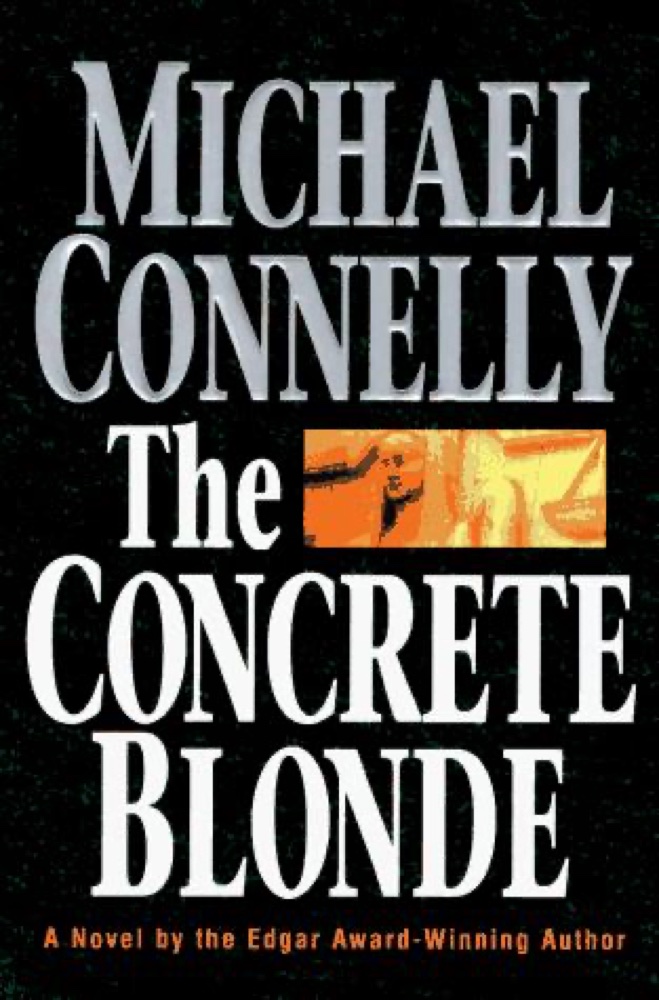


Quotes from The Concrete Blonde

Michael Connelly ·  484 pages

Rating: (39.7K votes)


“If the system turns away from the abuses inflicted on the guilty, then who can be next but the innocents?”
― Michael Connelly, quote from The Concrete Blonde


“I'm relaxed, Belk. I call it Zen and the art of not giving a shit.”
― Michael Connelly, quote from The Concrete Blonde


“That's justice," she said, nodding at the statue. "She doesn't hear you. She doesn't see you. She can't feel you and won't speak to you. Justice, Detective Bosch, is just a concrete blonde.”
― Michael Connelly, quote from The Concrete Blonde


“The house in Silverlake was dark, its windows as empty as a dead man’s eyes. It was an old California Craftsman with a full front porch and two dormer windows set on the long slope of the roof. But no light shone behind the glass, not even from above the doorway. Instead, the house cast a foreboding darkness about it that not even the glow from the streetlight could penetrate. A man could be standing there on the porch and Bosch knew he probably wouldn’t be able to see him. ‘You”
― Michael Connelly, quote from The Concrete Blonde


“That’s extortion,” Cerrone said. “No, asshole, that’s justice.”
― Michael Connelly, quote from The Concrete Blonde


“The black heart does not beat alone.”
― Michael Connelly, quote from The Concrete Blonde


“Whoever fights monsters should see to it that in the process he does not become a monster. And when you look into the abyss, the abyss also looks into you….”
― Michael Connelly, quote from The Concrete Blonde


“Nobody in this world is who they say they are. Nobody. Not when they’re in their own room with the door shut and locked. And nobody knows anybody, no matter what they think... The best you can hope for is to know yourself. And sometimes when you do, when you see your true self, you have to turn away.”
― Michael Connelly, quote from The Concrete Blonde


“To think about failure was to invite failure.”
― Michael Connelly, quote from The Concrete Blonde


“the best defense was a good lock or a mean dog. Or both.”
― Michael Connelly, quote from The Concrete Blonde


“Through political opportunism and ineptitude, the city had allowed the [police] department to languish for years as an understaffed and underequipped paramilitary organization. Infected with political bacteria itself, the department was top-heavy with managers while the ranks below were so thin that the dog soldiers on the street rarely had the time or inclination to step out of their protective machines, their cars, to meet the people they served. They only ventured out to deal with the dirtbags and consequently, Bosch knew, it had created a police culture in which everybody not in blue was seen as a dirtbag and was treated as such. Everybody.”
― Michael Connelly, quote from The Concrete Blonde


“In the morning, Bosch sat on the rear deck of his house and watched the sun come up over the Cahuenga Pass. It burned away the morning fog and bathed the wildflowers on the hillside that had burned the winter before. He watched and smoked and drank coffee until the sound of traffic on the Hollywood Freeway became one uninterrupted hiss from the pass below.”
― Michael Connelly, quote from The Concrete Blonde


About the author

Michael Connelly
Born place: in Philadelphia, Pennsylvania, The United States
See more on GoodReads

Popular quotes

“He was struck by the sensation she’d made it happen in some way, that his life was simply a story the old woman was making up in her head.”
― Michael Crummey, quote from Galore


“this reaction. This was on college campuses, exactly the kind of environment where I had expected curiosity, lively debate, and, yes, the thrill and energy of like-minded activists. Instead almost every campus audience I encountered bristled with anger and protest. I was accustomed to radical Muslim students from my experience as an activist and a politician in Holland. Any time I made a public speech, they would swarm to it in order to shout at me and rant in broken Dutch, in sentences so fractured you wondered how they qualified as students at all. On college campuses in the United States and Canada, by contrast, young and highly articulate people from the Muslim student associations would simply take over the debate. They would send e-mails of protest to the organizers beforehand, such as one (sent by a divinity student at Harvard) that protested that I did not “address anything of substance that actually affects Muslim women’s lives” and that I merely wanted to “trash” Islam. They would stick up posters and hand out pamphlets at the auditorium. Before I’d even stopped speaking they’d be lining up for the microphone, elbowing away all non-Muslims. They spoke in perfect English; they were mostly very well-mannered; and they appeared far better assimilated than their European immigrant counterparts. There were far fewer bearded young men in robes short enough to show their ankles, aping the tradition that says the Prophet’s companions dressed this way out of humility, and fewer girls in hideous black veils. In the United States a radical Muslim student might have a little goatee; a girl may wear a light, attractive headscarf. Their whole demeanor was far less threatening, but they were omnipresent. Some of them would begin by saying how sorry they were for all my terrible suffering, but they would then add that these so-called traumas of mine were aberrant, a “cultural thing,” nothing to do with Islam. In blaming Islam for the oppression of women, they said, I was vilifying them personally, as Muslims. I had failed to understand that Islam is a religion of peace, that the Prophet treated women very well. Several times I was informed that attacking Islam only serves the purpose of something called “colonial feminism,” which in itself was allegedly a pretext for the war on terror and the evil designs of the U.S. government. I was invited to one college to speak as part of a series of”
― Ayaan Hirsi Ali, quote from Nomad: From Islam to America: A Personal Journey Through the Clash of Civilizations


“Before drawing any affirmative conclusions let us first note the absence of the concept of imitation as a general pastoral or moral guideline. There is in the New Testament no Franciscan glorification of barefoot itinerancy. Even when Paul argues the case for celibacy, it does not occur to him to appeal to the example of Jesus. Even when Paul explains his own predilection for self-support there is no appeal to Jesus' years of village artisan. Even when the Apostle argues strongly the case for his teaching authority, there is no appeal to the rabbinic ministry of Jesus. Jesus' trade as a carpenter, his association with fishermen, and his choice of illustrations from the life of the sower and the shepherd have through Christian history given momentum to the romantic glorification of the handcrafts and the rural life; but there is none of this in the New Testament, which testifies throughout to the life and mission of a church going intentionally into the cities in full knowledge of the conflicts which awaited here there. That the concept of imitation is not applied by the New Testament at some of those points where Franciscan and romantic devotion has tried most piously to apply it, is all the more demonstration of how fundamental the thought of participation in the suffering of Christ is when the New Testament church sees it as guiding and explaining her attitude to the powers of the world. Only at one point, only on one subject - but then consistently, universally - is Jesus our example: in his cross.”
― John Howard Yoder, quote from The Politics of Jesus


“(The Kiowa didn’t scalp, and the real Mescalero did not live in pueblos, but factual accuracy, for May, was something that happened to other writers).”
― quote from The Encyclopedia of Fantastic Victoriana


“He's in his circle, and I'm in mine, and we just go around and around.”
― Jen Calonita, quote from Broadway Lights


Interesting books

Come Away with Me
(53.8K)
Come Away with Me
by Kristen Proby
Skin Game
(56.3K)
Skin Game
by Jim Butcher
The Orenda
(13.2K)
The Orenda
by Joseph Boyden
Fire and Hemlock
(8.1K)
Fire and Hemlock
by Diana Wynne Jones
Giles Goat-Boy
(1.8K)
Giles Goat-Boy
by John Barth
Chronicles, Volume One
(40.9K)
Chronicles, Volume O...
by Bob Dylan

About BookQuoters

BookQuoters is a community of passionate readers who enjoy sharing the most meaningful, memorable and interesting quotes from great books. As the world communicates more and more via texts, memes and sound bytes, short but profound quotes from books have become more relevant and important. For some of us a quote becomes a mantra, a goal or a philosophy by which we live. For all of us, quotes are a great way to remember a book and to carry with us the author’s best ideas.

We thoughtfully gather quotes from our favorite books, both classic and current, and choose the ones that are most thought-provoking. Each quote represents a book that is interesting, well written and has potential to enhance the reader’s life. We also accept submissions from our visitors and will select the quotes we feel are most appealing to the BookQuoters community.

Founded in 2023, BookQuoters has quickly become a large and vibrant community of people who share an affinity for books. Books are seen by some as a throwback to a previous world; conversely, gleaning the main ideas of a book via a quote or a quick summary is typical of the Information Age but is a habit disdained by some diehard readers. We feel that we have the best of both worlds at BookQuoters; we read books cover-to-cover but offer you some of the highlights. We hope you’ll join us.