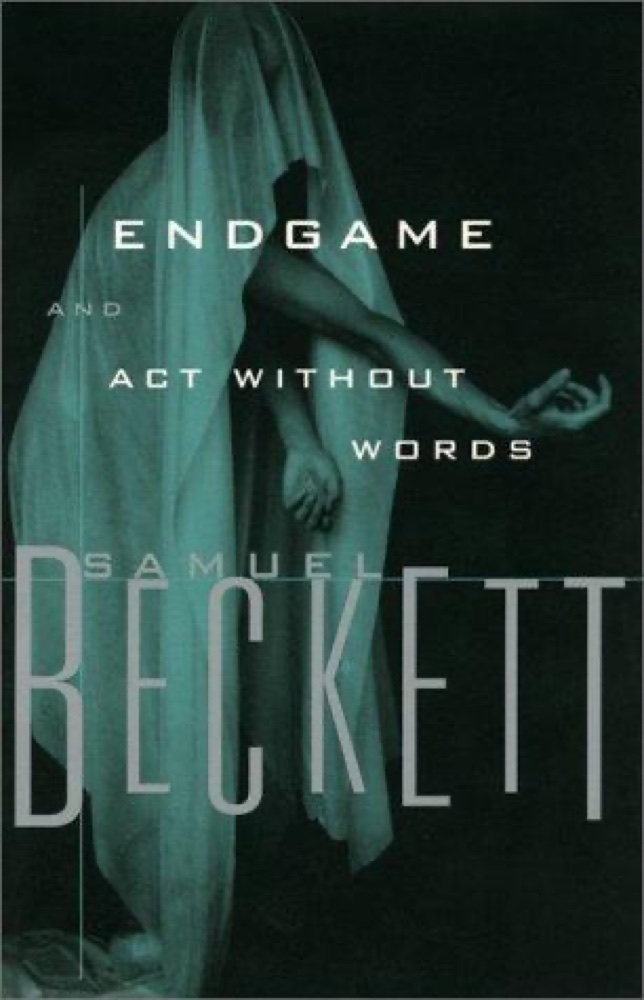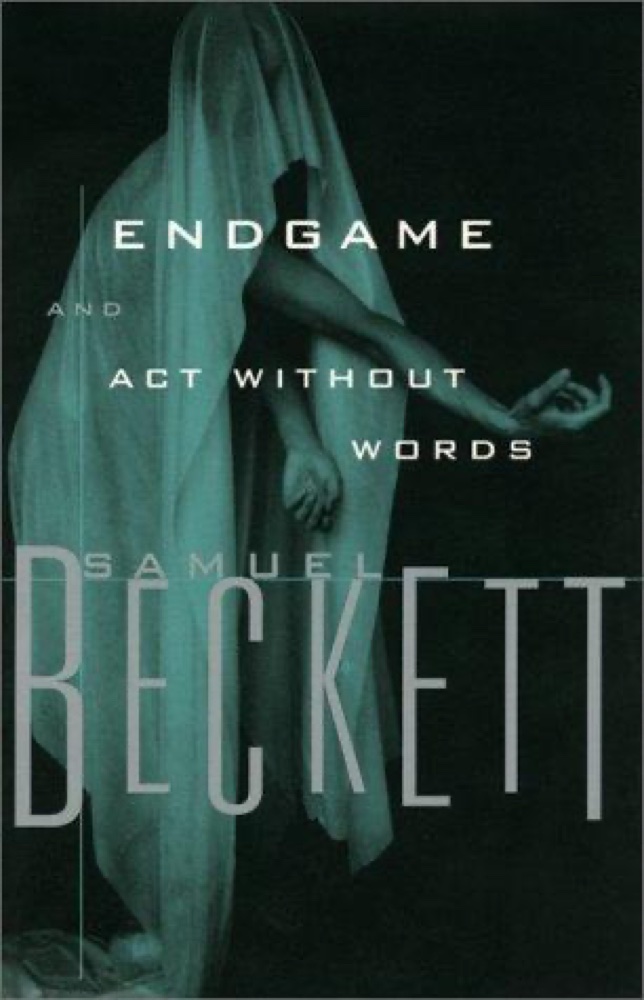


Quotes from Endgame & Act Without Words

Samuel Beckett ·  96 pages

Rating: (8.4K votes)


“CLOV:
Do you believe in the life to come?
HAMM:
Mine was always that.”
― Samuel Beckett, quote from Endgame & Act Without Words


“HAMM
Open the window.
CLOV
What for?
HAMM
I want to hear the sea.
CLOV
You wouldn't hear it.
HAMM Even if you opened the window?
CLOV
No.
HAMM
Then it's not worth opening it?
CLOV
No.
HAMM(violently)
Then open it!”
― Samuel Beckett, quote from Endgame & Act Without Words


“You weep, and weep, for nothing, so as not to laugh, and little by little . . . you begin to grieve.”
― Samuel Beckett, quote from Endgame & Act Without Words


“CLOV [sadly] No one that ever lived ever thought so crooked as we.”
― Samuel Beckett, quote from Endgame & Act Without Words


“There’s something dripping in my head. [Pause.] A heart, a heart in my head.”
― Samuel Beckett, quote from Endgame & Act Without Words


“One day you’ll say to yourself, I’m tired, I’ll sit down, and you’ll go and sit down. Then you’ll say, I’m hungry, I’ll get up and get something to eat. But you won’t get up. You’ll say, I shouldn’t have sat down, but since I have I’ll sit on a little longer, then I’ll get up and get something to eat. But you won’t get up and you won’t get anything to eat. [Pause.] You’ll look at the wall a while, then you’ll say, I’ll close my eyes, perhaps have a little sleep, after that I’ll feel better, and you’ll close them. And when you open them again there’ll be no wall any more. [Pause.] Infinite emptiness will be all around you, all the resurrected dead of all the ages wouldn’t fill it, and there you’ll be like a little bit of grit in the middle of the steppe. [Pause.]”
― Samuel Beckett, quote from Endgame & Act Without Words


“I open the door of the cell and go. I am so bowed I only see my feet, if I open my eyes, and between my legs a little trail of black dust. I say to myself that the earth is extinguished, though I never saw it lit.”
― Samuel Beckett, quote from Endgame & Act Without Words


About the author

Samuel Beckett
Born place: in Foxrock (Dublin), Ireland
Born date April 13, 1906
See more on GoodReads

Popular quotes

“It was the excitement, the richness of the whole experience, the mixture of pleasure and danger and freedom and the sun. You know, when we came back here, for a long while I still went on living in Euphoria inside my head. Outwardly I returned to my old routine. I got up in the morning, put on a tweed suit, read the Guardian over breakfast, walked into the University, gave the same old tutorials on the same old texts... and all the while I was leading a completely different life inside my head. Inside my head, I had decided not to come back to England, so I was waking up in Plotinus, sitting in the sun in my happi-coat, looking out over the Bay, putting on Levis and a sports shirt, reading the Euphoric Times over breakfast, and wondering what would happen today, would there be a protest, a demonstration, would my class have to fight their way through teargas and picket lines or should we meet off-campus in somebody's apartment, sitting on the floor surrounded by posters and leaflets and paperbacks about encounter groups and avant garde theatre and Viet Nam.”
― David Lodge, quote from Small World


“We come into contact with people only with our exteriors—physically and externally; yet each of us walks about with a great wealth of interior life, a private and secret self. We are, in reality, somewhat split in two, the self and the body; the one hidden, the other open. The child learns very quickly to cultivate this private self
because it puts a barrier between him and the demands of the world. He learns he can keep secrets—at first an excruciating, intolerable burden: it seems that the outer world has every right to penetrate into his self and that the parents could automatically do so if they wished—they always seem to know just what he is thinking and feeling. But then he discovers that he can lie and not be found out: it is a
great and liberating moment, this anxious first lie—it represents the staking out of his claim to an integral inner self, free from the prying eyes of the world. By the time we grow up we become masters at dissimulation, at cultivating a self that the world cannot probe. But we pay a price. After years of turning people away,
of protecting our inner self, of cultivating it by living in a different world, of furnishing this world with our fantasies and dreams—we find that we are hopelessly separated from everyone else. We have become victims of our own art. We touch people on the outsides of their bodies, and they us, but we cannot get at their insides and cannot reveal our insides to them. This is one of the great tragedies of our interiority—it is utterly personal and unrevealable. Often we want to say something unusually intimate to a spouse, a parent, a friend, communicate
something of how we are really feeling about a sunset, who we really feel we are—only to fall strangely and miserably flat. Once in a great while we succeed, sometimes more with one person, less or never with others. But the occasional breakthrough only proves the rule. You reach out with a disclosure, fail, and fall back bitterly into yourself. We emit huge globs of love to our parents and spouses, and the glob slithers away in exchanges of words that are somehow beside the point of what we are trying to say. People seem to keep bumping up against each other with their exteriors and falling away from each other. The cartoonist Jules Feiffer is the modern master of this aspect of the human tragedy. Take even the sexual act—the most intimate merger given to organisms. For most people, even for their entire lives, it is simply a joining of exteriors. The insides melt only in the moment of orgasm, but even this is brief, and a melting is not a communication. It is a physical overcoming of separateness, not a symbolic revelation and justification of one’s interior. Many people pursue sex precisely because it is a mystique of the overcoming of the separateness of the inner world; and they go from one partner to another because they can never quite achieve “it.” So the endless interrogations: “What are you thinking about right now—me? Do you feel what I feel? Do you love me?”
― Ernest Becker, quote from The Birth and Death of Meaning: An Interdisciplinary Perspective on the Problem of Man


“Although he was a young and virile man at 37, he was not inexhaustible. In addition to food and drink, he had better lay in a couple thousand tablets of viagra. The drug would probably remain potent if he vacuum packed the pills in groups of 10 and kept them in a freezer. That would work unless civilization completely collapsed and power companies were unable to function. Fortunately, Jim had a propane-powered backup generator with half a dozen tanks of fuel already on hand. If Henry added to the propane supply, and he used the generator only for essential maintenance like keeping the viagra freezer operating in warm weather, he would be happy here on the farm for a looong, looong time. Unless, even now, dead Jim was out there in the generator shed sabotaging the machinery.”
― Dean Koontz, quote from Breathless


“Well, you look like something the cat dragged in,” he remarked, immediately laying a hand on the warrior’s forehead and closing his eyes in order to assess the damage done to the warrior’s abused body.
Gideon did not understand why Elijah found his remark so terribly funny, but the warrior was laughing so hard that his nurse pinched him in the arm to stop him.
“I can’t keep pressure with your chest bobbing up and down. Besides, Gideon will never be that funny,” she said, giving him a cockeyed look.”
― Jacquelyn Frank, quote from Elijah


“Uncle alone in the house with the children said he'd dress up to amuse them. After a long wait, as he did not appear, they went down and saw a masked man putting the table silver into a bag. 'Oh, Uncle,' they cried in delight. 'Yes, isn't my make-up good?' said Uncle, taking his mask off. Thus goes the Hegelian syllogism of humour. Thesis: Uncle made himself up as a burglar (a laugh for the children); antithesis: it WAS a burglar (a laugh for the reader); synthesis: it still was Uncle (fooling the reader).”
― Vladimir Nabokov, quote from Laughter in the Dark


Interesting books

The Snowden Files: The Inside Story of the World's Most Wanted Man
(3.2K)
The Snowden Files: T...
by Luke Harding
Single White Vampire
(19.2K)
Single White Vampire
by Lynsay Sands
Forest Mage
(14.2K)
Forest Mage
by Robin Hobb
The Dying Earth
(6.2K)
The Dying Earth
by Jack Vance
The Ugly Duckling
(34.2K)
The Ugly Duckling
by Hans Christian Andersen
Hidden Currents
(9.2K)
Hidden Currents
by Christine Feehan

About BookQuoters

BookQuoters is a community of passionate readers who enjoy sharing the most meaningful, memorable and interesting quotes from great books. As the world communicates more and more via texts, memes and sound bytes, short but profound quotes from books have become more relevant and important. For some of us a quote becomes a mantra, a goal or a philosophy by which we live. For all of us, quotes are a great way to remember a book and to carry with us the author’s best ideas.

We thoughtfully gather quotes from our favorite books, both classic and current, and choose the ones that are most thought-provoking. Each quote represents a book that is interesting, well written and has potential to enhance the reader’s life. We also accept submissions from our visitors and will select the quotes we feel are most appealing to the BookQuoters community.

Founded in 2023, BookQuoters has quickly become a large and vibrant community of people who share an affinity for books. Books are seen by some as a throwback to a previous world; conversely, gleaning the main ideas of a book via a quote or a quick summary is typical of the Information Age but is a habit disdained by some diehard readers. We feel that we have the best of both worlds at BookQuoters; we read books cover-to-cover but offer you some of the highlights. We hope you’ll join us.