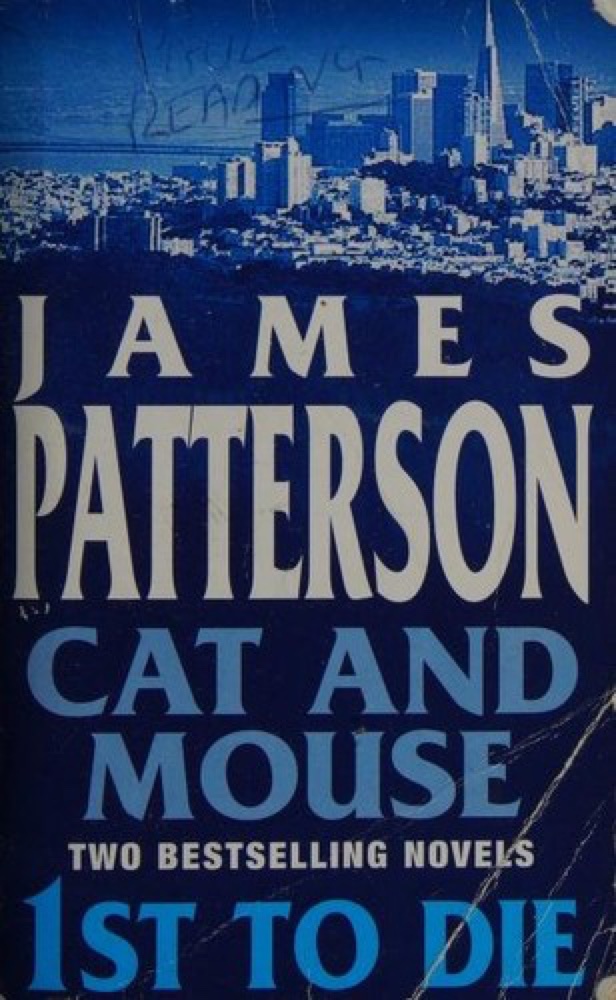

Quotes from Cat and Mouse

James Patterson ·  416 pages

Rating: (52.5K votes)


“Joy—that’s the word. So easy to say, so hard to find in life sometimes.”
― James Patterson, quote from Cat and Mouse


“Victory belongs to the player who makes the next-to-last mistake. Soneji”
― James Patterson, quote from Cat and Mouse


“of life’s important connections and mysteries. I was hoping that maybe someday she would”
― James Patterson, quote from Cat and Mouse


“Society prepares the crime; the criminal only commits it.”
― James Patterson, quote from Cat and Mouse


“Death is nature’s way of saying “howdy.” Statues”
― James Patterson, quote from Cat and Mouse


“Victory belongs to the player who makes the next-to-last mistake.”
― James Patterson, quote from Cat and Mouse


“The Chinese had a saying that had been in her mind for a while, troubling her: Society prepares the crime; the criminal only commits it.”
― James Patterson, quote from Cat and Mouse


“A FLAT, still sandy, still meadowy region… a superb range of ocean beach—miles and miles of it. The bright sun, the sparkling waves, the foam, the view—a sail here and there in the distance. Walt Whitman had written that”
― James Patterson, quote from Cat and Mouse


About the author

James Patterson
Born place: in Newburgh, New York, The United States
See more on GoodReads

Popular quotes

“Nobody has a more sacred obligation to obey the law than those who make the law.”
― Sophocles, quote from Antigone


“Why hasn't anyone killed him yet?”
“Dumb luck,” Wit said. “In that I’m lucky you’re all so dumb.”
― Brandon Sanderson, quote from Words of Radiance


“Edgar, do you actually think that how long a person grieves is a measure of how much they loved someone? There's no rule book that says how to do this." She laughed, bitterly. "Wouldn't that be great? No decisions to make. Everything laid right out for us. But there's no such thing. You want facts, don't you? Rules. Proof. You're like your father that way. Just because a thing can't be logged, charted, and summarized doesn't mean it isn't real. Half the time we walk around in love with the idea of a thing instead of the reality of it. But sometimes things don't turn out that way. You have to pay attentin to what's real, what's in the world. Not some imaginary alternative, as if it's a choice we could make.”
― David Wroblewski, quote from The Story of Edgar Sawtelle


“The news filled me with such euphoria that for an instant I was numb. My ingrained self-censorship immediately started working: I registered the fact that there was an orgy of weeping going on around me, and that I had to come up with some suitable performance. There seemed nowhere to hide my lack of correct emotion except the shoulder of the woman in front of me, one of the student officials, who was apparently heartbroken. I swiftly buried my head in her shoulder and heaved appropriately. As so often in China, a bit of ritual did the trick. Sniveling heartily she made a movement as though she was going to turn around and embrace me I pressed my whole weight on her from behind to keep her in her place, hoping to give the impression that I was in a state of abandoned grief.

In the days after Mao's death, I did a lot of thinking. I knew he was considered a philosopher, and I tried to think what his 'philosophy' really was. It seemed to me that its central principle was the need or the desire? for perpetual conflict. The core of his thinking seemed to be that human struggles were the motivating force of history and that in order to make history 'class enemies' had to be continuously created en masse. I wondered whether there were any other philosophers whose theories had led to the suffering and death of so many. I thought of the terror and misery to which the Chinese population had been subjected. For what?

But Mao's theory might just be the extension of his personality. He was, it seemed to me, really a restless fight promoter by nature, and good at it. He understood ugly human instincts such as envy and resentment, and knew how to mobilize them for his ends. He ruled by getting people to hate each other. In doing so, he got ordinary Chinese to carry out many of the tasks undertaken in other dictatorships by professional elites. Mao had managed to turn the people into the ultimate weapon of dictatorship.

That was why under him there was no real equivalent of the KGB in China. There was no need. In bringing out and nourishing the worst in people, Mao had created a moral wasteland and a land of hatred. But how much individual responsibility ordinary people should share, I could not decide.

The other hallmark of Maoism, it seemed to me, was the reign of ignorance. Because of his calculation that the cultured class were an easy target for a population that was largely illiterate, because of his own deep resentment of formal education and the educated, because of his megalomania, which led to his scorn for the great figures of Chinese culture, and because of his contempt for the areas of Chinese civilization that he did not understand, such as architecture, art, and music, Mao destroyed much of the country's cultural heritage. He left behind not only a brutalized nation, but also an ugly land with lit He of its past glory remaining or appreciated.

The Chinese seemed to be mourning Mao in a heartfelt fashion. But I wondered how many of their tears were genuine. People had practiced acting to such a degree that they confused it with their true feelings. Weeping for Mao was perhaps just another programmed act in their programmed lives.

Yet the mood of the nation was unmistakably against continuing Mao's policies. Less than a month after his death, on 6 October, Mme Mao was arrested, along with the other members of the Gang of Four. They had no support from anyone not the army, not the police, not even their own guards. They had had only Mao. The Gang of Four had held power only because it was really a Gang of Five.

When I heard about the ease with which the Four had been removed, I felt a wave of sadness. How could such a small group of second-rate tyrants ravage 900 million people for so long? But my main feeling was joy. The last tyrants of the Cultural Revolution were finally gone.”
― Jung Chang, quote from Wild Swans: Three Daughters of China


“I can awaken things inside you that have been sleeping all your life. You're strong enough to live in the dark, to glory in it. You can become a queen of the shadows. Why not take that power, Elena? Let me help you take it.”
― L.J. Smith, quote from The Awakening / The Struggle


Interesting books

First Grave on the Right
(61.5K)
First Grave on the R...
by Darynda Jones
Gaudy Night
(18.3K)
Gaudy Night
by Dorothy L. Sayers
London
(22.2K)
London
by Edward Rutherfurd
The Girl Who Loved Tom Gordon
(108.2K)
The Girl Who Loved T...
by Stephen King
Let the Great World Spin
(82.2K)
Let the Great World...
by Colum McCann
The Novice
(40.8K)
The Novice
by Trudi Canavan

About BookQuoters

BookQuoters is a community of passionate readers who enjoy sharing the most meaningful, memorable and interesting quotes from great books. As the world communicates more and more via texts, memes and sound bytes, short but profound quotes from books have become more relevant and important. For some of us a quote becomes a mantra, a goal or a philosophy by which we live. For all of us, quotes are a great way to remember a book and to carry with us the author’s best ideas.

We thoughtfully gather quotes from our favorite books, both classic and current, and choose the ones that are most thought-provoking. Each quote represents a book that is interesting, well written and has potential to enhance the reader’s life. We also accept submissions from our visitors and will select the quotes we feel are most appealing to the BookQuoters community.

Founded in 2023, BookQuoters has quickly become a large and vibrant community of people who share an affinity for books. Books are seen by some as a throwback to a previous world; conversely, gleaning the main ideas of a book via a quote or a quick summary is typical of the Information Age but is a habit disdained by some diehard readers. We feel that we have the best of both worlds at BookQuoters; we read books cover-to-cover but offer you some of the highlights. We hope you’ll join us.