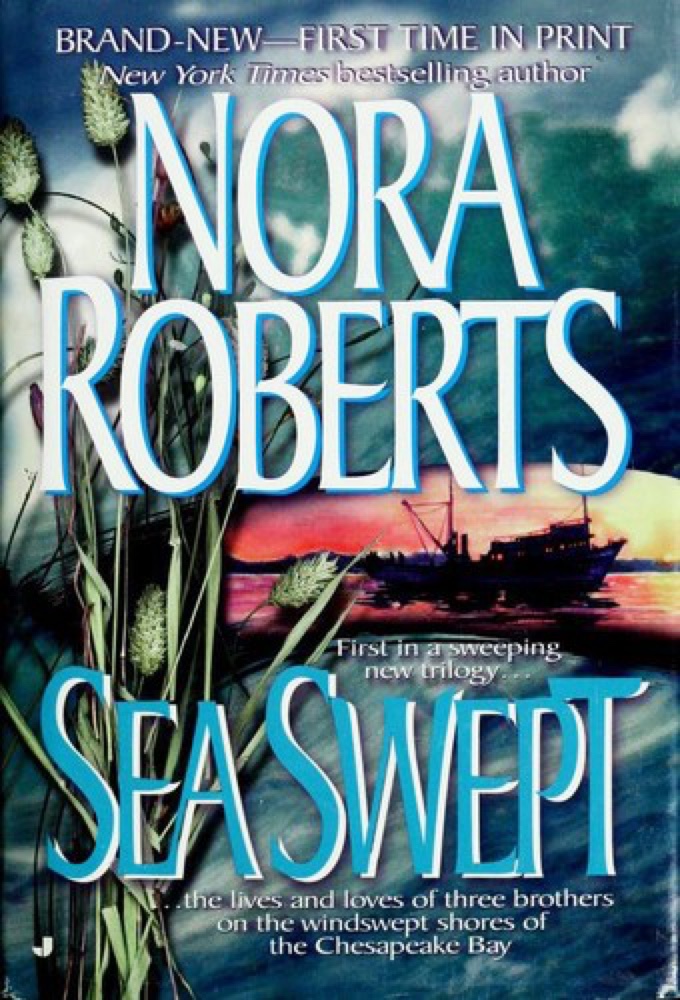


“Love is not enough. But, it is the rock on which all else stands.”
― Nora Roberts, quote from Blood Brothers
“What was your secret?"
That brought another smile. "Learn to laugh, otherwise, you'll beat them to death with a hammer first chance”
― Nora Roberts, quote from Blood Brothers
“Is your dog in a coma?" Quinn asked when the dog didn't move a muscle.
"No. Lump leads an active and demanding internal life that requires long periods of rest.”
― Nora Roberts, quote from Blood Brothers
“Cybil pushed to her feet. "If he hurts her, I'll twist off his dick and feed it to his dog." With that, she stormed out of the room.
"She's a little scary," Fox decided.
"She's not the only one. I'm the one who'll be roasting his balls for dessert." Layla headed out behind Cybil. "I have to find something to make for dinner."
"Oddly, I don't have much of an appetite right now." Fox glanced at Gage. "How about you?”
― Nora Roberts, quote from Blood Brothers
“Porque siempre sabes donde estan las llaves de tu coche y porque puedes pensar en diez cosas a la vez. Porque no te echas para atras y porque tu cabello es como los rayos del sol. Porque dices la verdad y porque sabes como ser buena amiga. Y por miles de razones que todavia no he descubierto. Y por otros cientos que puede ser que nunca descubra. Pero se que te puedo decir lo que nunca pense podría decirselo a nadie.”
― Nora Roberts, quote from Blood Brothers
“HESTER’S POOL WAS ALSO FORBIDDEN IN CAL’S world, which was only one of the reasons it was irresistible.”
― Nora Roberts, quote from Blood Brothers
“There is something about a mass-market Luxury Cruise that's unbearably sad. Like most unbearably sad things, it seems incredibly elusive and complex in its causes and simple in its effect: on board the Nadir—especially at night—I felt despair. The wor's overused and banalified now, despair, but it's a serious word, and I'm using it seriously.”
― David Foster Wallace, quote from A Supposedly Fun Thing I'll Never Do Again: Essays and Arguments
“POLLARD had known better, but instead of pulling rank and insisting that his officers carry out his proposal to sail for the Society Islands, he embraced a more democratic style of command. Modern survival psychologists have determined that this “social”—as opposed to “authoritarian”—form of leadership is ill suited to the early stages of a disaster, when decisions must be made quickly and firmly. Only later, as the ordeal drags on and it is necessary to maintain morale, do social leadership skills become important. Whalemen in the nineteenth century had a clear understanding of these two approaches. The captain was expected to be the authoritarian, what Nantucketers called a fishy man. A fishy man loved to kill whales and lacked the tendency toward self-doubt and self-examination that could get in the way of making a quick decision. To be called “fishy to the backbone” was the ultimate compliment a Nantucketer could receive and meant that he was destined to become, if he wasn’t already, a captain. Mates, however, were expected to temper their fishiness with a more personal, even outgoing, approach. After breaking in the green hands at the onset of the voyage—when they gained their well-deserved reputations as “spit-fires”—mates worked to instill a sense of cooperation among the men. This required them to remain sensitive to the crew’s changeable moods and to keep the lines of communication open. Nantucketers recognized that the positions of captain and first mate required contrasting personalities. Not all mates had the necessary edge to become captains, and there were many future captains who did not have the patience to be successful mates. There was a saying on the island: “[I]t is a pity to spoil a good mate by making him a master.” Pollard’s behavior, after both the knockdown and the whale attack, indicates that he lacked the resolve to overrule his two younger and less experienced officers. In his deference to others, Pollard was conducting himself less like a captain and more like the veteran mate described by the Nantucketer William H. Macy: “[H]e had no lungs to blow his own trumpet, and sometimes distrusted his own powers, though generally found equal to any emergency after it arose. This want of confidence sometimes led him to hesitate, where a more impulsive or less thoughtful man would act at once. In the course of his career he had seen many ‘fishy’ young men lifted over his head.” Shipowners hoped to combine a fishy, hard-driving captain with an approachable and steady mate. But in the labor-starved frenzy of Nantucket in 1819, the Essex had ended up with a captain who had the instincts and soul of a mate, and a mate who had the ambition and fire of a captain. Instead of giving an order and sticking with it, Pollard indulged his matelike tendency to listen to others. This provided Chase—who had no qualms about speaking up—with the opportunity to impose his own will. For better or worse, the men of the Essex were sailing toward a destiny that would be determined, in large part, not by their unassertive captain but by their forceful and fishy mate.”
― Nathaniel Philbrick, quote from In the Heart of the Sea: The Tragedy of the Whaleship Essex
“That evening it was announced that curfew would be postponed until midnight, so that the families of those ‘sent for labour’ would have time to bring them blankets, a change of underwear and food for the journey. This ‘magnanimity’ on the part of the Germans was truly touching, and the Jewish police made much of it in an effort to win our confidence. Not until much later did I learn that the thousand men rounded up in the ghetto had been taken straight to the camp at Treblinka, so that the Germans could test the efficiency of the newly built gas chambers and crematorium furnaces.”
― Władysław Szpilman, quote from The Pianist: The Extraordinary Story of One Man's Survival in Warsaw, 1939–45
“If you wish to draw profit, read with humility, simplicity, and faith, and never with the design of gaining a reputation for learning.”
― Thomas à Kempis, quote from The Imitation of Christ
“Kell has only two faces. The one he wears for the world at large, and the one he wears for those he loves.” He sipped his wine.
“For us.” Lila’s expression hardened. “Whatever he feels for me, it isn’t love.”
“Because it isn’t soft and sweet and doting?” Rhy rocked back, stretching against the pillar. “Do you know how many times he’s nearly beat me senseless out of love? How many times I’ve done the same? I’ve seen the way he looks at those he hates …” He shook his head. “There are very few things my brother cares about, and even fewer people.”
― V.E. Schwab, quote from A Gathering of Shadows
BookQuoters is a community of passionate readers who enjoy sharing the most meaningful, memorable and interesting quotes from great books. As the world communicates more and more via texts, memes and sound bytes, short but profound quotes from books have become more relevant and important. For some of us a quote becomes a mantra, a goal or a philosophy by which we live. For all of us, quotes are a great way to remember a book and to carry with us the author’s best ideas.
We thoughtfully gather quotes from our favorite books, both classic and current, and choose the ones that are most thought-provoking. Each quote represents a book that is interesting, well written and has potential to enhance the reader’s life. We also accept submissions from our visitors and will select the quotes we feel are most appealing to the BookQuoters community.
Founded in 2023, BookQuoters has quickly become a large and vibrant community of people who share an affinity for books. Books are seen by some as a throwback to a previous world; conversely, gleaning the main ideas of a book via a quote or a quick summary is typical of the Information Age but is a habit disdained by some diehard readers. We feel that we have the best of both worlds at BookQuoters; we read books cover-to-cover but offer you some of the highlights. We hope you’ll join us.