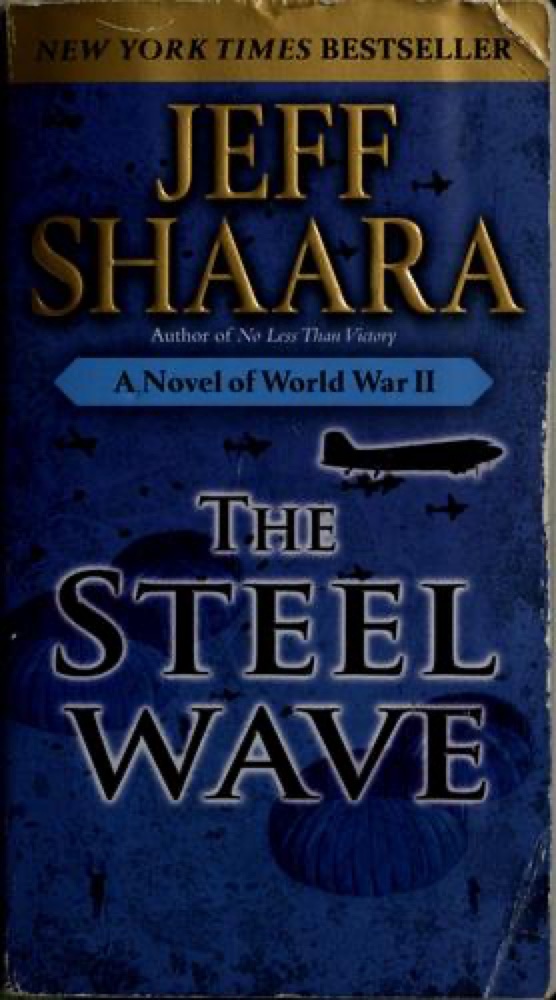

“We had a tough fight here, but dammit, we’re getting the job done. The First and the Twenty-ninth took heavy casualties all day yesterday, and they’re still taking them now.”
― Jeff Shaara, quote from The Steel Wave
“annoyance, Eisenhower knew that the prolonged”
― Jeff Shaara, quote from The Steel Wave
“Dammit, you’ve got a job to do! He tried to pull energy—confidence—from the faces of the others, even from men who had never done this before.”
― Jeff Shaara, quote from The Steel Wave
“He slapped one hand against the breech of the Thompson, slapped again, pulsing frustration, and said aloud, “Dammit!”
― Jeff Shaara, quote from The Steel Wave
“knows where he is now. Not here, that’s for sure. Hope the Krauts didn’t grab him. Buford…Dammit!”
― Jeff Shaara, quote from The Steel Wave
“have to know, he thought. I have to get out there and talk to people and see for myself. But there’s nothing I can do now, and, dammit, I need some sleep.”
― Jeff Shaara, quote from The Steel Wave
“Too far! Dammit, I need a rifle! But his own men were answering, the M-1s close beside him opening up. “I got one! I got one!” Marley’s”
― Jeff Shaara, quote from The Steel Wave
“Case in point: Warnings on cigarette packages can increase a smoker’s urge to light up. A 2009 study found that death warnings trigger stress and fear in smokers—exactly what public health officials hope for. Unfortunately, this anxiety then triggers smokers’ default stress-relief strategy: smoking. Oops. It isn’t logical, but it makes sense based on what we know about how stress influences the brain. Stress triggers cravings and makes dopamine neurons even more excited by any temptation in sight. It doesn’t help that the smoker is—of course—staring at a pack of cigarettes as he reads the warning. So even as a smoker’s brain encodes the words “WARNING: Cigarettes cause cancer” and grapples with awareness of his own mortality, another part of his brain starts screaming, “Don’t worry, smoking a cigarette will make you feel better!”
― Kelly McGonigal, quote from The Willpower Instinct: How Self-Control Works, Why It Matters, and What You Can Do to Get More of It
“When sleep came, I would dream bad dreams. Not the baby and the big man with a cigarette-lighter dream. Another dream. The castle dream.
A little girl of about six who looks -like me, but isn’t me, is happy as she steps out of the car with her daddy. They enter the castle and go down the steps to the dungeon where people move like shadows in the glow of burning candles. There are carpets and funny pictures on the walls. Some of the people wear hoods and robes. Sometimes they chant in droning voices that make the little girl afraid. There are other children, some of them without any clothes on. There is an altar like the altar in nearby St Mildred’s Church. The children take turns lying on that altar so the people, mostly men, but a few women, can kiss and lick their private parts. The daddy holds the hand of the little girl tightly. She looks up at him and he smiles. The little girl likes going out with her daddy.
I did want to tell Dr Purvis these dreams but I didn’t want her to think I was crazy, and so kept them to myself. The psychiatrist was wiser than I appreciated at the time; sixteen-year-olds imagine they are cleverer than they really are. Dr Purvis knew I had suffered psychological damage as a child, that’s why she kept making a fresh appointment week after week. But I was unable to give her the tools and clues to find out exactly what had happened.”
― quote from Today I'm Alice: Nine Personalities, One Tortured Mind
“What is the use of beauty in woman? Provided a woman is physically well made and capable of bearing children, she will always be good enough in the opinion of economists.
What is the use of music? -- of painting? Who would be fool enough nowadays to prefer Mozart to Carrel, Michael Angelo to the inventor of white mustard?
There is nothing really beautiful save what is of no possible use. Everything useful is ugly, for it expresses a need, and man's needs are low and disgusting, like his own poor, wretched nature. The most useful place in a house is the water-closet.
For my part, saving these gentry's presence, I am of those to whom superfluities are necessaries, and I am fond of things and people in inverse ratio to the service they render me. I prefer a Chinese vase with its mandarins and dragons, which is perfectly useless to me, to a utensil which I do use, and the particular talent of mine which I set most store by is that which enables me not to guess logogriphs and charades. I would very willingly renounce my rights as a Frenchman and a citizen for the sight of an undoubted painting by Raphael, or of a beautiful nude woman, -- Princess Borghese, for instance, when she posed for Canova, or Julia Grisi when she is entering her bath. I would most willingly consent to the return of that cannibal, Charles X., if he brought me, from his residence in Bohemia, a case of Tokai or Johannisberg; and the electoral laws would be quite liberal enough, to my mind, were some of our streets broader and some other things less broad. Though I am not a dilettante, I prefer the sound of a poor fiddle and tambourines to that of the Speaker's bell. I would sell my breeches for a ring, and my bread for jam. The occupation which best befits civilized man seems to me to be idleness or analytically smoking a pipe or cigar. I think highly of those who play skittles, and also of those who write verse. You may perceive that my principles are not utilitarian, and that I shall never be the editor of a virtuous paper, unless I am converted, which would be very comical.
Instead of founding a Monthyon prize for the reward of virtue, I would rather bestow -- like Sardanapalus, that great, misunderstood philosopher -- a large reward to him who should invent a new pleasure; for to me enjoyment seems to be the end of life and the only useful thing on this earth. God willed it to be so, for he created women, perfumes, light, lovely flowers, good wine, spirited horses, lapdogs, and Angora cats; for He did not say to his angels, 'Be virtuous,' but, 'Love,' and gave us lips more sensitive than the rest of the skin that we might kiss women, eyes looking upward that we might behold the light, a subtile sense of smell that we might breathe in the soul of the flowers, muscular limbs that we might press the flanks of stallions and fly swift as thought without railway or steam-kettle, delicate hands that we might stroke the long heads of greyhounds, the velvety fur of cats, and the polished shoulder of not very virtuous creatures, and, finally, granted to us alone the triple and glorious privilege of drinking without being thirsty, striking fire, and making love in all seasons, whereby we are very much more distinguished from brutes than by the custom of reading newspapers and framing constitutions.”
― Théophile Gautier, quote from Mademoiselle de Maupin
“Grown-ups never understand anything by themselves, and it is tiresome for children to be always and forever explaining things to them”
― Antoine de Saint-Exupéry, quote from Der kleine Prinz
“The vicious cycle starts: if you fail at something, you think it is your fault. Therefore you think you can’t do that task. As a result, next time you have to do the task, you believe you can’t, so you don’t even try. The result is that you can’t, just as you thought.”
― Donald A. Norman, quote from Design of Everyday Things: Revised and Expanded Edition (Revised)
BookQuoters is a community of passionate readers who enjoy sharing the most meaningful, memorable and interesting quotes from great books. As the world communicates more and more via texts, memes and sound bytes, short but profound quotes from books have become more relevant and important. For some of us a quote becomes a mantra, a goal or a philosophy by which we live. For all of us, quotes are a great way to remember a book and to carry with us the author’s best ideas.
We thoughtfully gather quotes from our favorite books, both classic and current, and choose the ones that are most thought-provoking. Each quote represents a book that is interesting, well written and has potential to enhance the reader’s life. We also accept submissions from our visitors and will select the quotes we feel are most appealing to the BookQuoters community.
Founded in 2023, BookQuoters has quickly become a large and vibrant community of people who share an affinity for books. Books are seen by some as a throwback to a previous world; conversely, gleaning the main ideas of a book via a quote or a quick summary is typical of the Information Age but is a habit disdained by some diehard readers. We feel that we have the best of both worlds at BookQuoters; we read books cover-to-cover but offer you some of the highlights. We hope you’ll join us.