
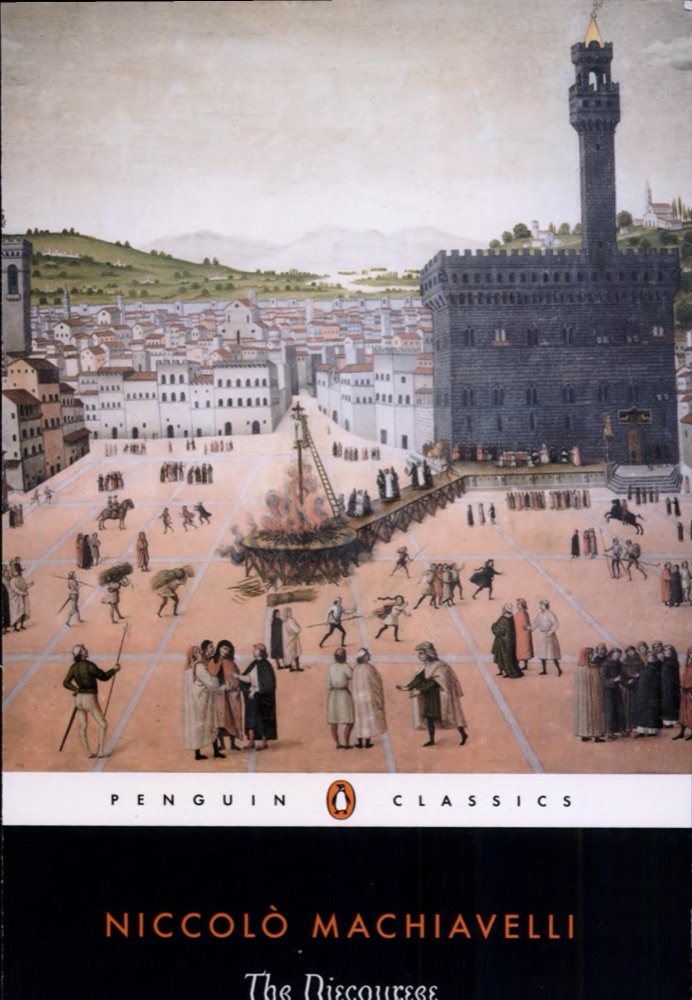
 The Discourses
Quotes from the Book
Everyone sees what you appear to be, few experience what you really are.
If an injury has to be done to a man it should be so severe that his vengeance need not be feared.
The lion cannot protect himself from traps, and the fox cannot defend himself from wolves. One must therefore be a fox to recognize traps, and a lion to frighten wolves.
There is no other way to guard yourself against flattery than by making men understand that telling you the truth will not offend you.
The first method for estimating the intelligence of a ruler is to look at the men he has around him.
it is much safer to be feared than loved because ...love is preserved by the link of obligation which, owing to the baseness of men, is broken at every opportunity for their advantage; but fear preserves you by a dread of punishment which never fails.
Never attempt to win by force what can be won by deception.
Because there are three classes of intellects: one which comprehends by itself; another which appreciates what others comprehend; and a third which neither comprehends by itself nor by the showing of others; the first is the most excellent, the second is good, the third is useless.
Where the willingness is great, the difficulties cannot be great.
Men in general judge more by the sense of sight than by the sense of touch, because everyone can see but few can test by feeling. Everyone sees what you seem to be, few know what you really are; and those few do not dare take a stand against the general opinion.
How we live is so different from how we ought to live that he who studies what ought to be done rather than what is done will learn the way to his downfall rather than to his preservation.
…he who seeks to deceive will always find someone who will allow himself to be deceived.
Since love and fear can hardly exist together, if we must choose between them, it is far safer to be feared than loved
The vulgar crowd always is taken by appearances, and the world consists chiefly of the vulgar.
A man who is used to acting in one way never changes; he must come to ruin when the times, in changing, no longer are in harmony with his ways.
And here comes in the question whether it is better to be loved rather than feared, or feared rather than loved. It might perhaps be answered that we should wish to be both; but since love and fear can hardly exist together, if we must choose between them, it is far safer to be feared than loved.
He who wishes to be obeyed must know how to command
A prudent man should always follow in the path trodden by great men and imitate those who are most excellent, so that if he does not attain to their greatness, at any rate he will get some tinge of it.
Of mankind we may say in general they are fickle, hypocritical, and greedy of gain.
The promise given was a necessity of the past: the word broken is a necessity of the present.
Wisdom consists of knowing how to distinguish the nature of trouble, and in choosing the lesser evil.
Any man who tries to be good all the time is bound to come to ruin among the great number who are not good. Hence a prince who wants to keep his authority must learn how not to be good, and use that knowledge, or refrain from using it, as necessity requires.
It must be considered that there is nothing more difficult to carry out, nor more doubtful of success, nor more dangerous to handle, than to initiate a new order of things.
Therefore, it is necessary to be a fox to discover the snares and a lion to terrify the wolves
Men ought either to be well treated or crushed, because they can avenge themselves of lighter injuries, of more serious ones they cannot; therefore the injury that is to be done to a man ought to be of such a kind that one does not stand in fear of revenge.
He who becomes a Prince through the favour of the people should always keep on good terms with them; which it is easy for him to do, since all they ask is not to be oppressed
In conclusion, the arms of others either fall from your back, or they weigh you down, or they bind you fast.
Men judge generally more by the eye than by the hand, for everyone can see and few can feel. Every one sees what you appear to be, few really know what you are.
A prince must not have any other object nor any other thought… but war, its institutions, and its discipline; because that is the only art befitting one who commands.
Did you know?
- Machiavelli wrote The Prince in 1513 but it was not printed until 1532, five years after his death.
- The treatise was originally written in Italian under the title Il Principe, with the Latin title De Principatibus.
- It was dedicated to a member of the ruling Medici family, at whose hands Machiavelli had earlier been imprisoned and tortured.
- The Catholic Church placed The Prince on its Index of Forbidden Books in 1559.
- The book gave rise to the English word "Machiavellian," used to describe cunning and unscrupulous political conduct.
- Scholars still debate whether the work is sincere advice to rulers or a veiled republican critique of tyranny.
About Niccolò Machiavelli
Niccolo Machiavelli (1469-1527) was a Florentine diplomat, historian and political philosopher who served the Republic of Florence until the Medici returned to power in 1512, after which he was dismissed, imprisoned and tortured. He wrote The Prince and the Discourses on Livy during his enforced retirement from public life.
More about the author →More by Niccolò Machiavelli
The Discourses
About the book
The Prince (Il Principe) is a short political treatise written by the Florentine diplomat Niccolo Machiavelli in 1513 and published posthumously in 1532. Framed as a practical manual dedicated to a Medici ruler, it sets out how a prince can acquire a state and, above all, hold on to it. Machiavelli surveys the different kinds of principalities, the roles of skill (virtu) and luck (fortuna) in gaining power, the necessity of one's own arms rather than mercenaries, and the qualities a ruler must project to survive among people who are seldom good.
Its enduring provocation lies in Machiavelli's insistence on the "effectual truth" of politics rather than how men ought ideally to behave. He argues that a prince must be prepared to act against conventional morality when preservation of the state demands it, that it is safer to be feared than loved if one cannot be both, and that a ruler must know how to seem virtuous while being ready to abandon virtue when necessary. This deliberate divorce of political success from Christian and classical ethics marked a sharp break from the mirror-for-princes tradition that came before it.
The Prince became one of the most influential and controversial works in the Western canon, giving rise to the adjective "Machiavellian" and earning a place on the Catholic Church's Index of Forbidden Books in 1559. Read variously as cynical advice, hard-headed realism, or covert republican satire, it is widely regarded as a foundational text of modern political science and continues to be studied and debated five centuries after it was written.
Key characters
- Cesare BorgiaContemporary ruler Machiavelli holds up as a model of the ambitious new prince
- Lorenzo de' MediciThe Medici ruler to whom the treatise is dedicated
Book details
- First published
- 1532
- Length
- 144 pages
- Reading time
- 2 hours
- Author
- Niccolò Machiavelli
- Genre
- Classics
- Goodreads rating
- 3.84 (395k ratings) →
- First line
- “Those who strive to obtain the good graces of a prince are accustomed to come before him with such things as they hold most precious.”
If you liked this, read…
- 1Discourses on LivyMachiavelli's longer companion work, applying his political realism to republics
- 2The Art of WarSun Tzu's classic on strategy and the pragmatic exercise of power
- 3LeviathanHobbes's foundational treatise on sovereignty and the necessity of strong authority
Keep reading
 The Grace of Kings
 Scion of Ikshvaku
 The Analects
 The Walking Drum
 The Once and Future King
 The Emperor's Blades
 Utopia
 The First Circle
 The Three Musketeers
 The Dagger of Adendigaeth
 Beyond Good and Evil
 The Republic
 Man and Superman
 Children of Dune
 Crime and Punishment
 The Screwtape Letters
 The Way of All Flesh
 The 48 Laws of Power
 Of Human Bondage
 Before They Are Hanged
 Chanakya's Chant
 The Winner Stands Alone
 Last Argument of Kings
 Aesop's Fables
 Half a War
 Shōgun
 The Complete Essays
 The Nicomachean Ethics
 The High King
 The Wall of Storms
 The Power of One
 The Dinosaur Lords
 Don Quixote
 The Burning White
 Ethics
 The Way We Live Now
 Self-Reliance and Other Essays
 The Blinding Knife
 History of the Peloponnesian War
 Silas Marner
 Sacred Hunger
 The Promise
 On Liberty
 Julian
 Hagakure: The Book of the Samurai
 Soul of the Fire
 The Black Gryphon
 The Jewel in the Crown
 Letters from a Stoic
 Royal Assassin
 Lord of the Silver Bow
 Falls the Shadow
 The Penultimate Peril
 Prince of Fools
 An Ideal Husband
 War and Peace
 Middlemarch
 Foundation
 The Man in the Iron Mask
 Lord of Chaos