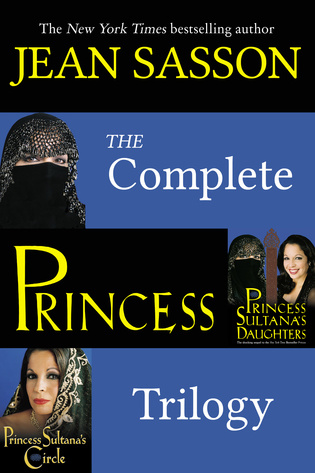
Jean Sasson · 826 pages
Rating: (770 votes)
“understood that from this moment, the stepping-stones”
― Jean Sasson, quote from The Complete Princess Trilogy: Princess; Princess Sultana's Daughters; and Princess Sultana's Circle
“I believe that the children of this generation have decayed with the ease of their lives, and that their great fortune has deprived them of any ambitions or real satisfactions. Surely the weakness of our monarchy in Saudi Arabia is bound up in our addiction to extravagance. I fear it will be our undoing.”
― Jean Sasson, quote from The Complete Princess Trilogy: Princess; Princess Sultana's Daughters; and Princess Sultana's Circle
“Surely the weakness of our monarchy in Saudi Arabia is bound up in our addiction to extravagance. I fear it will be our undoing.”
― Jean Sasson, quote from The Complete Princess Trilogy: Princess; Princess Sultana's Daughters; and Princess Sultana's Circle
“suddenly remembered a beautiful verse by the great Lebanese philosopher Kahlil Gibran: “Mayhap a funeral among men is a wedding feast among the angels.” I imagined my mother at the side of her mother and father, with her own little ones gathered in her arms.”
― Jean Sasson, quote from The Complete Princess Trilogy: Princess; Princess Sultana's Daughters; and Princess Sultana's Circle
“Riyadh was the base of the government, but none of the Al Sa’ud family particularly enjoyed the city; their complaints never ended about the dreariness of life in Riyadh. It was too hot and dry, the men of religion took themselves too seriously, the nights were too cold. Most of the family preferred Jeddah or Taif.”
― Jean Sasson, quote from The Complete Princess Trilogy: Princess; Princess Sultana's Daughters; and Princess Sultana's Circle

“that the children of this generation have decayed with the ease of their lives, and that their great fortune has deprived them of any ambitions or real satisfactions.”
― Jean Sasson, quote from The Complete Princess Trilogy: Princess; Princess Sultana's Daughters; and Princess Sultana's Circle

Jean Sasson
Born place: in Troy, The United States
See more on GoodReads
“You can't go around building a better world for people. Only people can build a better world for people. Otherwise it's just a cage. Besides you don't build a better world by choppin' heads off and giving decent girls away to frogs.”
― Terry Pratchett, quote from Witches Abroad
“When illusions are shattered by truth, talent is set free.”
― Lian Hearn, quote from Across the Nightingale Floor
“Today was the day a thousand dreams would die and a single dream would be born.”
― Mary E. Pearson, quote from The Kiss of Deception
“He’s like a song she can’t get out of her head. Hard as she tries, the melody of their meeting runs through her mind on an endless loop, each time as surprisingly sweet as the last, like a lullaby, like a hymn, and she doesn’t think she could ever get tired of hearing it.”
― Jennifer E. Smith, quote from The Statistical Probability of Love at First Sight
“He was very rich; he bought eggs to throw at a Chinaman. And one of those eggs missed the Chinaman and hit a policeman. So, Danny was in jail.”
― John Steinbeck, quote from Tortilla Flat

 The Red Necklace
 The Life of Charlott...
 Inferno

 Daylighters
 Blood Games
BookQuoters is a community of passionate readers who enjoy sharing the most meaningful, memorable and interesting quotes from great books. As the world communicates more and more via texts, memes and sound bytes, short but profound quotes from books have become more relevant and important. For some of us a quote becomes a mantra, a goal or a philosophy by which we live. For all of us, quotes are a great way to remember a book and to carry with us the author’s best ideas.
We thoughtfully gather quotes from our favorite books, both classic and current, and choose the ones that are most thought-provoking. Each quote represents a book that is interesting, well written and has potential to enhance the reader’s life. We also accept submissions from our visitors and will select the quotes we feel are most appealing to the BookQuoters community.
Founded in 2023, BookQuoters has quickly become a large and vibrant community of people who share an affinity for books. Books are seen by some as a throwback to a previous world; conversely, gleaning the main ideas of a book via a quote or a quick summary is typical of the Information Age but is a habit disdained by some diehard readers. We feel that we have the best of both worlds at BookQuoters; we read books cover-to-cover but offer you some of the highlights. We hope you’ll join us.
