

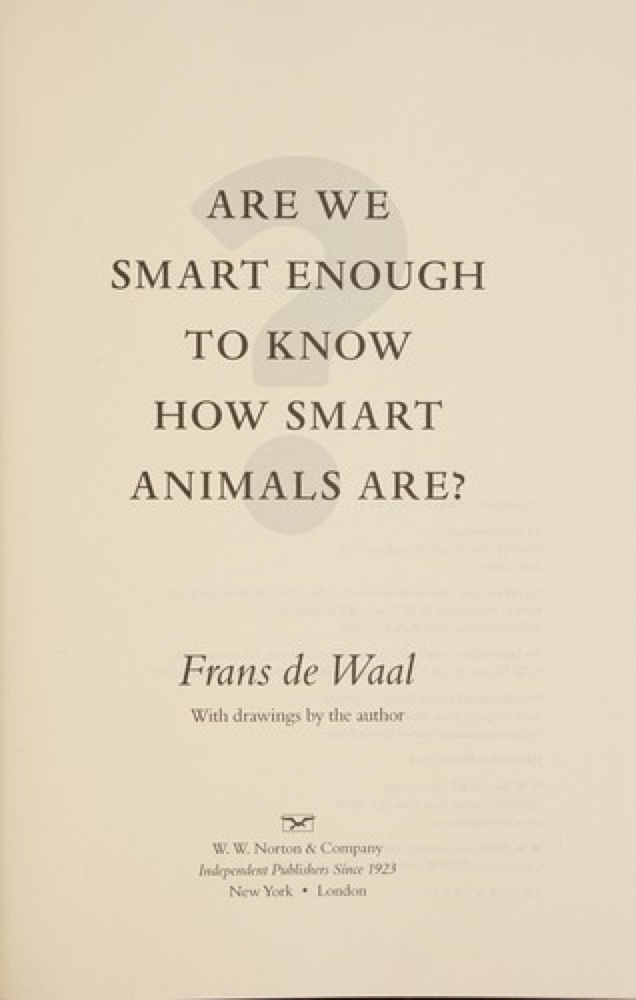
 Are We Smart Enough to Know How Smart Animals Are?
Quotes from the Book
Consider Steve Jobs. One biographer said, “Was he smart? No, not exceptionally. Instead he was a genius.” Jobs dropped out of college, went to find himself in India, and at one point was forced out of Apple, the company he co-founded, when sales were slow in 1985. Few would have predicted the level of his success by his death. “Think different” became the slogan of a multinational monolith that fused art and technology under his guidance. Jobs may have been average or unexceptional in many domains, but his vision and ability to think differently made him a genius.
It's always a little nerve-wracking when everybody agrees.
Openness (artistic, curious, imaginative, with a wide range of interests) Conscientiousness (efficient, organized, responsible, ambitious, able to delay gratification) Extroversion (assertive, energetic, enthusiastic, finds the company of others stimulating) Agreeableness (forgiving, generous, kind, considerate toward others) Neuroticism (anxious, tense, sensitive to criticism, moody)
One of the most famous dogs in Chinese history was from the eighth century. The emperor was playing chess with a prince and losing badly. His favorite concubine, legendary for her beauty, was watching discreetly in the distance with her little dog called Wo. Seeing her master losing face, she let Wo run onto the chessboard and knock over all the pieces. The emperor was delighted.
Chimpanzees are so skilled at working together to hunt down other chimpanzees that lethal intergroup aggression, or murder, is among the leading causes of mortality in wild chimpanzees.
Watch on YouTube
About Brian Hare
We have collected 5 quotes from 1 book by Brian Hare on BookQuoters.
More about the author →Book details
- Author
- Brian Hare
- Genre
- Nonfiction
- Goodreads rating
- 3.98 (4k ratings) →
Keep reading
Are We Smart Enough to Know How Smart Animals Are?
 What the Dog Saw and Other Adventures
 Dragons of Eden: Speculations on the Evolution of Human Intelligence
 Inside of a Dog: What Dogs See, Smell, and Know
 The Geography of Genius: A Search for the World's Most Creative Places from Ancient Athens to Silicon Valley
 The Social Animal: The Hidden Sources of Love, Character, and Achievement
 Humankind: A Hopeful History
 Curious: The Desire to Know and Why Your Future Depends On It
 The Zookeeper's Wife
 All the Birds in the Sky
 A Whole New Mind: Why Right-Brainers Will Rule the Future
 Beyond Words: What Animals Think and Feel
 Animals Make Us Human: Creating the Best Life for Animals
 Watchers
 The Lost World
 The One and Only Ivan
 The Art of Thinking Clearly
 Surrounded by Idiots
 Aesop's Fables
 The Most Human Human: What Talking with Computers Teaches Us About What It Means to Be Alive
 The Art of Creative Thinking
 Wired
Wired
 The Nix
 Some We Love, Some We Hate, Some We Eat: Why It's So Hard to Think Straight About Animals
 Steve Jobs
 Revenge of the Tipping Point
 The Genius of Birds
 The Undoing Project: A Friendship That Changed Our Minds
 Influx
 Xenocide
 Originals: How Non-Conformists Move the World
 How the Mind Works
 Playground
 On the Steel Breeze
 How to Win Friends & Influence People
 Kiln People
 A Beautiful Mind
 Pyramids
 Thrawn
 Genome
 A Hunter-Gatherer's Guide to the 21st Century: Evolution and the Challenges of Modern Life
 Eeeee Eee Eeee
 Social Intelligence: The New Science of Human Relationships
 Next
Next
 Thinking In Pictures: and Other Reports from My Life with Autism
 Shadows of Forgotten Ancestors
 The Ascent of Man
 Think Like a Freak
 The Philosopher and the Wolf
 The Art of Impossible: A Peak Performance Primer
 Sapiens: A Brief History of Humankind
 David and Goliath: Underdogs, Misfits, and the Art of Battling Giants
 Please Understand Me II: Temperament, Character, Intelligence
 Crowds and Power
 The Long Way to a Small, Angry Planet
 Creativity: Flow and the Psychology of Discovery and Invention
 My Ishmael
 Smartcuts: How Hackers, Innovators, and Icons Accelerate Success
 Parasite
 The Future of the Mind: The Scientific Quest to Understand, Enhance, and Empower the Mind