
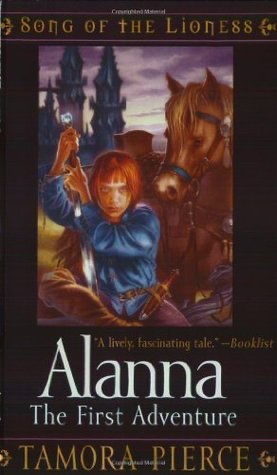
“Either I've turned stupid, or life's turned hard.”
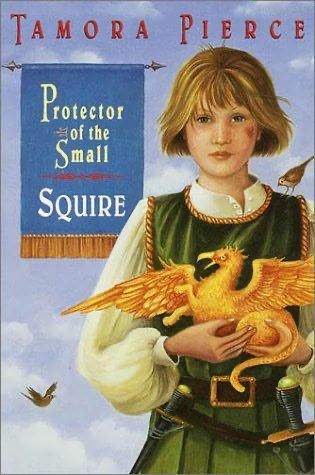
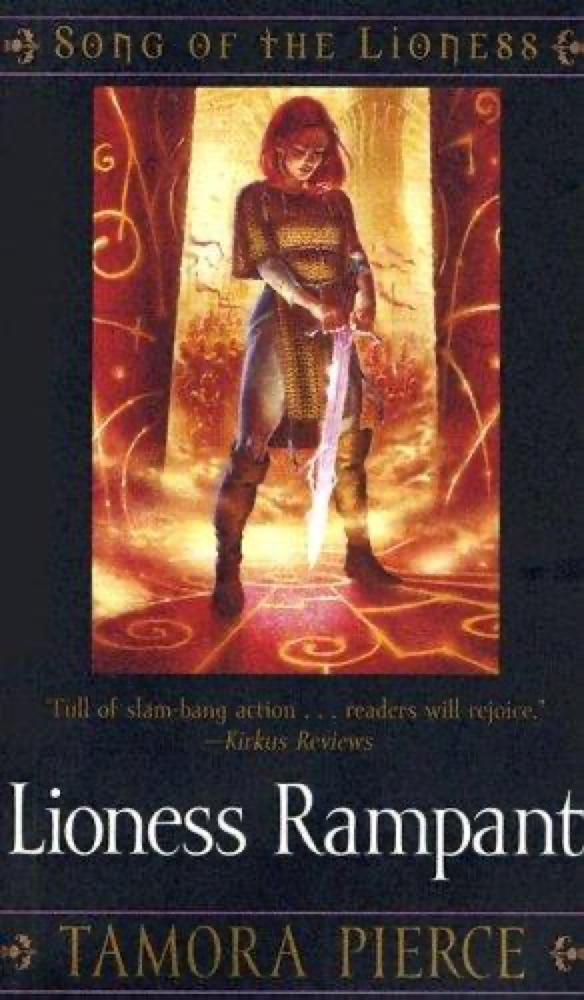
― Tamora Pierce, quote from Lioness Rampant
“You turned into a hero when I wasn't watching.”
― Tamora Pierce, quote from Lioness Rampant
“You know something? There are sandstorms that strip man and horse and bury them — I've seen them. I saw bones piled higher than my head for the folly of a bad king and those who wanted his throne. I lived through a blizzard that froze every other living creature solid. Against those things, you're only a man. I can deal with you.”
― Tamora Pierce, quote from Lioness Rampant
“Faithful: When will you learn to leave well enough alone?
Alanna sighed. "When I want to stop learning, I guess.”
― Tamora Pierce, quote from Lioness Rampant
“Horses are calmer people. They also don't throw things at cats.”
― Tamora Pierce, quote from Lioness Rampant
“There are times in every rider's life when it is necessary to apologize to a horse....”
― Tamora Pierce, quote from Lioness Rampant
“I wouldn't call it tamed, laddy-me-love. The lady of Pirate's Swoop shouldn't be tame.”
― Tamora Pierce, quote from Lioness Rampant
“He knows about things like betrayal, and being afraid, and the looks on people's faces when they know you did something they thought impossible”
― Tamora Pierce, quote from Lioness Rampant
“Belén shrugs. "It's a perfect plan."
"As easy as falling in love," Mara adds.
"Foolproof," Hector agrees.
I don't deserve such friends. I blink against the sting of threatening tears and say, "All you Joyans are filthy liars.”
― Rae Carson, quote from The Bitter Kingdom
“قال الأسكندر:"وماذا بشأن العبيد؟هل في الإمكان وجود عالم من دون عبيد؟"
أجاب أرسطو:"كلا طالما يستحيل وجود نول ينسج القماش من تلقاء نفسه,اما إذا أصبح ذلك ممكنا فيمكن عندها ان نتصور وجود عالم من دون عبيد لكنني لا أعتق أبدا أن ذلك سيحدث في المستقبل”
― Valerio Massimo Manfredi, quote from Alexander: Child of a Dream
“Oh, I’m so going to put a knife in the other side of your chest, I think, feeling stabby.”
― Amy A. Bartol, quote from Sea of Stars
“The brave man isn't he who doesn't feel afraid, but he who conquers that fear.”
― Cecelia Ahern, quote from How to Fall in Love
“Like any overt school of mysticism, a movement seeking to achieve a vicious goal has to invoke the higher mysteries of an incomprehensible authority. An unread and unreadable book serves this purpose. It does not count on men’s intelligence, but on their weaknesses, pretensions and fears. It is not a tool of enlightenment, but of intellectual intimidation. It is not aimed at the reader’s understanding, but at his inferiority complex.
An intelligent man will reject such a book with contemptuous indignation, refusing to waste his time on untangling what he perceives to be gibberish—which is part of the book’s technique: the man able to refute its arguments will not (unless he has the endurance of an elephant and the patience of a martyr). A young man of average intelligence—particularly a student of philosophy or of political science—under a barrage of authoritative pronouncements acclaiming the book as “scholarly,” “significant,” “profound,” will take the blame for his failure to understand. More often than not, he will assume that the book’s theory has been scientifically proved and that he alone is unable to grasp it; anxious, above all, to hide his inability, he will profess agreement, and the less his understanding, the louder his agreement—while the rest of the class are going through the same mental process. Most of them will accept the book’s doctrine, reluctantly and uneasily, and lose their intellectual integrity, condemning themselves to a chronic fog of approximation, uncertainty, self doubt. Some will give up the intellect (particularly philosophy) and turn belligerently into “pragmatic,” anti-intellectual Babbitts. A few will see through the game and scramble eagerly for the driver’s seat on the bandwagon, grasping the possibilities of a road to the mentally unearned.
Within a few years of the book’s publication, commentators will begin to fill libraries with works analyzing, “clarifying” and interpreting its mysteries. Their notions will spread all over the academic map, ranging from the appeasers, who will try to soften the book’s meaning—to the glamorizers, who will ascribe to it nothing worse than their own pet inanities—to the compromisers, who will try to reconcile its theory with its exact opposite—to the avant-garde, who will spell out and demand the acceptance of its logical consequences. The contradictory, antithetical nature of such interpretations will be ascribed to the book’s profundity—particularly by those who function on the motto: “If I don’t understand it, it’s deep.” The students will believe that the professors know the proof of the book’s theory, the professors will believe that the commentators know it, the commentators will believe that the author knows it—and the author will be alone to know that no proof exists and that none was offered.
Within a generation, the number of commentaries will have grown to such proportions that the original book will be accepted as a subject of philosophical specialization, requiring a lifetime of study—and any refutation of the book’s theory will be ignored or rejected, if unaccompanied by a full discussion of the theories of all the commentators, a task which no one will be able to undertake.
This is the process by which Kant and Hegel acquired their dominance. Many professors of philosophy today have no idea of what Kant actually said. And no one has ever read Hegel (even though many have looked at every word on his every page).”
― Ayn Rand, quote from Philosophy: Who Needs It
BookQuoters is a community of passionate readers who enjoy sharing the most meaningful, memorable and interesting quotes from great books. As the world communicates more and more via texts, memes and sound bytes, short but profound quotes from books have become more relevant and important. For some of us a quote becomes a mantra, a goal or a philosophy by which we live. For all of us, quotes are a great way to remember a book and to carry with us the author’s best ideas.
We thoughtfully gather quotes from our favorite books, both classic and current, and choose the ones that are most thought-provoking. Each quote represents a book that is interesting, well written and has potential to enhance the reader’s life. We also accept submissions from our visitors and will select the quotes we feel are most appealing to the BookQuoters community.
Founded in 2023, BookQuoters has quickly become a large and vibrant community of people who share an affinity for books. Books are seen by some as a throwback to a previous world; conversely, gleaning the main ideas of a book via a quote or a quick summary is typical of the Information Age but is a habit disdained by some diehard readers. We feel that we have the best of both worlds at BookQuoters; we read books cover-to-cover but offer you some of the highlights. We hope you’ll join us.