
“I'm going to teach you the art of swordsmanship-or in other words, how to totally kill someone with a sharp, pointy thing.”
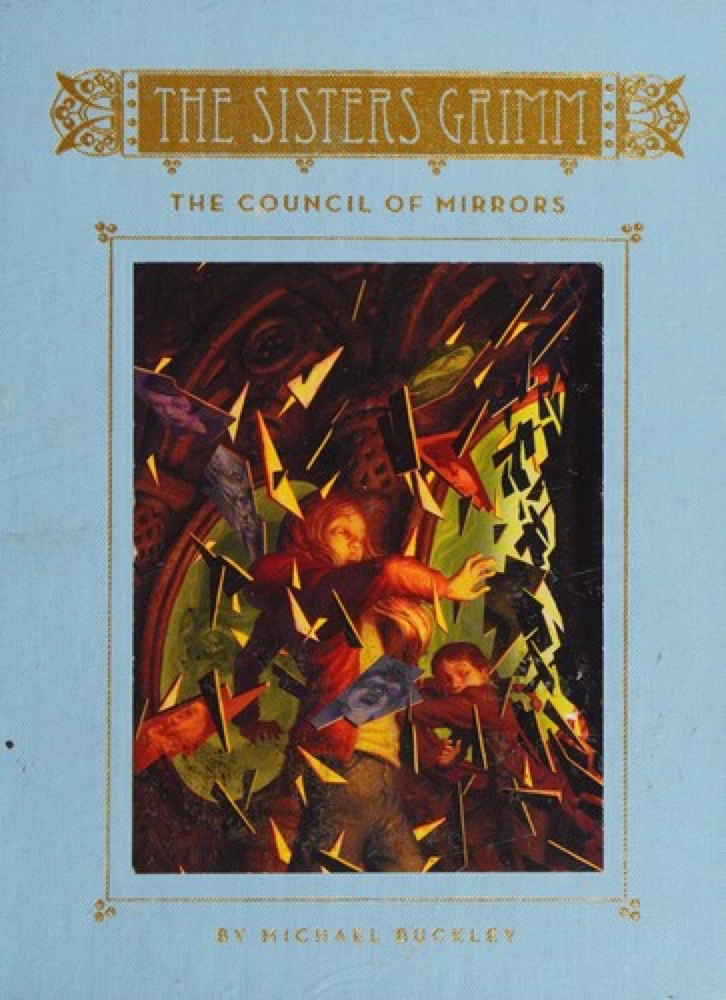
― Michael Buckley, quote from The Council of Mirrors
“Save the people you love, who cares about the rest of the world? - Uncle Jake”
― Michael Buckley, quote from The Council of Mirrors
“Puck flapped up to the happy couple. "Wait a minute! You have to ask someone to marry you? No one told me that! I thought you just hit them with a club and dragged them back to your cave!"
Henry put his arm around Sabrina. "You're officially grounded from ever getting married."
"Thank you," Sabrina whispered sincerely.”
― Michael Buckley, quote from The Council of Mirrors
“You can't ground us. We're homeless," Daphne said.”
― Michael Buckley, quote from The Council of Mirrors
“The world is always ruled by a maniac. - Baba Yaga”
― Michael Buckley, quote from The Council of Mirrors
“But that is love, isn't it? It's terribly inconvenient. It sweeps you up and stales your attention and slows down your work. our labors fall behind, our friends report us missing, and everything comes to a screeching halt! Everything, that is, except what truly matters in this life --- true love. We've all been there. We know the feelings. So when we see it in a friend, a dear, dear friend, we throw down our work and we celebrate. We rejoice. We raise a glass. Because when we recognize it in the hearts of friends, it reminds us of how important it is in our own. Mr. Seven, you are and always have been my companion and friend. You have made me a better man, and almost on a daily basis you have reminded me that I too need to celebrate the love in my life. - William Charming”
― Michael Buckley, quote from The Council of Mirrors
“Girls, I need to tell you some things about our family," Sabrina said. "Have you ever heard of the Brothers Grimm?”
― Michael Buckley, quote from The Council of Mirrors
“I'm soooooo telling." Puck stood behind her. "You two disobeyed your parents! I'm both shocked and really impressed.”
― Michael Buckley, quote from The Council of Mirrors
“We have earned our peace. It is, by now, more precious than honor, or even pity.”
― David Brin, quote from The Postman
“Get Comfortable Not Knowing There once was a village that had among its people a very wise old man. The villagers trusted this man to provide them answers to their questions and concerns. One day, a farmer from the village went to the wise man and said in a frantic tone, “Wise man, help me. A horrible thing has happened. My ox has died and I have no animal to help me plow my field! Isn’t this the worst thing that could have possibly happened?” The wise old man replied, “Maybe so, maybe not.” The man hurried back to the village and reported to his neighbors that the wise man had gone mad. Surely this was the worst thing that could have happened. Why couldn’t he see this? The very next day, however, a strong, young horse was seen near the man’s farm. Because the man had no ox to rely on, he had the idea to catch the horse to replace his ox—and he did. How joyful the farmer was. Plowing the field had never been easier. He went back to the wise man to apologize. “You were right, wise man. Losing my ox wasn’t the worst thing that could have happened. It was a blessing in disguise! I never would have captured my new horse had that not happened. You must agree that this is the best thing that could have happened.” The wise man replied once again, “Maybe so, maybe not.” Not again, thought the farmer. Surely the wise man had gone mad now. But, once again, the farmer did not know what was to happen. A few days later the farmer’s son was riding the horse and was thrown off. He broke his leg and would not be able to help with the crop. Oh no, thought the man. Now we will starve to death. Once again, the farmer went to the wise man. This time he said, “How did you know that capturing my horse was not a good thing? You were right again. My son is injured and won’t be able to help with the crop. This time I’m sure that this is the worst thing that could have possibly happened. You must agree this time.” But, just as he had done before, the wise man calmly looked at the farmer and in a compassionate tone replied once again, “Maybe so, maybe not.” Enraged that the wise man could be so ignorant, the farmer stormed back to the village. The next day troops arrived to take every able-bodied man to the war that had just broken out. The farmer’s son was the only young man in the village who didn’t have to go. He would live, while the others would surely die. The moral of this story provides a powerful lesson. The truth is, we don’t know what’s going to happen—we just think we do. Often we make a big deal out of something. We blow up scenarios in our minds about all the terrible things that are going to happen. Most of the time we are wrong. If we keep our cool and stay open to possibilities, we can be reasonably certain that, eventually, all will be well. Remember: maybe so, maybe not.”
― Richard Carlson, quote from Don't Sweat the Small Stuff ... and it's all small stuff: Simple Ways to Keep the Little Things from Taking Over Your Life
“I began this path with a sense that an individual should be able to live in freedom among his neighbors, and not as a host for parasites, even if those parasites were endowed with power by the state. I had a sense that the individual should not be at the mercy of the bully or the mob, even if the bully or the mob was sanctioned by the state. I had a sense that if an individual was the target of aggression and I stood with him, or her, or them, I would have the satisfaction of knowing I had opposed villainy, and if others who shared my beliefs would join in the fight, then perhaps a measure at a time, evil would not prosper. I believed that each time malevolence and iniquity were thwarted the chances were increased that I could live in freedom … that I would not be at the mercy of the aggression of others.”
He captured them as he looked them in the eyes across the silent hall. “The measure of success from acting on these simple truths is all around us, hangs above us in the sky, pervades the system of our sun … and may now be found among the stars.”
”
― William C. Samples, quote from Fe Fi FOE Comes
“...
'For where your treasure is, there your heart will be also.'
– Matthew 6:21”
― quote from New World Translation of the Holy Scriptures
“There can have been no doubt in Eleanor's mind as to what was expected of her as a wife. In her day, women were supposed to be chaste both inside and outside marriage, virginity and celibacy being highly prized states. When it came to fornication, women were usually apportioned the blame, because they were the descendants of Eve, who had tempted Adam in the Garden of Eden, with such dire consequences. Women, the Church taught, were the weaker vessel, the gateway to the Devil, and therefore the source of all lechery. St. Bernard of Clairvaux wrote: "To live with a woman without danger is more difficult than raising the dead to life." Noblewomen, he felt, were the most dangerous so fall. Women were therefore kept firmly in their place in order to prevent them from luring men away from the paths of righteousness.
Promiscuity--and its often inevitable consequence, illicit pregnancy--brought great shame upon a woman and her family, and was punishable by fines, social ostracism, and even, in the case of aristocratic and royal women, execution. Unmarried women who indulged in fornication devalued themselves on the marriage market. In England, women who were sexually experienced were not permitted to accuse men of rape in the King's court. Female adultery was seen as a particularly serious offence, since it jeopardized the laws of inheritance.
Men, however, often indulged in casual sex and adultery with impunity. Because the virtue of high-born women was jealously guarded, many men sought sexual adventures with lower-class women. Prostitution was common and official brothels were licensed and subject to inspection in many areas. There was no effective contraception apart from withdrawal, and the Church frowned upon that anyway: this was why so many aristocratic and royal bastards were born during this period.”
― Alison Weir, quote from Eleanor of Aquitaine: A Life
BookQuoters is a community of passionate readers who enjoy sharing the most meaningful, memorable and interesting quotes from great books. As the world communicates more and more via texts, memes and sound bytes, short but profound quotes from books have become more relevant and important. For some of us a quote becomes a mantra, a goal or a philosophy by which we live. For all of us, quotes are a great way to remember a book and to carry with us the author’s best ideas.
We thoughtfully gather quotes from our favorite books, both classic and current, and choose the ones that are most thought-provoking. Each quote represents a book that is interesting, well written and has potential to enhance the reader’s life. We also accept submissions from our visitors and will select the quotes we feel are most appealing to the BookQuoters community.
Founded in 2023, BookQuoters has quickly become a large and vibrant community of people who share an affinity for books. Books are seen by some as a throwback to a previous world; conversely, gleaning the main ideas of a book via a quote or a quick summary is typical of the Information Age but is a habit disdained by some diehard readers. We feel that we have the best of both worlds at BookQuoters; we read books cover-to-cover but offer you some of the highlights. We hope you’ll join us.