
 How to Be Good
Quotes from the Book
People worry about kids playing with guns, and teenagers watching violent videos; we are scared that some sort of culture of violence will take them over. Nobody worries about kids listening to thousands - literally thousands - of songs about broken hearts and rejection and pain and misery and loss.
What came first – the music or the misery? Did I listen to the music because I was miserable? Or was I miserable because I listened to the music? Do all those records turn you into a melancholy person?
It's brilliant, being depressed; you can behave as badly as you like.
Sentimental music has this great way of taking you back somewhere at the same time that it takes you forward, so you feel nostagic and hopeful all at the same time.
I've committed to nothing...and that's just suicide...by tiny, tiny increments.
I'm very good at the past. It's the present I can't understand.
Over the last couple of years, the photos of me when I was a kid... well, they've started to give me a little pang or something - not unhappiness, exactly, but some kind of quiet, deep regret... I keep wanting to apologize to the little guy: "I'm sorry, I've let you down. I was the person who was supposed to look after you, but I blew it: I made wrong decisions at bad times, and I turned you into me.
Those days are gone, and good fucking riddance to them; unhappiness really meant something back then. Now it's just a drag, like a cold or having no money. If you really wanted to mess me up, you should have got to me earlier.
Maybe we all live life at too high a pitch, those of us who absorb emotional things all day, and as mere consequence we can never feel merely content: we have to be unhappy, or ecstatically, head-over-heels happy, and those states are difficult to achieve within a stable, solid relationship.
If you really wanted to mess me up, you should have got to me earlier.
…I've had a bad week." What's happened?" Nothing's happened. I've had a bad week in my head, is all.
I've been thinking with my guts since I was fourteen years old, and frankly speaking, between you and me, I have come to the conclusion that my guts have shit for brains.
I lost the plot for a while then. And I lost the subplot, the script, the soundtrack, the intermission, my popcorn, the credits, and the exit sign.
It's a mystery of human chemistry and I don't understand it, some people, as far as their senses are concerned, just feel like home.
Have you got any soul?" a woman asks the next afternoon. That depends, I feel like saying; some days yes, some days no. A few days ago I was right out; now I've got loads, too much, more than I can handle. I wish I could spread it a bit more evenly, I want to tell her, get a better balance, but I can't seem to get it sorted. I can see she wouldn't be interested in my internal stock control problems though, so I simply point to where I keep the soul I have, right by the exit, just next to the blues.
I used to think--and given the way we ended up, maybe I still do--that all relationships need the kind of violent shove that a crush brings, just to get you started and to push you over the humps. And then, when the energy from that shove has gone and you come to something approaching a halt, you have to look around and see what you've got. It could be something completely different, it could be something roughly the same, but gentler and calmer, or it could be nothing at all.
It's not what you like but what you are like that's important.
It's no wonder we're all such a mess, is it? We're like Tom Hanks in Big. Little boys and girls trapped in adult bodies and forced to get on with it.
A good compilation tape, like breaking up, is hard to do. You've got to kick off with a corker, to hold the attention (I started with 'Got To Get You Off My Mind', but then realised that she might not get any further than track one, side one if I delivered what she wanted straight away, so I buried it in the middle of side two), and then you've got to up it a notch, and you can't have white music and black music together, unless the white music sounds like black music, and you can't have two tracks by the same artist side by side, unless you've done the whole thing in pairs, and ... oh there are loads of rules.
Is it wrong, wanting to be at home with your record collection? It's not like collecting records is like collecting stamps, or beermats, or antique thimbles. There's a whole world in here, a nicer, dirtier, more violent, more peaceful, more colorful, sleazier, more dangerous, more loving world than the world I live in; there is history, and geography, and poetry, and countless other things I should have studied at school, including music.
my friends don't seem to be friends at all but people whose phone numbers I haven't lost.
What came first, the music or the misery? People worry about kids playing with guns, or watching violent videos, that some sort of culture of violence will take them over. Nobody worries about kids listening to thousands, literally thousands of songs about heartbreak, rejection, pain, misery and loss. Did I listen to pop music because I was miserable? Or was I miserable because I listened to pop music?"- Rob
Did I do and say these things? Yes, I did. Are there any mitigating circumstances? Not really, unless any circumstances {in other words, context) can be regarded as mitigating. And before you judge, although you have probably already done so, go away and write down the four worst things you have done to a partner, even if - especially if - your partner doesn't know about them. Don't dress things up, or try to explain them; just write them down, in a list, in the plainest language possible. Finished? Ok, so who's the arsehole now?
(About Love)The most important thing in life, and you can't tell whether people have it or not. Surely this is wrong? Surely people who are happy should look happy, at all times, no matter how much money they have or how uncomfortable their shoes are or how little their child is sleeping; and people who are doing OK but have still not found their soul-mate should look, I don't know, anxious, like Billy Crystal in When Harry Met Sally; and people who are desperate should wear something, a yellow ribbon maybe, which would allow them to be identified by similar desperate people.
That’s why; he’s worried about how his life is turning out, and he’s lonely, and lonely people are the bitterest of them all
Look at all the things that can go wrong for men. There’s the nothing-happening-at-all problem, the too-much-happening-too-soon problem, the dismal-droop-after-a-promising-beginning problem; there’s the size-doesn’t-matter-except-in-my-case problem, the failing-to-deliver-the-goods problem…and what do women have to worry about? A handful of cellulite? Join the club. A spot of I-wonder-how-I-rank? Ditto.
It would be nice to think that as I've got older times have changed, relationships have become more sophisticated, females less cruel, skins thicker, reactions sharper, instincts more developed. But there still seems to be an element of that evening in everything that happened to me since; all my other romantic stories seem to be a scrambled version of that first one. Of course, I have never had to take that long walk again, and my ears have not burned with quite the same fury, and I have never had to count the packs of cheap cigarettes in order to avoid mocking eyes and floods of tears... not really, not actually, not as such. It just feels that way, sometimes.
One day, maybe not in the next few weeks, but certainly in the conceivable future, someone will be able to refer to me without using the word 'arse' somewhere in the sentence.
I don't even feel as if I'm the center of my own world, so how am I supposed to feel as though I'm the center of anyone else's?
The unhappiest people I know, romantically speaking, are the ones who like pop music the most; and I don't know whether pop music has caused this unhappiness, but I do know that they've been listening to the sad songs longer than they've been living the unhappy lives.
Did you know?
- The novel was first published in the United Kingdom on 13 April 1995 by Victor Gollancz Ltd.
- It has sold over a million copies and appeared on the BBC's Big Read survey in 2003.
- The 2000 film adaptation moved the story from London to Chicago and starred John Cusack as the protagonist.
- A stage musical version opened on Broadway in 2006.
- A television series adaptation aired in 2020, with the lead role gender-swapped to a woman.
About Nick Hornby
Nick Hornby is an English writer born in 1957, best known for his memoir Fever Pitch (1992) and novels High Fidelity (1995) and About a Boy (1998). His books frequently explore music and sport and have sold millions of copies, with several adapted into successful films.
More about the author →More by Nick Hornby
All books by Nick Hornby →
About the book
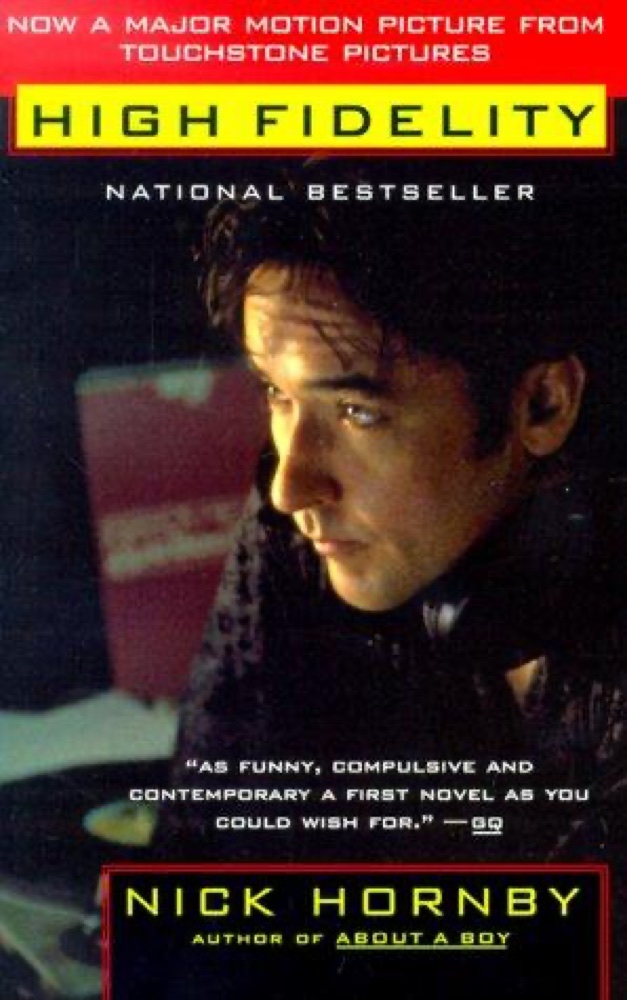
High Fidelity is Nick Hornby's 1995 novel narrated by Rob Fleming, a thirty-five-year-old owner of a struggling London record shop called Championship Vinyl. When his girlfriend Laura leaves him, Rob revisits his "top five all-time most memorable split-ups" and sets out to contact his old girlfriends, hoping to understand why his relationships keep failing. Framed as a first-person confession punctuated by obsessive lists, the book follows Rob's stumbling attempts to grow up, hold onto Laura, and revive his stalled DJ ambitions.
Beneath its comedy the novel examines arrested male adolescence, the way pop-culture fandom becomes a substitute for emotional maturity, and the fear of commitment. Rob and his shop assistants Barry and Dick treat taste in music as a moral hierarchy, ranking songs and relationships alike, and Hornby uses this compulsion to explore how men his character's age can hide behind irony rather than face intimacy and loss.
High Fidelity was a defining book of 1990s British fiction and helped popularize a confessional, music-saturated style of "lad lit." It sold over a million copies, appeared on the BBC's Big Read survey, and was adapted into a 2000 film relocating the story to Chicago, a 2006 Broadway musical, and a 2020 television series, cementing Rob's list-making narration as one of the era's most recognizable literary voices.
Key characters
- Rob FlemingRecord-shop owner and narrator navigating his breakup
- LauraRob's girlfriend, a lawyer, whose departure sets off the story
- BarryRob's loud, opinionated record-shop employee
- DickRob's shy, music-obsessed record-shop employee
- Marie LaSalleAmerican singer-songwriter Rob briefly becomes involved with
Book details
- First published
- 1995
- Length
- 253 pages
- Reading time
- 4 hours
- Author
- Nick Hornby
- Genre
- Literature
- Goodreads rating
- 3.90 (218k ratings) →
- First line
- “My desert-island, all-time, top five most memorable split-ups, in chronological order:”
Movie & TV adaptations
- IMDb
- IMDb
- IMDb
If you liked this, read…
- 1About a BoyHornby's own comic novel of an immature man reluctantly growing up
- 2Fever PitchHornby's memoir applying the same obsessive-fandom voice to football
Keep reading
 A Long Way Down
 Attempting Normal
 This Song Will Save Your Life
 My Booky Wook
 Second Helpings
 The Gum Thief
 Sloppy Firsts
 Tell Me Three Things
 Will Grayson, Will Grayson
How to Be Good
Will Grayson, Will Grayson
How to Be Good
 Buffering: Unshared Tales of a Life Fully Loaded
 When It Happens
 Tweak: Growing Up On Methamphetamines
 Gone Girl
 More, Now, Again: A Memoir of Addiction
 Mosquitoland
 Belong to Me
 Looking for Alibrandi
 Sing You Home
 Every Exquisite Thing
 How to Kill a Rock Star
 Wishful Drinking
 Different Seasons
 Bruiser
 My Not So Perfect Life
 600 Hours of Edward
 Microserfs
 Clothes, Clothes, Clothes. Music, Music, Music. Boys, Boys, Boys
 Life
Life
 Mo' Meta Blues: The World According to Questlove
 Humans of New York
 Hard-Boiled Wonderland and the End of the World
 The Golden Notebook
 Infinite Jest
 Dry
Dry
 Permanent Record
 Eleanor Oliphant Is Completely Fine
 Extremely Loud and Incredibly Close
 Love Is a Mix Tape
 Ask the Passengers
 Finding Audrey
 A Fraction of the Whole
 It's Kind of a Funny Story
 Saving June
 Something Borrowed
 The Love of My Afterlife
 The Time of My Life
 How To Talk To A Widower
 The Folded Clock: A Diary
 A Pho Love Story
 I'm Fine...And Other Lies
 Seven Types of Ambiguity
 The Ex Talk
 The Return
 Norwegian Wood
 The Beginning of Everything
 Sex, Drugs, and Cocoa Puffs: A Low Culture Manifesto
 The Fortunes of Indigo Skye
 Thirteen Reasons Why