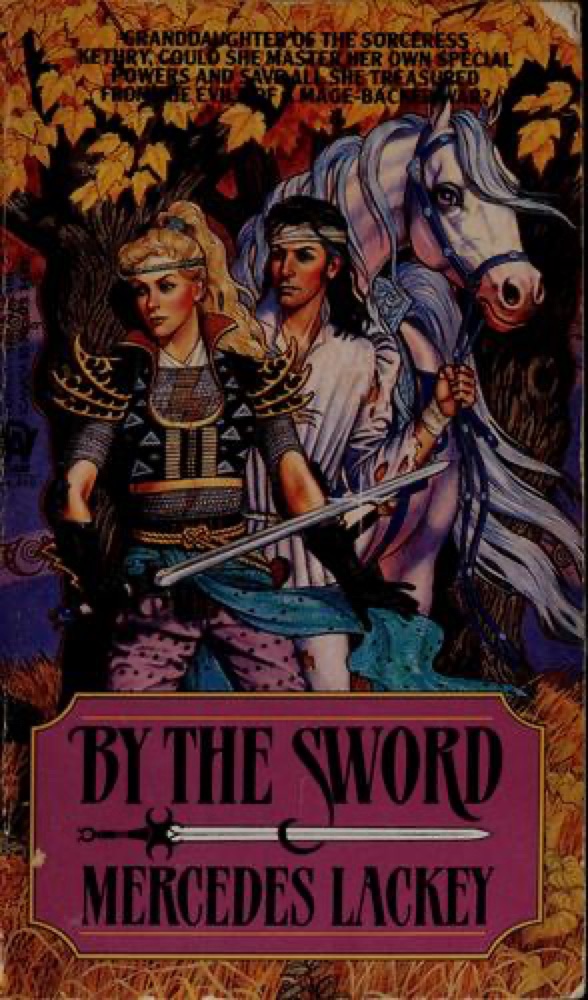

Quotes from By the Sword

Mercedes Lackey ·  492 pages

Rating: (18.3K votes)


“Three things never anger or you'll not live for long;
A wolf with cubs,
A man with power, And a woman's sense of wrong.”
― Mercedes Lackey, quote from By the Sword


“Three things trust and cherish well-
The horse on which you ride,
The beast that guards and watches,
And your shield-mate at your side.”
― Mercedes Lackey, quote from By the Sword


“Of three things be wary-
of a feather on a cat,
The shepherd eating mutton,
And a guardsman that is fat. ”
― Mercedes Lackey, quote from By the Sword


“Three things never trust in-
The maiden sworn as pure,
The vows a king has given,
And an ambush that is sure.”
― Mercedes Lackey, quote from By the Sword


“Three things see no end-
A flower blighted ere it bloomed,
A message that was wasted,
And a journey that was doomed.”
― Mercedes Lackey, quote from By the Sword


“Three things know a secret-
First; the lady in a dream,
The dog that barks no warning,
And a maid that does not scream.”
― Mercedes Lackey, quote from By the Sword


“That’s how you tell a merc is dead; he just stops collecting paychecks.”
― Mercedes Lackey, quote from By the Sword


About the author

Mercedes Lackey
Born place: in Chicago, Illinois, The United States
Born date June 24, 1950
See more on GoodReads

Popular quotes

“A man can see by starlight, if he takes the time.”
― Michael Crichton, quote from Next


“Our study of psychoneurotic disturbances points to a more comprehensive explanation, which includes that of Westermarck. When a wife loses her husband, or a daughter her mother, it not infrequently happens that the survivor is afflicted with tormenting scruples, called ‘obsessive reproaches’ which raises the question whether she herself has not been guilty through carelessness or neglect, of the death of the beloved person. No recalling of the care with which she nursed the invalid, or direct refutation of the asserted guilt can put an end to the torture, which is the pathological expression of mourning and which in time slowly subsides. Psychoanalytic investigation of such cases has made us acquainted with the secret mainsprings of this affliction. We have ascertained that these obsessive reproaches are in a certain sense justified and therefore are immune to refutation or objections. Not that the mourner has really been guilty of the death or that she has really been careless, as the obsessive reproach asserts; but still there was something in her, a wish of which she herself was unaware, which was not displeased with the fact that death came, and which would have brought it about sooner had it been strong enough. The reproach now reacts against this unconscious wish after the death of the beloved person. Such hostility, hidden in the unconscious behind tender love, exists in almost all cases of intensive emotional allegiance to a particular person, indeed it represents the classic case, the prototype of the ambivalence of human emotions. There is always more or less of this ambivalence in everybody’s disposition; normally it is not strong enough to give rise to the obsessive reproaches we have described. But where there is abundant predisposition for it, it manifests itself in the relation to those we love most, precisely where you would least expect it. The disposition to compulsion neurosis which we have so often taken for comparison with taboo problems, is distinguished by a particularly high degree of this original ambivalence of emotions.”
― Sigmund Freud, quote from Totem and Taboo


“And so she cut out her heart and offered it as a sacrifice. She would pay whatever price her mother Wallachia demanded.
“Make me prince,” she said without feeling.”
― Kiersten White, quote from And I Darken


“The future of the human race outweighs all. Every death and every sacrifice are well worth the ultimate outcome.”
― James Dashner, quote from The Maze Runner Series


“WHY THE SEA IS SALT Once upon a time, long, long ago, there were two brothers, the one rich and the other poor. When Christmas Eve came, the poor one had not a bite in the house, either of meat or bread; so he went to his brother, and begged him, in God's name, to give him something for Christmas Day. It was by no means the first time that the brother had been forced to give something to him, and he was not better pleased at being asked now than he generally was. "If you will do what I ask you, you shall have a whole ham," said he. The poor one immediately thanked him, and promised this. "Well, here is the ham, and now you must go straight to Dead Man's Hall," said the rich brother, throwing the ham to him. "Well, I will do what I have promised," said the other, and he took the ham and set off. He went on and on for the livelong day, and at nightfall he came to a place where there was a bright light. "I have no doubt this is the place," thought the man with the ham. An old man with a long white beard was standing in the outhouse, chopping Yule logs. "Good-evening," said the man with the ham. "Good-evening to you. Where are you going at this late hour?" said the man. "I am going to Dead Man's Hall, if only I am on the right track," answered the poor man. "Oh! yes, you are right enough, for it is here," said the old man. "When you get inside they will all want to buy your ham, for they don't get much meat to eat there; but you must not sell it unless you can get the hand-mill which stands behind the door for it. When you come out again I will teach you how to stop the hand-mill, which is useful for almost everything." So the man with the ham thanked the other for his good advice, and rapped at the door. When he got in, everything happened just as the old man had said it would: all the people, great and small, came round him like ants on an ant-hill, and each tried to outbid the other for the ham. "By rights my old woman and I ought to have it for our Christmas dinner, but, since you have set your hearts upon it, I must just give it up to you," said the man. "But, if I sell it, I will have the hand-mill which is standing there behind the door." At first they would not hear of this, and haggled and bargained with the man, but he stuck to what he had said, and the people were forced to give him the hand-mill. When the man came out again into the yard, he asked the old wood-cutter how he was to stop the hand-mill, and when he had learned that, he thanked him and set off home with all the speed he could, but did not get there until after the clock had struck twelve on Christmas Eve.”
― Andrew Lang, quote from The Blue Fairy Book


Interesting books

Come Back to Me
(5.4K)
Come Back to Me
by Mila Gray
The Tao of Wu
(2.5K)
The Tao of Wu
by The RZA
All My Friends are Superheroes
(8.9K)
All My Friends are S...
by Andrew Kaufman
Accuse
(384)
Accuse
by Nikki Sex
Give It Back
(0.9K)
Give It Back
by Danielle Esplin
The Rose & the Dagger
(37K)
The Rose & the Dagge...
by Renee Ahdieh

About BookQuoters

BookQuoters is a community of passionate readers who enjoy sharing the most meaningful, memorable and interesting quotes from great books. As the world communicates more and more via texts, memes and sound bytes, short but profound quotes from books have become more relevant and important. For some of us a quote becomes a mantra, a goal or a philosophy by which we live. For all of us, quotes are a great way to remember a book and to carry with us the author’s best ideas.

We thoughtfully gather quotes from our favorite books, both classic and current, and choose the ones that are most thought-provoking. Each quote represents a book that is interesting, well written and has potential to enhance the reader’s life. We also accept submissions from our visitors and will select the quotes we feel are most appealing to the BookQuoters community.

Founded in 2023, BookQuoters has quickly become a large and vibrant community of people who share an affinity for books. Books are seen by some as a throwback to a previous world; conversely, gleaning the main ideas of a book via a quote or a quick summary is typical of the Information Age but is a habit disdained by some diehard readers. We feel that we have the best of both worlds at BookQuoters; we read books cover-to-cover but offer you some of the highlights. We hope you’ll join us.