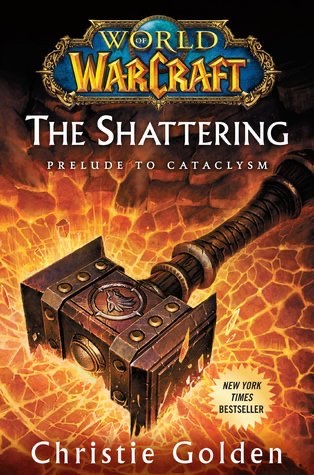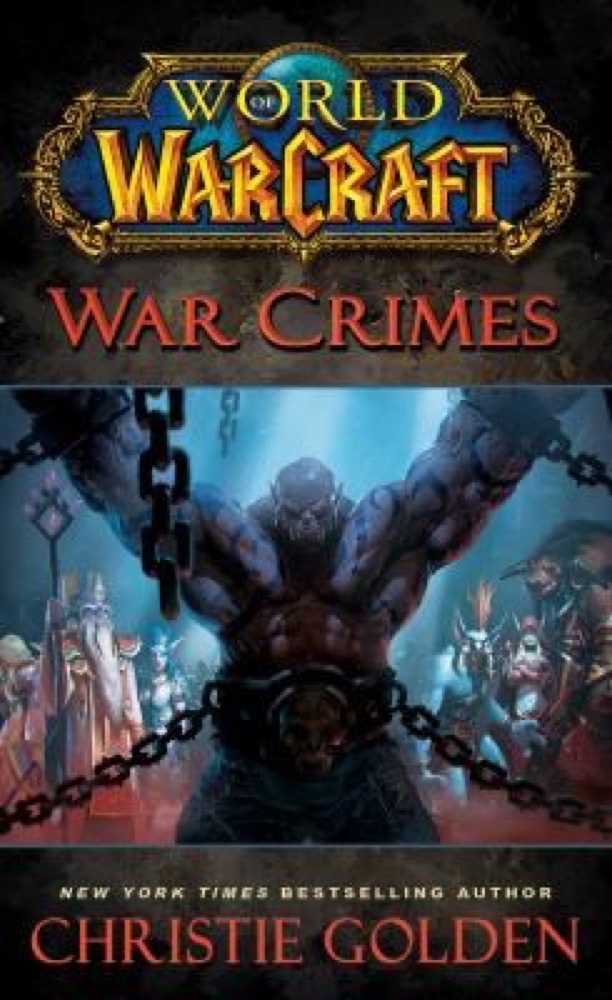

“Life is not about reward and punishment,” said Xuen. “It is about understanding, accepting who oneself is right now, in order to know what to change, and how.”
― Christie Golden, quote from War Crimes
“How have you managed to survive for so long, Saurfang? Not fallen victim to your own memories?” Saurfang smiled. “I don’t eat pork.”
― Christie Golden, quote from War Crimes
“Cooperation was possible; he’d seen it. Every individual was unique—and could grow.”
― Christie Golden, quote from War Crimes
“All nights end, and all storms clear. The only storms that last are those within your own soul.”
― Christie Golden, quote from War Crimes
“Such was the way of the discontented. No proof, no explanation or reason would ever be enough to disabuse them of tightly held, deeply cherished grievances.”
― Christie Golden, quote from War Crimes
“He stabbed a sharp-nailed digit in the direction of the Shattered Straits,”
― Christie Golden, quote from War Crimes
“shape about the size of a large dog hovering a few yards over his head.”
― Christie Golden, quote from War Crimes
“And in whatever afterlife your precious Light grants you, your parents will wish Queen Tiffin had miscarried.”
― Christie Golden, quote from War Crimes
“Thus is the blessing of Chi-Ji,” the crane said. “No more shall die this day. Take this second chance, and use it wisely.”
― Christie Golden, quote from War Crimes
“Wishes do not a world make. We do the best we can where we are, every minute, every breath. We make mistakes, and we have to live with them. We try to learn from them. And that is all we can do.”
― Christie Golden, quote from War Crimes
“Asked about the role of America’s newspaper publishers, later, when they opposed him editorially, he answered, “Their job is to separate the wheat from the chaff and then print the chaff.”
― David Halberstam, quote from The Fifties
“It is in our collective behavior that we are the most mysterious. We won't be able to construct machines like ourselves until we've understood this, and we're not even close. All we know is the phenomenon: we spend our time sending messages to each other, talking and trying to listen at the same time, exchanging information. This seems to be our most urgent biological function; it is what we do with our lives. By the time we reach the end, each of us has taken in a staggering store, enough to exhaust any computer, much of it incomprehensible, and we generally manage to put out even more than we take in. Information is our source of energy; we are driven by it. It has become a tremendous enterprise, a kind of energy system on its own. All 3 billion of us are being connected by telephones, radios, television sets, airplanes, satellites, harangues on public-address systems, newspapers, magazines, leaflets dropped from great heights, words got in edgewise. We are becoming a grid, a circuitry around the earth.”
― Lewis Thomas, quote from The Lives of a Cell: Notes of a Biology Watcher
“When Communism fell in 1989, the temptation for Western commentators to gloat triumphantly proved irresistible. This, it was declared, marked the end of History. Henceforth, the world belonged to liberal capitalism – there was no alternative – and we would all march forward in unison towards a future shaped by peace, democracy and free markets. Twenty years on this assertion looks threadbare.
There can be no question that the fall of the Berlin Wall and the domino-like collapse of Communism states from the suburbs of Vienna to the shores of the Pacific marked a very significant transition: one in which millions of men and women were liberated from a dismal and defunct ideology and its authoritarian institutions. But no one could credibly assert that what replaced Communism was an era of idyllic tranquility. There was no peace in post-Communist Yugoslavia, and precious little democracy in any of the successor states of the Soviet Union.
As for free markets, they surely flourished, but it is not clear for whom. The West – Europe and the United States above all – missed a once-in-a-century opportunity to re-shape the world around agreed and improved international institutions and practices. Instead, we sat back and congratulated ourselves upon having won the Cold War: a sure way to lose the peace. The years from 1989 to 2009 were consumed by locusts.”
― Tony Judt, quote from Ill Fares the Land
“The ultimate good of the gospel is seeing and savoring the beauty and value of God. God’s wrath and our sin obstruct that vision and that pleasure. You can’t see and savor God as supremely satisfying while you are full of rebellion against Him and He is full of wrath against you. The removal of this wrath and this rebellion is what the gospel is for. The ultimate aim of the gospel is the display of God’s glory and the removal of every obstacle to our seeing it and savoring it as our highest treasure. “Behold Your God!” is the most gracious command and the best gift of the gospel. If we do not see Him and savor Him as our greatest fortune, we have not obeyed or believed the gospel.”
― John Piper, quote from God Is the Gospel: Meditations on God's Love as the Gift of Himself
“It’s one thing building a cloister to reflect the 768 of the numerological Bismillah, it’s another planning a giant alphabet out of an entire city before you’ve even built your first mosque.’
‘It is, but remember, Sinan was chief architect and city planner at the time of the conquest of Cairo. He practised on that city; demolishing and building where he liked. I have no doubt that he was already forming the idea of a sacred geometry. His first building as Architect of the Abode of Felicity was the Haseki Hürrem Mosque for the Kadin Roxelana. Not his greatest work by any means, and he was working from existing designs, but it was identifiable as his first mature work. There’s a story in his autobiography Tezkiretül Bünyan that while he was surveying the site he noticed that children were pulling live fish from a grating in the street. When he went to investigate he discovered an entire Roman cistern down there. Perhaps it was this that inspired him to realize his vision. Hidden water. The never-ceasing stream of Hurufism.”
― Ian McDonald, quote from The Dervish House
BookQuoters is a community of passionate readers who enjoy sharing the most meaningful, memorable and interesting quotes from great books. As the world communicates more and more via texts, memes and sound bytes, short but profound quotes from books have become more relevant and important. For some of us a quote becomes a mantra, a goal or a philosophy by which we live. For all of us, quotes are a great way to remember a book and to carry with us the author’s best ideas.
We thoughtfully gather quotes from our favorite books, both classic and current, and choose the ones that are most thought-provoking. Each quote represents a book that is interesting, well written and has potential to enhance the reader’s life. We also accept submissions from our visitors and will select the quotes we feel are most appealing to the BookQuoters community.
Founded in 2023, BookQuoters has quickly become a large and vibrant community of people who share an affinity for books. Books are seen by some as a throwback to a previous world; conversely, gleaning the main ideas of a book via a quote or a quick summary is typical of the Information Age but is a habit disdained by some diehard readers. We feel that we have the best of both worlds at BookQuoters; we read books cover-to-cover but offer you some of the highlights. We hope you’ll join us.