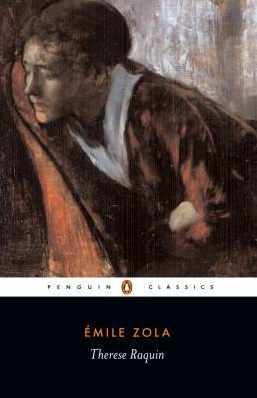
“They dared not peer down into their own natures, down into the feverish confusion that filled their minds with a kind of dense, acrid mist.”
― Émile Zola, quote from Thérèse Raquin
“When there is no hope in the future, the present appears atrociously bitter.”
― Émile Zola, quote from Thérèse Raquin
“Nothing could be more heart rending than this mute and motionless dispair”
― Émile Zola, quote from Thérèse Raquin
“In the sudden change that had come over her heart she no longer recognized herself”
― Émile Zola, quote from Thérèse Raquin
“Sometimes she was seized with hallucinations and thought she was buried in some vault together with a lot of puppet-like corpses which nodded their heads and moved their legs and arms when you pulled the strings.”
― Émile Zola, quote from Thérèse Raquin

“He knew that, from now on, every day would be alike, that they would all bring the same sufferings. And he saw the weeks, the months, the years that awaited him, gloomy and implacable, coming one after the other, falling on him and suffocating him bit by bit. When the future is without hope, the present takes on a vile, bitter taste.”
― Émile Zola, quote from Thérèse Raquin
“they seemed to be greater strangers than before”
― Émile Zola, quote from Thérèse Raquin
“Living in musty shadows and dismal, oppressive silence, Thérèse could see her whole life stretching out before her totally void, bringing night after night the same cold bed and morning after morning the same empty day.”
― Émile Zola, quote from Thérèse Raquin
“She made one instinctive effort to resist and then yielded, slipping down on to the floor. Not a single word was exchanged. The act was silent and brutal”
― Émile Zola, quote from Thérèse Raquin
“They have so smothered me in their middle-class refinement that I don't know how there can be any blood left in my veins. I lowered my eyes, put on a dismal, silly expression, just like them; I was just as dead-and-alive as they were.”
― Émile Zola, quote from Thérèse Raquin
“After a time, she believed in the reality of this comedy”
― Émile Zola, quote from Thérèse Raquin
“The critics greeted this book with a churlish and horrified outcry. Certain virtuous people, in newspapers no less virtuous, made a grimace of disgust as they picked it up with the tongs to throw it into the fire. Even the minor literary reviews, the ones that retail nightly the tittle-tattle from alcoves and private rooms, held their noses and talked of filth and stench. I am not complaining about this reception; on the contrary I am delighted to observe that my colleagues have such maidenly susceptibilities.”
― Émile Zola, quote from Thérèse Raquin
“In cima alla via Guénégaud, venendo dalla strada lungo la Senna, si trova il passaggio del Ponte Nuovo, una specie di corridoio stretto e oscuro che va dalla via Mazarino alla via della Senna. Quel passaggio ha, al massimo, trenta passi di lunghezza e due di larghezza; è selciato di pietre giallastre, consunte, sconnesse, che trasudano sempre un'acre umidità; la vetrata che lo ricopre, tagliata ad angolo retto, è nera di sporcizia.
Nei bei giorni d'estate, quando un ardente sole incendia le vie, un chiarore biancastro cade dai vetri sporchi e si trascina miseramente nel passaggio. Nei brutti giorni d'inverno, nelle mattinate di nebbia, i vetri gettano soltanto oscurità sulle pietre viscide, oscurità sporca e ignobile.”
― Émile Zola, quote from Thérèse Raquin
“All his [Laurent's] great powerful body wanted was to do nothing, to wallow in never-ending idleness and self-indulgence. He would have liked to eat well, sleep well, satisfy his passions liberally, without stirring from one spot or risking the misfortune of a bit of fatigue.”
― Émile Zola, quote from Thérèse Raquin
“On her [Thérèse's] part she seemed to revel in daring and shamelessness. Not a single moment of hesitation or fear possessed her. She threw herself into adultery with a kind of furious honesty, flouting danger, and as it were, taking pride in doing so.”
― Émile Zola, quote from Thérèse Raquin
“When they got back into the carriage they felt greater strangers than before.”
― Émile Zola, quote from Thérèse Raquin
“The couple fell one atop of the other, struck down, finding consolation, at last, in death.”
― Émile Zola, quote from Thérèse Raquin
“Quando non c’è più speranza nel futuro, il presente si colora di una spaventosa amarezza.”
― Émile Zola, quote from Thérèse Raquin
“such a strange look of repugnance and horror”
― Émile Zola, quote from Thérèse Raquin
“His remorse was purely physical. Only his body, strained nerves, and cowering flesh were afraid of the drowned man. Conscience played no part in his terrors, and he had not the slightest regret about killing Camille; in his moments of calm, when the spectre was not present, he would have committed the murder over again had he thought his interests required it.”
― Émile Zola, quote from Thérèse Raquin
“Like certain devotees, who think they can fool God and wrest a pardon by paying lip-service to prayer and adopting the humble attitude of the penitent, Therese humiliated herself, beat her chest, found words of repentance, without having anything in the bottom of her heart except fear and cowardice.”
― Émile Zola, quote from Thérèse Raquin
“O şimdiye kadar bedeniyle sevmişti. Şimdi kafasıyla sevmeye başladı.”
― Émile Zola, quote from Thérèse Raquin
“La disperazione non si era mai abbattuta con tanto furore su un essere umano. La sinistra verità bruciò con l’impeto di un lampo negli occhi della paralitica e s’insediò in lei con la ferocia senza scampo della folgore. Se avesse potuto alzarsi in piedi, vomitare l’orrore che l’afferrava alla gola, maledire gli assassini del figlio, avrebbe sofferto di meno. Invece, dopo aver ascoltato, dopo aver compreso, era condannata a rimanere immobile, chiusa nel silenzio, a custodire quel dolore scoppiante: non aveva scampo.”
― Émile Zola, quote from Thérèse Raquin
“Lorsque l'avenir est sans espoir, le présent prend une amertume ignoble”
― Émile Zola, quote from Thérèse Raquin
“Gli amanti non cercarono mai di vedersi da soli. Non si diedero nessun appuntamento, non si scambiarono neanche un bacio furtivo. Per il momento, il delitto aveva placato la spinta impetuosa della carne: uccidendo Camillo, erano riusciti a soddisfare la foga insaziabile del desiderio che non avevano potuto appagare gettandosi l’uno nelle braccia dell’altro. L’omicidio era divenuto, ai loro occhi, simile a un indicibile perenne stato d’orgasmo che annullava la possibilità di un amplesso, tramutato al confronto in ben misera cosa.”
― Émile Zola, quote from Thérèse Raquin
“La nature et les circonstances semblaient avoir fait cette femme pour cet homme, et les avoir poussés l'un vers l'autre.”
― Émile Zola, quote from Thérèse Raquin
“Laurent avait élargi une de ses grosses mains dont il regardait attentivement la paume. Ses doigts eurent de légers frémissements, des lueurs rouges montèrent à ses joues ... Laurent leva la tête et vit Thérèse devant lui, muette, immobile. La jeune femme le regardait avec une fixité ardente. Ses yeux, d'un noir mat, semblaient deux trous sans fond, et, par ses lèvres entrouvertes, on apercevait des clartés roses dans sa bouche. Elle était comme écrasée, ramassée sur elle-même; elle écoutait.”
― Émile Zola, quote from Thérèse Raquin
“À eux deux, la femme, nerveuse et hypocrite, l'homme, sanguin et vivant en brute, ils faisaient un couple puissamment lié. Ils se complétaient, se protégeaient mutuellement. Le soir, à table, dans les clartés pâles de la lampe, on sentait la force de leur union, à voir le visage épais et souriant de Laurent, en face du masque muet et impénétrable de Thérèse.”
― Émile Zola, quote from Thérèse Raquin
“Il a besoin de cette femme pour vivre comme on a besoin de boire et de manger.”
― Émile Zola, quote from Thérèse Raquin
“Laurent sollevò il capo e si vide davanti Thérèse, zitta, immobile. La giovane donna lo guardava con una fissità ardente. Di un nero opaco i suoi occhi sembravano due cavità abissali; attraverso le labbra socchiuse si intravedevano nella bocca rosei luccicori. Era come annientata, rattrappita su se stessa; ascoltava.”
― Émile Zola, quote from Thérèse Raquin
Émile Zola
Born place: in Paris, France
Born date April 2, 1840
See more on GoodReads
“You let us out right now, o r Gabe is going to shoot you with his gun! I mean it! He’s got a million guns, and he’ll shoot you, then cut you up with a knife!”
― Susan Elizabeth Phillips, quote from Dream a Little Dream
“It's never right to give up on someone.”
― Lauren DeStefano, quote from Fever
“[He taught her] that life is interwoven with suffering. That in every life, without exception, illnesses are unavoidable. That we will age, and that we cannot elude death. These are the laws and conditions of human existence.”
― Jan-Philipp Sendker, quote from The Art of Hearing Heartbeats
“Tenho uma doença que está além do alcance da medicina; mesmo meu bom amigo Graham não tem cura para ela. Assim que eu chegar em terra, vou querer partir de novo. Meu lar é o navio. Minha pátria é o mar.”
― Celia Rees, quote from Pirates!
“Part of him wanted to weep... but his purpose was rigid within him. He felt he could not bend to gentleness without breaking.”
― Stephen R. Donaldson, quote from The Chronicles of Thomas Covenant, the Unbeliever
 The Snail on the Slo...
 Masterpiece
 The Giant's House
 The Book of Tea
 The Complete Poems
 Artemisia
BookQuoters is a community of passionate readers who enjoy sharing the most meaningful, memorable and interesting quotes from great books. As the world communicates more and more via texts, memes and sound bytes, short but profound quotes from books have become more relevant and important. For some of us a quote becomes a mantra, a goal or a philosophy by which we live. For all of us, quotes are a great way to remember a book and to carry with us the author’s best ideas.
We thoughtfully gather quotes from our favorite books, both classic and current, and choose the ones that are most thought-provoking. Each quote represents a book that is interesting, well written and has potential to enhance the reader’s life. We also accept submissions from our visitors and will select the quotes we feel are most appealing to the BookQuoters community.
Founded in 2023, BookQuoters has quickly become a large and vibrant community of people who share an affinity for books. Books are seen by some as a throwback to a previous world; conversely, gleaning the main ideas of a book via a quote or a quick summary is typical of the Information Age but is a habit disdained by some diehard readers. We feel that we have the best of both worlds at BookQuoters; we read books cover-to-cover but offer you some of the highlights. We hope you’ll join us.
