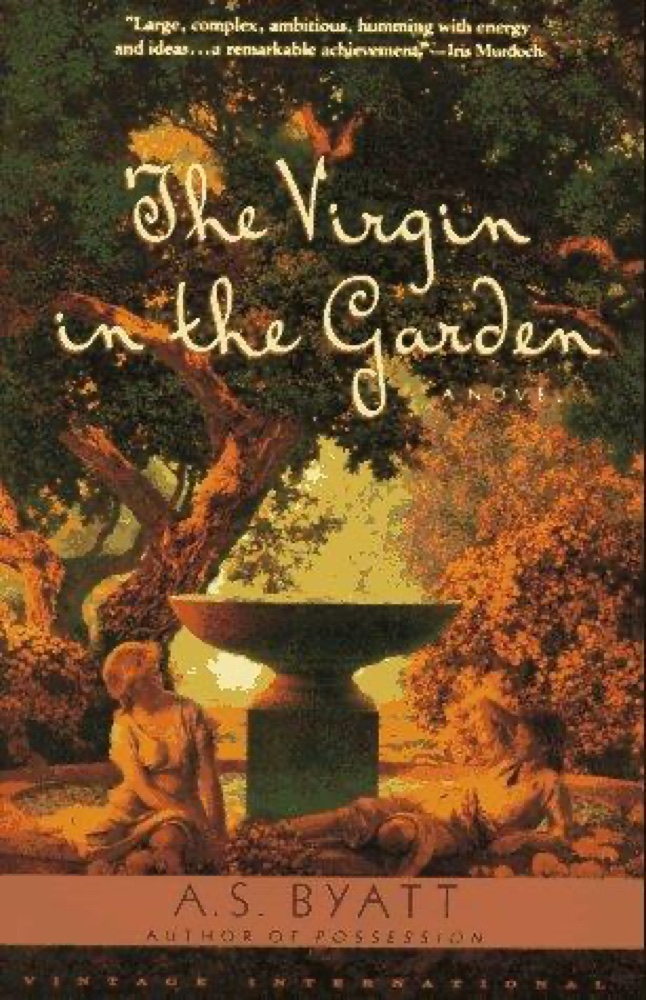

Quotes from The Virgin in the Garden

A.S. Byatt ·  428 pages

Rating: (2.7K votes)


“Lists are a form of power.”
― A.S. Byatt, quote from The Virgin in the Garden


“...it is not possible to create the opposite of what one has always known, simply because the opposite is believed to be desired. Human beings need what they already know, even horrors.”
― A.S. Byatt, quote from The Virgin in the Garden


“There was a moment during this time, when his face was on hers, cheek on cheek, brow on brow, heavy skull on skull, through soft skin and softer flesh. He thought: skulls separate people. In this one sense, I could say, they would say, I lose myself in her. But in that bone box, she thinks and thinks, as I think in mine, things the other won't hear, can't hear, though we go on like this for sixty years. What does she think I am? He had no idea. He had no idea what she was.”
― A.S. Byatt, quote from The Virgin in the Garden


“A metamorphosis... The shining butterfly of the soul from the pupa of the body. Larva, pupa, imago. An image of art.”
― A.S. Byatt, quote from The Virgin in the Garden


“Those words . . . national and portrait. They were both to do with identity: the identity of a culture (place, language and history), the identity of an individual human being as an object for mimetic representation.”
― A.S. Byatt, quote from The Virgin in the Garden


“Contemporary' was in those days [1953] synonymous with 'modern' as it had not been before and is not now [1977].”
― A.S. Byatt, quote from The Virgin in the Garden


About the author

A.S. Byatt
Born place: in Sheffield, Yorkshire, The United Kingdom
Born date August 24, 1936
See more on GoodReads

Popular quotes

“No hells or heavens has Mirdad to offer you, but Holy Understanding which lifts you far beyond the fire of any hell and the luxuriance of any heaven. Not with the hand, but with the heart must you receive the gift. For that the heart must needs be disencumbered of every stray desire and will, save the desire and will to understand.”
― Mikhail Naimy, quote from The Book of Mirdad: The Strange Story of a Monastery Which Was Once Called the Ark


“I am glad I have caught up with you,”
― quote from Little Pilgrim's Progress: From John Bunyan's Classic


“You see, each country has a colour, a smell, and also a contagious sickness. In my country the sickness is complacency. In France it's arrogance, and in the United States it's ignorance."

"What about Rwanda?"

"Easy power and impunity. Here, there's total disorder. To someone who has a little money or powere, everything that seems forbidden elsewhere looks permissible and possible. All it takes is to dare it. Someone who's simply a liar in my country can be a fraud artist here, and the fraud artist gets to be a big-time thief. Chaos and most of all poverty give him powers he wouldn't have elsewhere.”
― Gil Courtemanche, quote from A Sunday at the Pool in Kigali


“Intensity of experience is what we're looking for, I think. We know we won't find it at home any more, but there's always the hope that we'll find it abroad”
― David Lodge, quote from Small World


“We come into contact with people only with our exteriors—physically and externally; yet each of us walks about with a great wealth of interior life, a private and secret self. We are, in reality, somewhat split in two, the self and the body; the one hidden, the other open. The child learns very quickly to cultivate this private self
because it puts a barrier between him and the demands of the world. He learns he can keep secrets—at first an excruciating, intolerable burden: it seems that the outer world has every right to penetrate into his self and that the parents could automatically do so if they wished—they always seem to know just what he is thinking and feeling. But then he discovers that he can lie and not be found out: it is a
great and liberating moment, this anxious first lie—it represents the staking out of his claim to an integral inner self, free from the prying eyes of the world. By the time we grow up we become masters at dissimulation, at cultivating a self that the world cannot probe. But we pay a price. After years of turning people away,
of protecting our inner self, of cultivating it by living in a different world, of furnishing this world with our fantasies and dreams—we find that we are hopelessly separated from everyone else. We have become victims of our own art. We touch people on the outsides of their bodies, and they us, but we cannot get at their insides and cannot reveal our insides to them. This is one of the great tragedies of our interiority—it is utterly personal and unrevealable. Often we want to say something unusually intimate to a spouse, a parent, a friend, communicate
something of how we are really feeling about a sunset, who we really feel we are—only to fall strangely and miserably flat. Once in a great while we succeed, sometimes more with one person, less or never with others. But the occasional breakthrough only proves the rule. You reach out with a disclosure, fail, and fall back bitterly into yourself. We emit huge globs of love to our parents and spouses, and the glob slithers away in exchanges of words that are somehow beside the point of what we are trying to say. People seem to keep bumping up against each other with their exteriors and falling away from each other. The cartoonist Jules Feiffer is the modern master of this aspect of the human tragedy. Take even the sexual act—the most intimate merger given to organisms. For most people, even for their entire lives, it is simply a joining of exteriors. The insides melt only in the moment of orgasm, but even this is brief, and a melting is not a communication. It is a physical overcoming of separateness, not a symbolic revelation and justification of one’s interior. Many people pursue sex precisely because it is a mystique of the overcoming of the separateness of the inner world; and they go from one partner to another because they can never quite achieve “it.” So the endless interrogations: “What are you thinking about right now—me? Do you feel what I feel? Do you love me?”
― Ernest Becker, quote from The Birth and Death of Meaning: An Interdisciplinary Perspective on the Problem of Man


Interesting books

Devil May Cry
(33.5K)
Devil May Cry
by Sherrilyn Kenyon
Fool's Errand
(60.9K)
Fool's Errand
by Robin Hobb
The Woman in Black
(36.7K)
The Woman in Black
by Susan Hill
Factotum
(43.6K)
Factotum
by Charles Bukowski
The Penultimate Peril
(74.5K)
The Penultimate Peri...
by Lemony Snicket
Earth Abides
(20.3K)
Earth Abides
by George R. Stewart

About BookQuoters

BookQuoters is a community of passionate readers who enjoy sharing the most meaningful, memorable and interesting quotes from great books. As the world communicates more and more via texts, memes and sound bytes, short but profound quotes from books have become more relevant and important. For some of us a quote becomes a mantra, a goal or a philosophy by which we live. For all of us, quotes are a great way to remember a book and to carry with us the author’s best ideas.

We thoughtfully gather quotes from our favorite books, both classic and current, and choose the ones that are most thought-provoking. Each quote represents a book that is interesting, well written and has potential to enhance the reader’s life. We also accept submissions from our visitors and will select the quotes we feel are most appealing to the BookQuoters community.

Founded in 2023, BookQuoters has quickly become a large and vibrant community of people who share an affinity for books. Books are seen by some as a throwback to a previous world; conversely, gleaning the main ideas of a book via a quote or a quick summary is typical of the Information Age but is a habit disdained by some diehard readers. We feel that we have the best of both worlds at BookQuoters; we read books cover-to-cover but offer you some of the highlights. We hope you’ll join us.