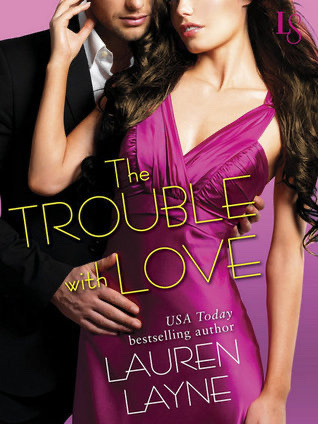

Quotes from The Trouble with Love

Lauren Layne ·  237 pages

Rating: (5K votes)


“Ask me what else I remember."
She started to run away, but his hand touched her arm.
"Ask me," he commanded.
Emma shook her head feeling both terrified and the most alive she'd felt in years.
He waited patiently until her eyes met his. "I remember us, Emma.”
― Lauren Layne, quote from The Trouble with Love


“You want to know what I remember," he said quietly, his fingers fiddling with his cuffs as he rolled the sleeves up to his elbow, his eyes locked on the view before them.
She nodded.
He shoved his hands into his pockets and dipped his head just slightly, glancing at the floor before lifting it and staring out at the night sky.
"I remember everything.”
― Lauren Layne, quote from The Trouble with Love


“That's what we do. We sex things up.”
― Lauren Layne, quote from The Trouble with Love


“Just that I figure at some point, some guy must have been able to make you smile. And I always wondered if it was the same guy that made you stop.”
― Lauren Layne, quote from The Trouble with Love


About the author

Lauren Layne
Born place: The United States
See more on GoodReads

Popular quotes

“It says ‘One Step at a Time’.”
― Kristen Proby, quote from Come Away with Me


“beer is an excellent argument that there is a God, and that furthermore, He wants us to be happy.”
― Jim Butcher, quote from Skin Game


“They laugh at this, the idea that one might keep herds of friendly deer or elk that walk happily to their slaughter whenever it's time for the human to eat meat. Some ask openly if there aren't consequences of a life so easy to live.”
― Joseph Boyden, quote from The Orenda


“Mr. Lynn gave her one of his considering looks. "People are strange," he said. "Usually they're much stranger than you think. Start from there and you'll never be unpleasantly surprised. Do you fancy doughnuts?”
― Diana Wynne Jones, quote from Fire and Hemlock


“Studentdom, he felt, must pass its own Examinations and define its own Commencement--a slow, most painful process, made the more anguishing by bloody intelligences like the Bonifacists of Siegfrieder College. Yet however it seemed at times that men got nowhere, but only repeated class by class the mistakes of their predecessors, two crucial facts about them were at once their hope and the limitation of their possibility, so he believed. One was their historicity: the campus was young, the student race even younger, and by contrast with the whole of past time, the great collegiate cultures had been born only yesterday. The other had to do with comparative cyclology, a field of systematic speculation he could not review for me just then, but whose present relevance lay in the correspondency he held to obtain between the life-history of individuals and the history of studentdom in general. As the embryologists maintained that ontogeny repeats phylogeny, so, Max claimed, the race itself--and on a smaller scale, West-Campus culture--followed demonstrably--in capital letters, as it were, or slow motion--the life-pattern of its least new freshman. This was the basis of Spielman's Law--ontogeny repeats cosmogeny--and there was much more to it and to the science of cyclology whereof it was first principle. The important thing for now was that, by his calculations, West-Campus as a whole was in mid-adolescence...
'Look how we been acting,' he invited me, referring to intercollegiate political squabbles; 'the colleges are spoilt kids, and the whole University a mindless baby, ja? Okay: so weren't we all once, Enos Enoch too? And we got to admit that the University's a precocious kid. If the history of life on campus hadn't been so childish, we couldn't hope it'll reach maturity.' Studentdom had passed already, he asserted, from a disorganized, pre-literate infancy (of which Croaker was a modern representative, nothing ever being entirely lost) through a rather brilliant early childhood ('...ancient Lykeion, Remus, T'ang...') which formed its basic and somewhat contradictory character; it had undergone a period of naive general faith in parental authority (by which he meant early Founderism) and survived critical spells of disillusionment, skepticism, rationalism, willfulness, self-criticism, violence, disorientation, despair, and the like--all characteristic of pre-adolescence and adolescence, at least in their West-Campus form. I even recognized some of those stages in my own recent past; indeed, Max's description of the present state of West-Campus studentdom reminded me uncomfortably of my behavior in the Lady-Creamhair period: capricious, at odds with itself, perverse, hard to live with. Its schisms, as manifested in the Quiet Riot, had been aggravated and rendered dangerous by the access of unwonted power--as when, in the space of a few semesters, a boy finds himself suddenly muscular, deep-voiced, aware of his failings, proud of his strengths, capable of truly potent love and hatred--and on his own. What hope there was that such an adolescent would reach maturity (not to say Commencement) without destroying himself was precisely the hope of the University.”
― John Barth, quote from Giles Goat-Boy


Interesting books

Feel the Fear and Do It Anyway
(21.6K)
Feel the Fear and Do...
by Susan Jeffers
Milkweed
(21.8K)
Milkweed
by Jerry Spinelli
The Magician's Elephant
(17.1K)
The Magician's Eleph...
by Kate DiCamillo
The Map of Time
(10.7K)
The Map of Time
by Félix J. Palma
A Stolen Life
(83.5K)
A Stolen Life
by Jaycee Dugard
The Loved One
(8.8K)
The Loved One
by Evelyn Waugh

About BookQuoters

BookQuoters is a community of passionate readers who enjoy sharing the most meaningful, memorable and interesting quotes from great books. As the world communicates more and more via texts, memes and sound bytes, short but profound quotes from books have become more relevant and important. For some of us a quote becomes a mantra, a goal or a philosophy by which we live. For all of us, quotes are a great way to remember a book and to carry with us the author’s best ideas.

We thoughtfully gather quotes from our favorite books, both classic and current, and choose the ones that are most thought-provoking. Each quote represents a book that is interesting, well written and has potential to enhance the reader’s life. We also accept submissions from our visitors and will select the quotes we feel are most appealing to the BookQuoters community.

Founded in 2023, BookQuoters has quickly become a large and vibrant community of people who share an affinity for books. Books are seen by some as a throwback to a previous world; conversely, gleaning the main ideas of a book via a quote or a quick summary is typical of the Information Age but is a habit disdained by some diehard readers. We feel that we have the best of both worlds at BookQuoters; we read books cover-to-cover but offer you some of the highlights. We hope you’ll join us.