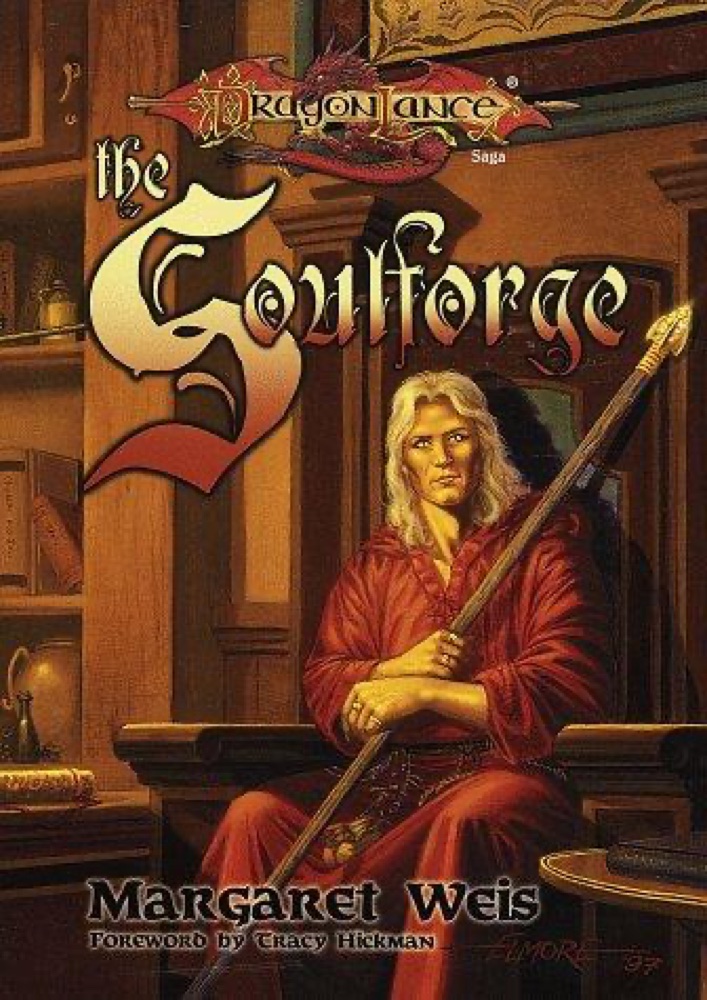
Quotes from The Soulforge

Margaret Weis ·  408 pages

Rating: (9K votes)


“The blade must past threw the fire, else it breaks.”
― Margaret Weis, quote from The Soulforge


“You cannot hide from danger. Death floats on the air, creeps through the window, comes with the handshake of a stranger. If we stop living because we fear death, then we have already died.

-Raistlin Majere”
― Margaret Weis, quote from The Soulforge


“A mage's soul is forged in the crucible of the magic”
― Margaret Weis, quote from The Soulforge


“and someday, fat innkeepers will bow to me.”
― Margaret Weis, quote from The Soulforge


“If I am to be judged by those who come after me, let me be judged for the truth.”
― Margaret Weis, quote from The Soulforge


“The magic will not solve your problems. It will only add to them. The magic will not make people like you. It will increase their distrust. The magic will not ease your pain. It will twist and burn inside you until sometimes you think that even death would be preferable."
-Antimodes, "Soulforge”
― Margaret Weis, quote from The Soulforge


“So dark. Endless darkness, eternal. It was not the absence of light that was so frightening as the absence of thought, of knowledge, of comprehension. Our lives, the lives of the living will go on. The sun shines, the moons rise, we will laugh and talk, and he will know nothing, feel nothing. Nothing.
So final. It will come to us all. It will come to me.”
― Margaret Weis, quote from The Soulforge


About the author

Margaret Weis
Born place: Independence, Missouri, The United States
See more on GoodReads

Popular quotes

“It’s part of a vow we made up: One blade to protect my brothers, one blade for vengeance.”
― Annika Martin, quote from Prisoner


“I said I wouldn't leave her.”
― Jenny Downham, quote from Now is Good


“it is not uncommon for experts in DNA analysis to testify at a criminal trial that a DNA sample taken from a crime scene matches that taken from a suspect. How certain are such matches? When DNA evidence was first introduced, a number of experts testified that false positives are impossible in DNA testing. Today DNA experts regularly testify that the odds of a random person’s matching the crime sample are less than 1 in 1 million or 1 in 1 billion. With those odds one could hardly blame a juror for thinking, throw away the key. But there is another statistic that is often not presented to the jury, one having to do with the fact that labs make errors, for instance, in collecting or handling a sample, by accidentally mixing or swapping samples, or by misinterpreting or incorrectly reporting results. Each of these errors is rare but not nearly as rare as a random match. The Philadelphia City Crime Laboratory, for instance, admitted that it had swapped the reference sample of the defendant and the victim in a rape case, and a testing firm called Cellmark Diagnostics admitted a similar error.20 Unfortunately, the power of statistics relating to DNA presented in court is such that in Oklahoma a court sentenced a man named Timothy Durham to more than 3,100 years in prison even though eleven witnesses had placed him in another state at the time of the crime. It turned out that in the initial analysis the lab had failed to completely separate the DNA of the rapist and that of the victim in the fluid they tested, and the combination of the victim’s and the rapist’s DNA produced a positive result when compared with Durham’s. A later retest turned up the error, and Durham was released after spending nearly four years in prison.21 Estimates of the error rate due to human causes vary, but many experts put it at around 1 percent. However, since the error rate of many labs has never been measured, courts often do not allow testimony on this overall statistic. Even if courts did allow testimony regarding false positives, how would jurors assess it? Most jurors assume that given the two types of error—the 1 in 1 billion accidental match and the 1 in 100 lab-error match—the overall error rate must be somewhere in between, say 1 in 500 million, which is still for most jurors beyond a reasonable doubt. But employing the laws of probability, we find a much different answer. The way to think of it is this: Since both errors are very unlikely, we can ignore the possibility that there is both an accidental match and a lab error. Therefore, we seek the probability that one error or the other occurred. That is given by our sum rule: it is the probability of a lab error (1 in 100) + the probability of an accidental match (1 in 1 billion). Since the latter is 10 million times smaller than the former, to a very good approximation the chance of both errors is the same as the chance of the more probable error—that is, the chances are 1 in 100. Given both possible causes, therefore, we should ignore the fancy expert testimony about the odds of accidental matches and focus instead on the much higher laboratory error rate—the very data courts often do not allow attorneys to present! And so the oft-repeated claims of DNA infallibility are exaggerated.”
― Leonard Mlodinow, quote from The Drunkard's Walk: How Randomness Rules Our Lives


“The second time, I had a freakin’ vampire at my back.” I froze. Oh shit. “No offense, Mr. Moreau,” I quickly added.

“None taken, Agent Fraser. During the course of my lengthy life, I have been called many things, but ‘freakin’’ has never been one of them. I’ll consider it a novelty.”
― Lisa Shearin, quote from The Grendel Affair


“Learning to understand those you hate and fear is harder. I”
― Kim Harrison, quote from The Witch With No Name


Interesting books

The Education of Little Tree
(12.5K)
The Education of Lit...
by Forrest Carter
Witches Abroad
(58.9K)
Witches Abroad
by Terry Pratchett
Across the Nightingale Floor
(30.4K)
Across the Nightinga...
by Lian Hearn
The Kiss of Deception
(59K)
The Kiss of Deceptio...
by Mary E. Pearson
The Statistical Probability of Love at First Sight
(100.2K)
The Statistical Prob...
by Jennifer E. Smith
Tortilla Flat
(36.6K)
Tortilla Flat
by John Steinbeck

About BookQuoters

BookQuoters is a community of passionate readers who enjoy sharing the most meaningful, memorable and interesting quotes from great books. As the world communicates more and more via texts, memes and sound bytes, short but profound quotes from books have become more relevant and important. For some of us a quote becomes a mantra, a goal or a philosophy by which we live. For all of us, quotes are a great way to remember a book and to carry with us the author’s best ideas.

We thoughtfully gather quotes from our favorite books, both classic and current, and choose the ones that are most thought-provoking. Each quote represents a book that is interesting, well written and has potential to enhance the reader’s life. We also accept submissions from our visitors and will select the quotes we feel are most appealing to the BookQuoters community.

Founded in 2023, BookQuoters has quickly become a large and vibrant community of people who share an affinity for books. Books are seen by some as a throwback to a previous world; conversely, gleaning the main ideas of a book via a quote or a quick summary is typical of the Information Age but is a habit disdained by some diehard readers. We feel that we have the best of both worlds at BookQuoters; we read books cover-to-cover but offer you some of the highlights. We hope you’ll join us.