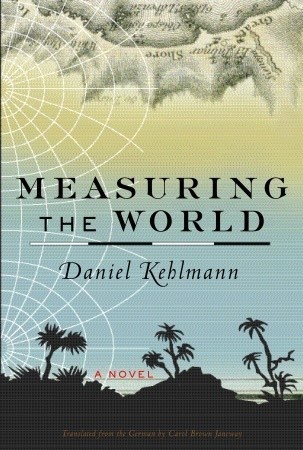

Quotes from Measuring the World

Daniel Kehlmann ·  259 pages

Rating: (9.5K votes)


“That was the moment when he grasped that nobody wanted to use their minds. People wanted peace. They wanted to eat and sleep and have other people be nice to them. What they didn't want to do was think.”
― Daniel Kehlmann, quote from Measuring the World


“Whenever things were frightening, it was a good idea to measure them.”
― Daniel Kehlmann, quote from Measuring the World


“Inzwischen geht es ihm besser, manche Tage seien schon fieberfrei, auch die Träume, in denen er Baron Humboldt erwürge, zerhacke, erschieße, anzünde, vergifte oder unter Steinen begrabe, würden seltener.”
― Daniel Kehlmann, quote from Measuring the World


“Man hat uns früh eingeredet, dass ein Leben Publikum benötigt.”
― Daniel Kehlmann, quote from Measuring the World


“Ich habe herausgefunden, dass der Mensch bereit ist, Unbill zu erfahren, aber viel Erkenntnis entgeht ihm, weil er den Schmerz fürchtet.”
― Daniel Kehlmann, quote from Measuring the World


“Insa, cand au trecut de primele suburbii ale Berlinului si Humboldt si-a inchipuit cum Gauss a cercetat corpurile ceresti prin telescopul sau in tot acest timp - corpuri ceresti ale caror orbite pot fi descrise in formule simple -, n-a mai fost in stare sa spuna care dintre ei doi a ramas acasa si care a colindat lumea.”
― Daniel Kehlmann, quote from Measuring the World


“Den Hunde, sagte Bonpland, habe er nie leiden können.”
― Daniel Kehlmann, quote from Measuring the World


“Links, sagte Humboldt.
Wieso links, fragte Bonpland.
Also rechts, sagte Humboldt.
Aber warum rechts?
Zum Teufel, rief Humboldt, jetzt werde es ihm zu blöd.”
― Daniel Kehlmann, quote from Measuring the World


“Seltsam sei es und ungerecht, sagte Gauß, so recht ein Beispiel für die erbärmliche Zufälligkeit der Existenz, dass man in einer bestimmten Zeit geboren und ihr verhaftet sei, ob man wolle oder nicht. Es verschaffe einem einen unziemlichen Vorteil vor der Vergangenheit und mache einen zum Clown der Zukunft. [...] Sogar ein Verstand wie der seine, sagte Gauß, hätte in frühen Menschheitsaltern oder an den Ufern des Orinoko nichts zu leisten vermocht, wohingegen jeder Dummkopf in zweihundert Jahren sich über ihn lustig machen und absurden Unsinn über seine Person erfinden könne.”
― Daniel Kehlmann, quote from Measuring the World


“Gauß kam auf den Zufall zu sprechen, den Feind allen Wissens, den er immer habe besiegen wollen. Aus der Nähe betrachtet, sehe man hinter jedem Ereignis die unendliche Feinheit des Kausalgewebes. Trete man weit genug zurück, offenbarten sich die großen Muster. Freiheit und Zufall seien eine Frage der mittleren Entfernung, eine Sache des Abstands...”
― Daniel Kehlmann, quote from Measuring the World


“Aici nu există mai devreme sau mai târziu... aici există doar muncă, asta facem aici.”
― Daniel Kehlmann, quote from Measuring the World


“Seltsam sei es und ungerecht, sagte Gauß, so recht ein Beispiel für die erbärmliche Zufälligkeit der Existenz, dass man in einer bestimmten Zeit geboren und ihr verhaftet sei, ob man wolle oder nicht. Es verschaffe einem einen unziemlichen Vorteil vor der Vergangenheit und mache einen zum Clown der Zukunft.”
― Daniel Kehlmann, quote from Measuring the World


“Žena je imala tanane, prilično izvijene obrve. Haljina joj je otkrivala leđa i Gaus se pitao kako bi bilo pritisnuti usne na njih.”
― Daniel Kehlmann, quote from Measuring the World


“Man hat uns früh eingeschärft, dass ein Leben Publikum benötigt.”
― Daniel Kehlmann, quote from Measuring the World


About the author

Daniel Kehlmann
Born place: in Munich, Germany
Born date January 13, 1975
See more on GoodReads

Popular quotes

“She returned her sword to its sheath. "It was a good idea, son of Thor. You have wounded it."
"Seriously?"
"Yes, I am always serious."
"No, I mean did I seriously wound it."
She paused. "I do not know. You may have mostly angered it."
"Great...”
― K.L. Armstrong, quote from Thor's Serpents


“I stand on the end platform of the tram and am completely unsure of my footing in this world, in this town, in my family. Not even casually could I indicate any claims that I might rightly advance in any direction. I have not even any defense to offer for standing on this platform, holding on to this strap, letting myself be carried along by this tram, nor for the people who give way to the tram or walk quietly along or stand gazing into shop windows. Nobody asks me to put up a defense, indeed, but that is irrelevant.”
― Franz Kafka, quote from The Complete Short Stories


“Du kannst werden, was immer du willst. Was du dir auch in den Kopf setzt. Folge einfach deinem Herzen und lebe deine Träume." - Die guten alten Plattitüden einer ausgestorbenen Spezies.”
― Blake Crouch, quote from Wayward


“The key point is that these patterns, while mostly stable, are not permanent: certain environmental experiences can add or subtract methyls and acetyls, changing those patterns. In effect this etches a memory of what the organism was doing or experiencing into its cells—a crucial first step for any Lamarck-like inheritance. Unfortunately, bad experiences can be etched into cells as easily as good experiences. Intense emotional pain can sometimes flood the mammal brain with neurochemicals that tack methyl groups where they shouldn’t be. Mice that are (however contradictory this sounds) bullied by other mice when they’re pups often have these funny methyl patterns in their brains. As do baby mice (both foster and biological) raised by neglectful mothers, mothers who refuse to lick and cuddle and nurse. These neglected mice fall apart in stressful situations as adults, and their meltdowns can’t be the result of poor genes, since biological and foster children end up equally histrionic. Instead the aberrant methyl patterns were imprinted early on, and as neurons kept dividing and the brain kept growing, these patterns perpetuated themselves. The events of September 11, 2001, might have scarred the brains of unborn humans in similar ways. Some pregnant women in Manhattan developed post-traumatic stress disorder, which can epigenetically activate and deactivate at least a dozen genes, including brain genes. These women, especially the ones affected during the third trimester, ended up having children who felt more anxiety and acute distress than other children when confronted with strange stimuli. Notice that these DNA changes aren’t genetic, because the A-C-G-T string remains the same throughout. But epigenetic changes are de facto mutations; genes might as well not function. And just like mutations, epigenetic changes live on in cells and their descendants. Indeed, each of us accumulates more and more unique epigenetic changes as we age. This explains why the personalities and even physiognomies of identical twins, despite identical DNA, grow more distinct each year. It also means that that detective-story trope of one twin committing a murder and both getting away with it—because DNA tests can’t tell them apart—might not hold up forever. Their epigenomes could condemn them. Of course, all this evidence proves only that body cells can record environmental cues and pass them on to other body cells, a limited form of inheritance. Normally when sperm and egg unite, embryos erase this epigenetic information—allowing you to become you, unencumbered by what your parents did. But other evidence suggests that some epigenetic changes, through mistakes or subterfuge, sometimes get smuggled along to new generations of pups, cubs, chicks, or children—close enough to bona fide Lamarckism to make Cuvier and Darwin grind their molars.”
― Sam Kean, quote from The Violinist's Thumb: And Other Lost Tales of Love, War, and Genius, as Written by Our Genetic Code


“Even if there is only one possible unified theory, it is just a set of rules and equations. What is it that breathes fire into the equations and makes a universe for them to describe? The usual approach of science of constructing a mathematical model cannot answer the questions of why there should be a universe for the model to describe. Why does the universe go to all the bother of existing?”
― Stephen Hawking, quote from A Brief History of Time: From the Big Bang to Black Holes


Interesting books

Lies
(139)
What's Left of Me
(6.8K)
What's Left of Me
by Amanda Maxlyn
The Two Kings
(2.8K)
Evil and the Mask
(894)
Evil and the Mask
by Fuminori Nakamura
Guitar Notes
(5K)
Guitar Notes
by Mary Amato
Ink
(9.2K)
Ink
by Amanda Sun

About BookQuoters

BookQuoters is a community of passionate readers who enjoy sharing the most meaningful, memorable and interesting quotes from great books. As the world communicates more and more via texts, memes and sound bytes, short but profound quotes from books have become more relevant and important. For some of us a quote becomes a mantra, a goal or a philosophy by which we live. For all of us, quotes are a great way to remember a book and to carry with us the author’s best ideas.

We thoughtfully gather quotes from our favorite books, both classic and current, and choose the ones that are most thought-provoking. Each quote represents a book that is interesting, well written and has potential to enhance the reader’s life. We also accept submissions from our visitors and will select the quotes we feel are most appealing to the BookQuoters community.

Founded in 2023, BookQuoters has quickly become a large and vibrant community of people who share an affinity for books. Books are seen by some as a throwback to a previous world; conversely, gleaning the main ideas of a book via a quote or a quick summary is typical of the Information Age but is a habit disdained by some diehard readers. We feel that we have the best of both worlds at BookQuoters; we read books cover-to-cover but offer you some of the highlights. We hope you’ll join us.