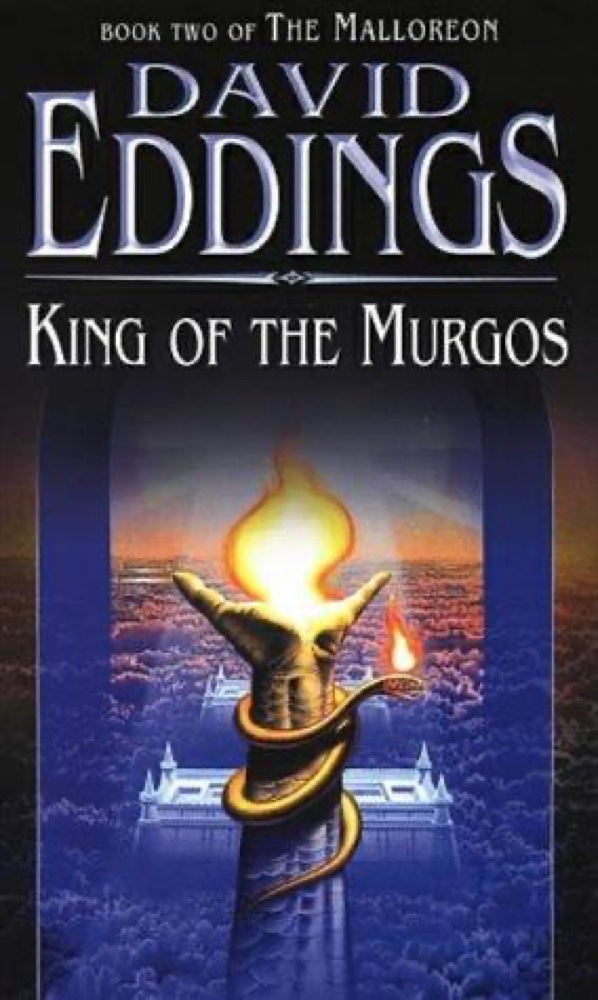
Quotes from King of the Murgos

David Eddings ·  418 pages

Rating: (45.2K votes)


“The old man was peering intently at the shelves. 'I'll have to admit that he's a very competent scholar.'
Isn't he just a librarian?' Garion asked, 'somebody who looks after books?'
That's where all the rest of scholarship starts, Garion. All the books in the world won't help you if they're just piled up in a heap.”
― David Eddings, quote from King of the Murgos


“...only in the surrender of the light could the darkness prevail.”
― David Eddings, quote from King of the Murgos


“The only reason there's such a thing as a morning in the first place is to keep night and afternoon from bumping into each other.
-Kheldar”
― David Eddings, quote from King of the Murgos


“Any time there's something so ridiculously dangerous that no rational human being would try it, they send for me.' --Garion”
― David Eddings, quote from King of the Murgos


“The whole world is beautiful, Belgarion' Eriond assured him in response to that unspoken thought. 'You just have to know how to look at it”
― David Eddings, quote from King of the Murgos


“Then you’ve learned something today. No day in which you learn something is a complete loss.”
― David Eddings, quote from King of the Murgos


“Watch out for snakes,’ Durnik called after him.”
― David Eddings, quote from King of the Murgos


About the author

David Eddings
Born place: in Spokane, Washington, The United States
Born date July 7, 1931
See more on GoodReads

Popular quotes

“Teachers dread nothing so much as unusual characteristics in precocious boys during the initial stages of their adolescence. A certain streak of genius makes an ominous impression on them, for there exists a deep gulf between genius and the teaching profession. Anyone with a touch of genius seems to his teachers a freak from the very first. As far as teachers are concerned, they define young geniuses as those who are bad, disrespectful, smoke at fourteen, fall in love at fifteen, can be found at sixteen hanging out in bars, read forbidden books, write scandalous essays, occasionally stare down a teacher in class, are marked in the attendance book as rebels, and are budding candidates for room-arrest. A schoolmaster will prefer to have a couple of dumbheads in his class than a single genius, and if you regard it objectively, he is of course right. His task is not to produce extravagant intellects but good Latinists, arithmeticians and sober decent folk. The question of who suffers more acutely at the other's hands - the teacher at the boy's, or vice versa - who is more of a tyrant, more of a tormentor, and who profanes parts of the other's soul, student or teacher, is something you cannot examine without remembering your own youth in anger and shame. yet that s not what concerns us here. We have the consolation that among true geniuses the wounds almost always heal. As their personalities develop, they create their art in spite of school. Once dead, and enveloped by the comfortable nimbus of remoteness, they are paraded by the schoolmasters before other generations of students as showpieces and noble examples. Thus teh struggle between rule and spirit repeats itself year after year from school to school. The authorities go to infinite pains to nip the few profound or more valuable intellects in the bud. And time and again the ones who are detested by their teachers are frequently punished, the runaways and those expelled, are the ones who afterwards add to society's treasure. But some - and who knows how many? - waste away quiet obstinacy and finally go under.”
― Hermann Hesse, quote from Beneath the Wheel


“Although we had been warned by some of the greatest political thinkers of the nineteenth century, by Tocqueville and Lord Acton, that socialism means slavery, we have steadily moved in the direction of socialism.”
― Friedrich A. Hayek, quote from The Road to Serfdom


“In that place things begin to wear away even as they are built; the living die a little more each day. The sun is too far away; light slides endlessly into night; fire and love consume themselves; the heart tries to warm itself with ashes.”
― Patricia A. McKillip, quote from Winter Rose


“This was a transformation from what the late Isaiah Berlin described as “Negative Liberty” to “Positive Liberty.”4 The idea of negative liberty is perhaps more familiar. It can be defined as the absence of restraint, a freedom from interference by outside authority with individual thought or behavior. A law requiring motorcyclists to wear a helmet would be, under this definition, to prevent them from enjoying the freedom to go bareheaded if they wish. Negative liberty, therefore, can be described as freedom from. Positive liberty can best be understood as freedom to . It is not necessarily incompatible with negative liberty, but has a different focus or emphasis. Freedom of the press is generally viewed as a negative liberty—freedom from interference with what a writer writes or a reader reads. But an illiterate person suffers from a denial of positive liberty; he is unable to enjoy the freedom to write or read whatever he chooses, not because some authority prevents him from doings so but because he cannot read or write anything. He suffers not the absence of a negative liberty—freedom from—but of a positive liberty—freedom to read and write. The remedy lies not in removal of restraint but in achievement of the capacity to read and write.”
― James M. McPherson, quote from Battle Cry of Freedom


“I am Number Seven I will make them pay.”
― Pittacus Lore, quote from The Revenge of Seven


Interesting books

The Second Summer of the Sisterhood
(81K)
The Second Summer of...
by Ann Brashares
Fated
(15.8K)
Fated
by Alyson Noel
Wolf-Speaker
(42.7K)
Wolf-Speaker
by Tamora Pierce
Fortune's Rocks
(25.9K)
Fortune's Rocks
by Anita Shreve
Rose Madder
(80.8K)
Rose Madder
by Stephen King
The Slow Regard of Silent Things
(81K)
The Slow Regard of S...
by Patrick Rothfuss

About BookQuoters

BookQuoters is a community of passionate readers who enjoy sharing the most meaningful, memorable and interesting quotes from great books. As the world communicates more and more via texts, memes and sound bytes, short but profound quotes from books have become more relevant and important. For some of us a quote becomes a mantra, a goal or a philosophy by which we live. For all of us, quotes are a great way to remember a book and to carry with us the author’s best ideas.

We thoughtfully gather quotes from our favorite books, both classic and current, and choose the ones that are most thought-provoking. Each quote represents a book that is interesting, well written and has potential to enhance the reader’s life. We also accept submissions from our visitors and will select the quotes we feel are most appealing to the BookQuoters community.

Founded in 2023, BookQuoters has quickly become a large and vibrant community of people who share an affinity for books. Books are seen by some as a throwback to a previous world; conversely, gleaning the main ideas of a book via a quote or a quick summary is typical of the Information Age but is a habit disdained by some diehard readers. We feel that we have the best of both worlds at BookQuoters; we read books cover-to-cover but offer you some of the highlights. We hope you’ll join us.