
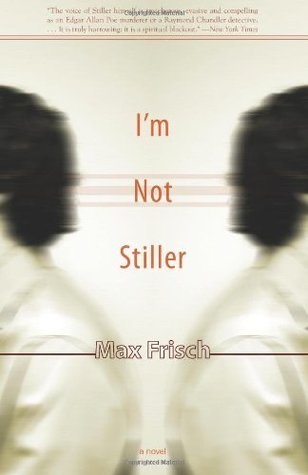
 I'm Not Stiller
Quotes from the Book
Technology is the knack of arranging the world in such a way that you don't have to experience it.
115
I've often wondered what people mean when they talk about an experience. I'm a technologist and accustomed to seeing things as they are. I see everything they are talking about very clearly; after all, I'm not blind. I see the moon over the Tamaulipas desert--it is more distinct than at other times, perhaps, but still a calculable mass circling around our planet, an example of gravitation, interesting, but in what way an experience? I see the jagged rocks, standing out black against the moonlight; perhaps they do look like the jagged backs of prehistoric monsters, but I know they are rocks, stone, probably volcanic, one should have to examine them to be sure of this. Why should I feel afraid? There aren't any prehistoric monsters any more. Why should I imagine them? I'm sorry, but I don't see any stone angels either; nor demons; I see what I see--the usual shapes due to erosion and also my long shadow on the sand, but no ghosts. Why get womanish? I don't see any Flood either, but sand lit up by the moon and made undulating, like water, by the wind, which doesn't surprise me; I don't find it fantastic, but perfectly explicable. I don't know what the souls of the damned look like; perhaps like black agaves in the desert at night. What I see are agaves, a plant that blossoms once only and dies. Furthermore, I know (however I may look at the moment) that I am not the last or the first man on earth; and I can't be moved by the mere idea that I am the last man, because it isn't true. Why get hysterical? Mountains are mountains, even if in a certain light they may look like something else, but it is the Sierra Madre Oriental, and we are not standing in a kingdom of the dead, but in the Tamaulipas desert, Mexico, about sixty miles from the nearest road, which is unpleasant, but in what way an experience? Nor can I bring myself to hear something resembling eternity; I don't hear anything, apart from the trickle of sand at every step. Why should I experience what isn't there?
14
I called her a sentimentalist and artsy-craftsy. She called me Homo Faber.
13
Everything happened exactly as I had intended it shouldn’t.
12
She thought it stupid of a woman to want to be understood by a man; the man (said Hanna) wants the woman to be a mystery, so that he can be inspired and excited by his own incomprehension.
11
Being alone is the only possible condition for me, since I don't want to make a woman unhappy, and women have a tendency to become unhappy. Being alone isn't always fun, you can't always be in form. Moreover, I have learned from experience that once you are not in form women don't remain in form either; as soon as they are bored they start complaining you've no feeling.
11
The main thing is to stand up to the light, to joy (like our child) in the knowledge that I shall be extinguished in the light over gorse, asphalt, and sea, to stand up to time, or rather to eternity in the instant. To be eternal means to have existed.
7
Come,” she said. “We’re married, Walter, married. Don’t touch me.
5
Was mir auf die Nerven ging: die Molche in jedem Tümpel, in jeder Eintagspfütze ein Gewimmel von Molchen - überhaupt diese Fortpflanzerei überall, es stinkt nach Fruchtbarkeit, nach blühender Verwesung. Wo man hinspuckt, keimt es!
4
Do you know,” she said, “that was the Ludovisi Altar we liked so much this morning. It’s madly famous!” I let her give me a lecture.
3
I had said what I never meant to say, but what has been said cannot be unsaid, I enjoyed our silence, I was completely sober again, but all the same I had no idea what I was thinking, probably nothing.
3
It is always the moralists who do the most harm.
2
The wish to walk on earth—there beneath the last firs standing in the sunshine, to smell their resin and listen to the water, which is probably roaring, to drink water.
2
the streamers and the couples busily engaged in bursting one another’s balloons.
2
Conversation was hardly possible; I had forgotten that anyone could be so young.
2
Hanna had Communist leanings, which I couldn’t bear, and on the other a tendency to mysticism, or to put it less kindly, hysteria
2
Mathematically speaking, the probable (that in 6,000,000,000 throws with a regular six-sided die the die will come up proximately 1 ,000,000,000 times) and the improbable (that in six throws with the same die the one will come approximately up six times) are not different in kind, but only in frequency, whereby the more frequent appears a priori more probable. But the occasional occurrence of the improbable does not imply the intervention of a higher power, something in the nature of a miracle, as the layman is so ready to assume. The term "probability" includes improbability at the extreme limits of probability, and when the improbable does occur this is no cause for surprise, bewilderment or mystification. Cf. Ernst Mally's Probability and Law, Hans Reichenbach The theory Probability, Whitehead and Russell's Principia Mathematica, von Mises' Probability, Statistics and Truth
2
As long as God is a man, not a couple, the life of a woman, according to Hanna,is bound to remain as it is now, namely wretched, with woman as the proletarian of Creation, however smartly dressed.
2
How many of the people I meet are interested in whether I’m enjoying myself, in my feelings at all?
1
I stand still so as not to hear steps in my apartment, steps that are after all only my own. The whole thing isn’t tragic, merely tiresome. You can’t wish yourself good night . . . Is that a reason for marrying?
1
When I woke Herbert, he sprang to his feet. What was the matter? When he saw that nothing was the matter, he started snoring again—to avoid being bored.
1
I don’t deny that it was more than a coincidence which made things turn out as they did, it was a whole train of coincidences. But what has providence to do with it? I don’t need any mystical explanation for the occurrence of the improbable; mathematics explains it adequately, as far as I’m concerned. Mathematically speaking, the probable (that in 6,000,000,000 throws with a regular six-sided die the one will come up approximately 1,000,000,000 times) and the improbable (that in six throws with the same die the one will come up six times) are not different in kind, but only in frequency, whereby the more frequent appears a priori more probable. But the occasional occurrence of the improbable does not imply the intervention of a higher power, something in the nature of a miracle, as the layman is so ready to assume. The term probability includes improbability at the extreme limits of probability, and when the improbable does occur this is no cause for surprise, bewilderment or mystification.
1
Das Wahrscheinliche (dass bei 6 000 000 000 Würfen mit einem regelmäßigen Sechserwürfel annähernd 1 000 000 000 Einser vorkommen) und das Unwahrscheinliche (dass bei 6 Würfen mit demselben Würfel einmal 6 Einser vorkommen) unterscheiden sich nicht dem Wesen nach, sondern nur Häufigkeit nach, wobei das Häufigere von vornherein als glaubwürdiger erscheint. Es ist aber, wenn einmal das Unwahrscheinliche eintritt, nichts Höheres dabei, keinerlei Wunder oder Derartiges, wie es der Laie so gerne haben möchte. Indem wir vom Wahrscheinlichen sprechen, ist ja das Unwahrscheinliche immer schon inbegriffen und zwar als Grenzfall des Möglichen, und wenn es einmal eintritt, das Unwahrscheinliche, so besteht für unsereinen keinerlei Grund zur Verwunderung, zur Erschütterung, zur Mystifikation.
1
Watch on YouTube
About Max Frisch
We have collected 30 quotes from 2 books by Max Frisch on BookQuoters.
More about the author →More by Max Frisch
I'm Not Stiller
About the book
Walter Faber is an emotionally detached engineer forced by a string of coincidences to embark on a journey through his past.
Book details
- First published
- 1957
- Author
- Max Frisch
- Genre
- Classics
- Goodreads rating
- 3.68 (33k ratings)
Keep reading
 Axiomatic
 Dept. of Speculation
 Sixty Stories
 Sexus
Sexus
 Selected Stories
 Gaudy Night
 What I Loved
 Purity
 The Golden Notebook
 Ravelstein
 Min kamp 2
 All That I Am
 The Illustrated Man
 Jailbird
 The Broom of the System
 Fifth Business
 That Hideous Strength
 The Joke
 The Color Master: Stories
 We the Living
 Girl with Curious Hair
 V.
V.
 Her Fearful Symmetry
 The Manticore
 The Star Diaries
 The Adventures of Augie March
 Manalive
 Beautiful Losers
 Nine Stories
 The Rebel Angels
 Selected Stories of Anton Chekhov
 Without Dogma
 The Magus
 Stories of Your Life and Others
 The Hour of the Star
 Sexing the Cherry
 Cat's Cradle
 Bluebeard's Egg
 On Beauty
 The Moonstone
 The Idiot
![What Was She Thinking? [Notes on a Scandal]](/i/book/g/08/what-was-she-thinking-notes-on-a-scandal.jpg) What Was She Thinking? [Notes on a Scandal]
What Was She Thinking? [Notes on a Scandal]
 Brief Interviews with Hideous Men
 Women in Love
 The Adolescent
 Dhalgren
 Senlin Ascends
 The Post-Birthday World
 Herzog
 Flappers and Philosophers
 Angle of Repose
 The Imperfectionists
 Laughable Loves
 Lady Chatterley's Lover
 The Magic Mountain
 Too Much Happiness: Stories
 Doctor Zhivago
 Speaking from Among the Bones
 Narcissus and Goldmund