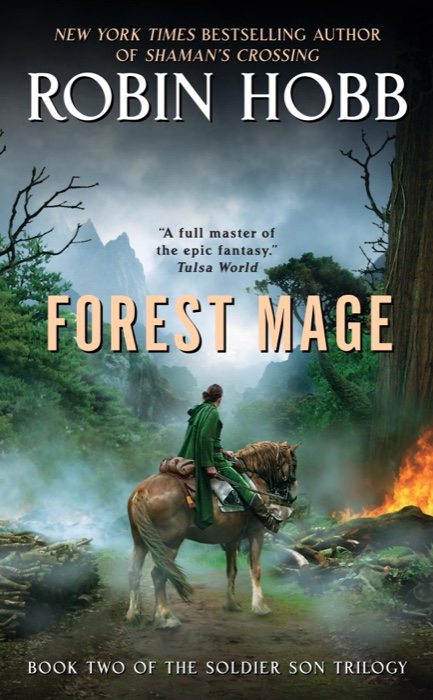

Quotes from Forest Mage

Robin Hobb ·  718 pages

Rating: (14.2K votes)


“None of us ever know what we are choosing when we choose life. If certainty is so important to you, than you should have chosen to be dead. That is a certain thing.”
― Robin Hobb, quote from Forest Mage


“A leaf turns in the wind, and you suddenly have a different perception of what colour it is.”
― Robin Hobb, quote from Forest Mage


“It was all so meaningless when I looked at it that way. It was meaningless in the same way as when I stood up from a game and then looked down on the scatter of playing pieces, and realized that they all were just bits of polished stone on a wooden board marked with squares. All the meaning they'd had moments before when I'd been trying to win a game were meanings that I'd imbued them with. Of themselves, neither they nor the board had any significance.”
― Robin Hobb, quote from Forest Mage


“Boredom is vastly underrated. Boredom means that nothing is trying to kill you every day.”
― Robin Hobb, quote from Forest Mage


“Isolation was better than shame. I would continue on my own. This was my fight and no one else”
― Robin Hobb, quote from Forest Mage


“Any future can be!” she replied, laughing at me. “If it were not so, if it were fixed, it would be a past. You say a foolish thing. How can a future be impossible?”
― Robin Hobb, quote from Forest Mage


“They need other people to make them think they’re alive. They only feel like they’re important if someone else tells them they are.”
― Robin Hobb, quote from Forest Mage


About the author

Robin Hobb
Born place: in California, The United States
See more on GoodReads

Popular quotes

“Grief turns out to be a place none of us know until we reach it. We anticipate (we know) that someone close to us could die, but we do not look beyond the few days or weeks that immediately follow such an imagined death. We misconstrue the nature of even those few days or weeks. We might expect if the death is sudden to feel shock. We do not expect the shock to be obliterative, dislocating to both body and mind. We might expect that we will be prostrate, inconsolable, crazy with loss. We do not expect to be literally crazy, cool customers who believe that their husband is about to return and need his shoes. In the version of grief we imagine, the model will be "healing." A certain forward movement will prevail. The worst days will be the earliest days. We imagine that the moment to most severely test us will be the funeral, after which this hypothetical healing will take place. When we anticipate the funeral we wonder about failing to "get through it," rise to the occasion, exhibit the "strength" that invariably gets mentioned as the correct response to death. We anticipate needing to steel ourselves the for the moment: will I be able to greet people, will I be able to leave the scene, will I be able even to get dressed that day? We have no way of knowing that this will not be the issue. We have no way of knowing that the funeral itself will be anodyne, a kind of narcotic regression in which we are wrapped in the care of others and the gravity and meaning of the occasion. Nor can we know ahead of the fact (and here lies the heart of the difference between grief was we imagine it and grief as it is) the unending absence that follows, the void, the very opposite of meaning, the relentless succession of moments during which we will confront the experience of meaninglessness itself.”
― Joan Didion, quote from The Year of Magical Thinking


“I found this method safest for myself and very embarrassing to those against whom I used it; therefore I took a delight in it, practis'd it continually, and grew very artful and expert in drawing people, even of superior knowledge, into concessions, the consequences of which they did not foresee, entangling them in difficulties out of which they could not extricate themselves, and so obtaining victories that neither myself nor my cause always deserved. I continu'd this method some few years, but gradually left it, retaining only the habit of expressing myself in terms of modest diffidence; never using, when I advanced any thing that may possibly be disputed, the words certainly, undoubtedly, or any others that give the air of positiveness to an opinion; but rather say, I conceive or apprehend a thing to be so and so; it appears to me, or I should think it so or so, for such and such reasons; or I imagine it to be so; or it is so, if I am not mistaken. This habit, I believe, has been of great advantage to me when I have had occasion to inculcate my opinions, and persuade men into measures that I have been from time to time engag'd in promoting; and, as the chief ends of conversation are to inform or to be informed, to please or to persuade, I wish well-meaning, sensible men would not lessen their power of doing good by a positive, assuming manner, that seldom fails to disgust, tends to create opposition, and to defeat every one of those purposes for which speech was given to us, to wit, giving or receiving information or pleasure. For, if you would inform, a positive and dogmatical manner in advancing your sentiments may provoke contradiction and prevent a candid attention. If you wish information and improvement from the knowledge of others, and yet at the same time express yourself as firmly fix'd in your present opinions, modest, sensible men, who do not love disputation, will probably leave you undisturbed in the possession of your error. And by such a manner, you can seldom hope to recommend yourself in pleasing your hearers, or to persuade those whose concurrence you desire. Pope says, judiciously:           "Men should be taught as if you taught them not,           And things unknown propos'd as things forgot;" farther recommending to us "To speak, tho' sure, with seeming diffidence.”
― Benjamin Franklin, quote from The Autobiography of Benjamin Franklin


“Don’t interrupt my anxiety attack. It’s rude.”
― Jamie McGuire, quote from Providence


“Maybe we're all like that with our mothers. They seem ordinary until one day they're extraordinary.”
― Lisa See, quote from Shanghai Girls


“I explained that he was Chinese, and she asked if the movie would be in Chinese.
"No," I said, "he lives in America. In California. He's been there since he was a baby."
"Then what does it matter if he's Chinese?"
"Well," I said, "he's got... you know, a sensibility.”
― David Sedaris, quote from Dress Your Family in Corduroy and Denim


Interesting books

The Education of Little Tree
(12.5K)
The Education of Lit...
by Forrest Carter
Witches Abroad
(58.9K)
Witches Abroad
by Terry Pratchett
Across the Nightingale Floor
(30.4K)
Across the Nightinga...
by Lian Hearn
The Kiss of Deception
(59K)
The Kiss of Deceptio...
by Mary E. Pearson
The Statistical Probability of Love at First Sight
(100.2K)
The Statistical Prob...
by Jennifer E. Smith
Tortilla Flat
(36.6K)
Tortilla Flat
by John Steinbeck

About BookQuoters

BookQuoters is a community of passionate readers who enjoy sharing the most meaningful, memorable and interesting quotes from great books. As the world communicates more and more via texts, memes and sound bytes, short but profound quotes from books have become more relevant and important. For some of us a quote becomes a mantra, a goal or a philosophy by which we live. For all of us, quotes are a great way to remember a book and to carry with us the author’s best ideas.

We thoughtfully gather quotes from our favorite books, both classic and current, and choose the ones that are most thought-provoking. Each quote represents a book that is interesting, well written and has potential to enhance the reader’s life. We also accept submissions from our visitors and will select the quotes we feel are most appealing to the BookQuoters community.

Founded in 2023, BookQuoters has quickly become a large and vibrant community of people who share an affinity for books. Books are seen by some as a throwback to a previous world; conversely, gleaning the main ideas of a book via a quote or a quick summary is typical of the Information Age but is a habit disdained by some diehard readers. We feel that we have the best of both worlds at BookQuoters; we read books cover-to-cover but offer you some of the highlights. We hope you’ll join us.