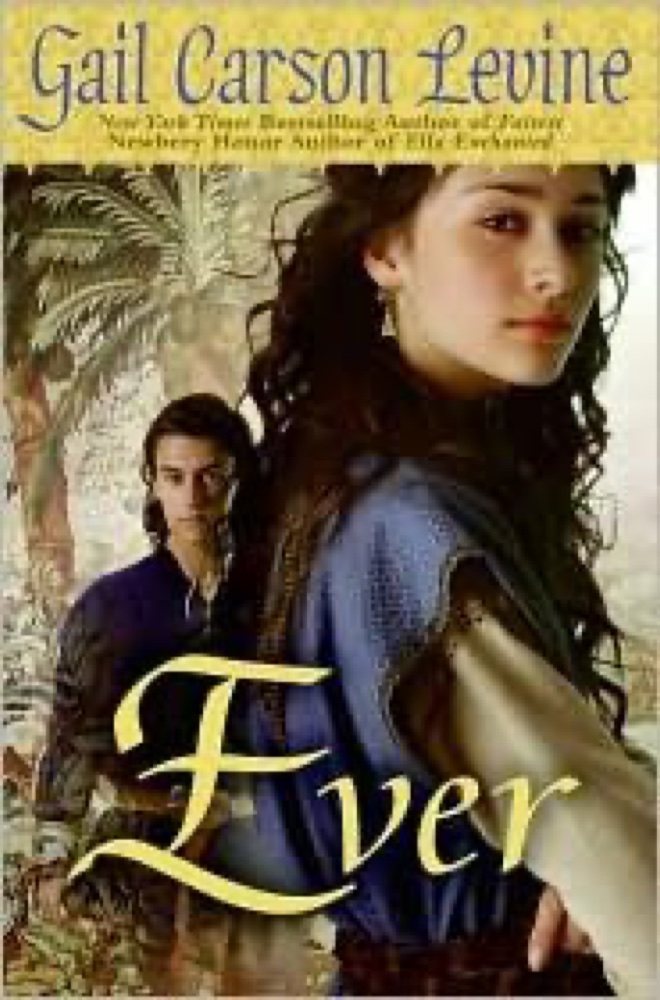

Quotes from Ever

Gail Carson Levine ·  244 pages

Rating: (18.5K votes)


“He is flawless, without a blemish. Majesic . . . muscular.”
― Gail Carson Levine, quote from Ever


“I wonder how Admat can be everywhere. Is he in my sandal? Or is he my sandal itself? Why would a god bother to be a sandal? Does he wear shoes or sandals himself, invisible ones?”
― Gail Carson Levine, quote from Ever


“The air is fresher here. Rock walls rise on either side of me. They must be the bowl of the volcano.”
― Gail Carson Levine, quote from Ever


“Admat, don’t kill me! Don’t be wrathful. Don’t exist!”
― Gail Carson Levine, quote from Ever


About the author

Gail Carson Levine
Born place: in New York, New York, The United States
Born date September 17, 1947
See more on GoodReads

Popular quotes

“find depressing his determination to make his characters suffer even when a little common sense on both his part and theirs could avoid it. Tess is one of the most irritating young women in Victorian fiction. Won”
― P.D. James, quote from The Private Patient


“And yet it had come to this: a cult that followed a dogmatic hard line of exclusion and repression, believed its teachings alone were the way that others must follow, and claimed special knowledge of something that had happened more than five centuries ago. It did nothing to soften its rigid stance, nothing to heal wounds that it had helped to create by deliberately shunning people of other Races, and nothing to explore the possibility of other beliefs. It held its ground even in the face of hard evidence that perhaps it had misjudged and refused to consider that it was courting a danger that might destroy everyone. p96”
― Terry Brooks, quote from Bearers of the Black Staff


“But I was not my self, confronted with my thoughts. I should also rise up above my thoughts to my own self. My journey goes there, and that is why it leads away from men and events into solitude. Is it solitude, to be with oneself? Solitude is true only when the self is a desert.73 Should I also make a garden out of the desert? Should I people a desolate land? Should I open the airy magic garden of the wilderness? What leads me into the desert, and what am I to do there? Is it a deception that I can no longer trust my thoughts? Only life is true, and only life leads me into the desert, truly not my thinking, that would like to return to thoughts, to men and events, since it feels uncanny in the desert. My soul, what am I to do here? But my soul spoke to me and said, “Wait.” I heard the cruel word. Torment belongs to the desert.”
― C.G. Jung, quote from The Red Book: Liber Novus


“Darwin concluded that language ability is “an instinctive tendency to acquire an art,” a design that is not peculiar to humans but seen in other species such as song-learning birds. A language instinct may seem jarring to those who think of language as the zenith of the human intellect and who think of instincts as brute impulses that compel furry or feathered zombies to build a dam or up and fly south. But one of Darwin’s followers, William James, noted that an instinct possessor need not act as a “fatal automaton.” He argued that we have all the instincts that animals do, and many more besides; our flexible intelligence comes from the interplay of many instincts competing. Indeed, the instinctive nature of human thought is just what makes it so hard for us to see that it is an instinct: It takes…a mind debauched by learning to carry the process of making the natural seem strange, so far as to ask for the why of any instinctive human act. To the metaphysician alone can such questions occur as: Why do we smile, when pleased, and not scowl? Why are we unable to talk to a crowd as we talk to a single friend? Why does a particular maiden turn our wits so upside-down? The common man can only say, “Of course we smile, of course our heart palpitates at the sight of the crowd, of course we love the maiden, that beautiful soul clad in that perfect form, so palpably and flagrantly made for all eternity to be loved!” And so, probably, does each animal feel about the particular things it tends to do in presence of particular objects…. To the lion it is the lioness which is made to be loved; to the bear, the she-bear. To the broody hen the notion would probably seem monstrous that there should be a creature in the world to whom a nestful of eggs was not the utterly fascinating and precious and never-to-be-too-much-sat-upon object which it is to her.”
― Steven Pinker, quote from The Language Instinct: How the Mind Creates Language


“Ignore me. I don’t want to talk about my nonexistent love life today.”
― Julie James, quote from About That Night


Interesting books

After the Blue Hour
(79)
After the Blue Hour
by John Rechy
Saving Grace
(10.9K)
Saving Grace
by Jane Green
Vicious
(25K)
Vicious
by L.J. Shen
Blood Vow
(13.3K)
Blood Vow
by J.R. Ward
Tsugumi
(6.7K)
Tsugumi
by Banana Yoshimoto
A Murder in Time
(11.2K)
A Murder in Time
by Julie McElwain

About BookQuoters

BookQuoters is a community of passionate readers who enjoy sharing the most meaningful, memorable and interesting quotes from great books. As the world communicates more and more via texts, memes and sound bytes, short but profound quotes from books have become more relevant and important. For some of us a quote becomes a mantra, a goal or a philosophy by which we live. For all of us, quotes are a great way to remember a book and to carry with us the author’s best ideas.

We thoughtfully gather quotes from our favorite books, both classic and current, and choose the ones that are most thought-provoking. Each quote represents a book that is interesting, well written and has potential to enhance the reader’s life. We also accept submissions from our visitors and will select the quotes we feel are most appealing to the BookQuoters community.

Founded in 2023, BookQuoters has quickly become a large and vibrant community of people who share an affinity for books. Books are seen by some as a throwback to a previous world; conversely, gleaning the main ideas of a book via a quote or a quick summary is typical of the Information Age but is a habit disdained by some diehard readers. We feel that we have the best of both worlds at BookQuoters; we read books cover-to-cover but offer you some of the highlights. We hope you’ll join us.