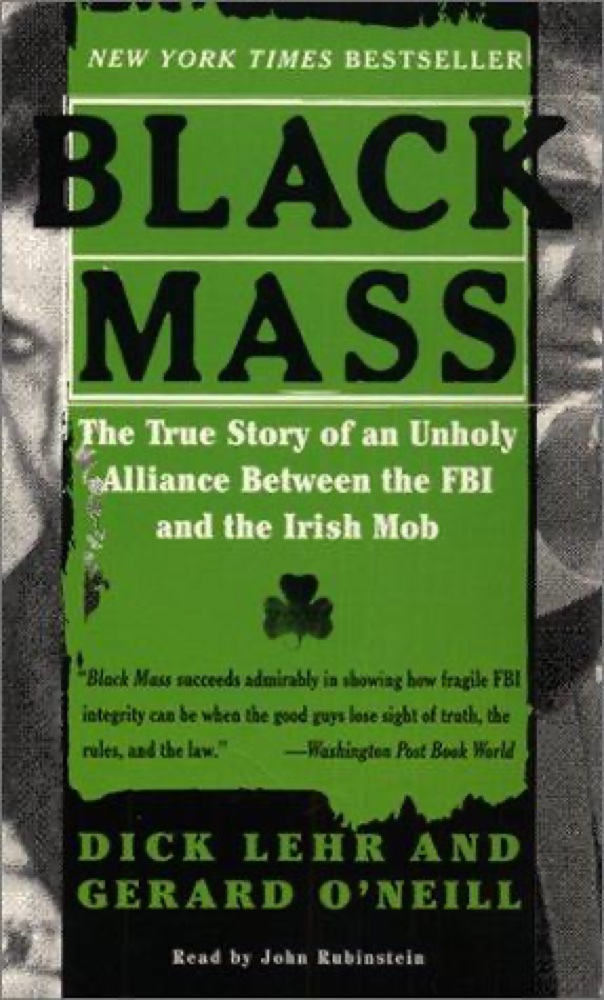


“He was the antithesis of the gaudy mafiosi”
― Dick Lehr, quote from Black Mass
“press, and Connolly had a plan, a work-in-progress”
― Dick Lehr, quote from Black Mass
“The newly arrived Irish Catholics took immediately to Southie's grievance list with outside force. Indeed, it became holy writ as the community coalesced around church and family, forming a solid phalanx against those who did not understand their ways. Over the decades since then, nothing had galvanized Southies more than a perceived slight by an outsider who would change The Way Things Are.”
― Dick Lehr, quote from Black Mass
“There was some admiration for the way he handled himself. At least back then, there was a sense he would be loyal to his friends. That was the culture of the time. It was incredibly tribal, and the gang affiliation meant so much to poor city kids.”
― Dick Lehr, quote from Black Mass
“The intelligent want self-control; children want candy. —RUMI INTRODUCTION Welcome to Willpower 101 Whenever I mention that I teach a course on willpower, the nearly universal response is, “Oh, that’s what I need.” Now more than ever, people realize that willpower—the ability to control their attention, emotions, and desires—influences their physical health, financial security, relationships, and professional success. We all know this. We know we’re supposed to be in control of every aspect of our lives, from what we eat to what we do, say, and buy. And yet, most people feel like willpower failures—in control one moment but overwhelmed and out of control the next. According to the American Psychological Association, Americans name lack of willpower as the number-one reason they struggle to meet their goals. Many feel guilty about letting themselves and others down. Others feel at the mercy of their thoughts, emotions, and cravings, their lives dictated by impulses rather than conscious choices. Even the best-controlled feel a kind of exhaustion at keeping it all together and wonder if life is supposed to be such a struggle. As a health psychologist and educator for the Stanford School of Medicine’s Health Improvement Program, my job is to help people manage stress and make healthy choices. After years of watching people struggle to change their thoughts, emotions, bodies, and habits, I realized that much of what people believed about willpower was sabotaging their success and creating unnecessary stress. Although scientific research had much to say that could help them, it was clear that these insights had not yet become part of public understanding. Instead, people continued to rely on worn-out strategies for self-control. I saw again and again that the strategies most people use weren’t just ineffective—they actually backfired, leading to self-sabotage and losing control. This led me to create “The Science of Willpower,” a class offered to the public through Stanford University’s Continuing Studies program. The course brings together the newest insights about self-control from psychology, economics, neuroscience, and medicine to explain how we can break old habits and create healthy habits, conquer procrastination, find our focus, and manage stress. It illuminates why we give in to temptation and how we can find the strength to resist. It demonstrates the importance of understanding the limits of self-control,”
― Kelly McGonigal, quote from The Willpower Instinct: How Self-Control Works, Why It Matters, and What You Can Do to Get More of It
“I remembered during puberty, through the anorexic mists of intermittent menstrual cycles, that man, my father, lifting Shirley's nightdress over her head and asking her in his mocking way to choose what colour condom she wanted. 'Red or yellow?' Which did she choose? I can't remember. Perhaps she alternated. Perhaps there were other colours. It didn't happen once. It happened again and again. I had no power to stop it. That man, my father, had some control over me. I was drugged by the black silence in that big house, the vile whiff of aftershave, the crushing torment of inevitability. My father fucked Shirley using red or yellow condoms and it was those condoms that brought it all to an end. It was my last realization of the day; any more would have been too much to contemplate.
That time when my mother had found used condoms in bedroom, he had admitted, after a pointless burst my father's of denial, that he had been going to prostitutes. That was no doubt true but I can't imagine clients take used condoms away with them; prostitutes would surely get rid of the things. No. My father kept those used condoms as a prize. He was fucking his fourteen-year-old-daughter. He was proud of it.
Rebecca welled up with tears. Poor thing, she kept saying. Poor thing.”
― quote from Today I'm Alice: Nine Personalities, One Tortured Mind
“[The critic] serves up his erudition in strong doses; he pours out all the knowledge he got up the day before in some library or other, and treats in heathenish fashion people at whose feet he ought to sit, and the most ignorant of whom could give points to much wiser men than he.
Authors bear this sort of thing with a magnanimity and a patience that are really incomprehensible. For, after all, who are those critics, who with their trenchant tone, their dicta, might be supposed sons of the gods? They are simply fellows who were at college with us, and who have turned their studies to less account, since they have not produced anything, and can do no more than soil and spoil the works of others, like true stymphalid vampires.”
― Théophile Gautier, quote from Mademoiselle de Maupin
“All grown-ups were once children... but only few of them remember it.”
― Antoine de Saint-Exupéry, quote from Der kleine Prinz
“Affordances define what actions are possible. Signifiers specify how people discover those possibilities: signifiers are signs, perceptible
signals of what can be done. Signifiers are of far more importance to designers than are affordances.”
― Donald A. Norman, quote from Design of Everyday Things: Revised and Expanded Edition (Revised)
BookQuoters is a community of passionate readers who enjoy sharing the most meaningful, memorable and interesting quotes from great books. As the world communicates more and more via texts, memes and sound bytes, short but profound quotes from books have become more relevant and important. For some of us a quote becomes a mantra, a goal or a philosophy by which we live. For all of us, quotes are a great way to remember a book and to carry with us the author’s best ideas.
We thoughtfully gather quotes from our favorite books, both classic and current, and choose the ones that are most thought-provoking. Each quote represents a book that is interesting, well written and has potential to enhance the reader’s life. We also accept submissions from our visitors and will select the quotes we feel are most appealing to the BookQuoters community.
Founded in 2023, BookQuoters has quickly become a large and vibrant community of people who share an affinity for books. Books are seen by some as a throwback to a previous world; conversely, gleaning the main ideas of a book via a quote or a quick summary is typical of the Information Age but is a habit disdained by some diehard readers. We feel that we have the best of both worlds at BookQuoters; we read books cover-to-cover but offer you some of the highlights. We hope you’ll join us.