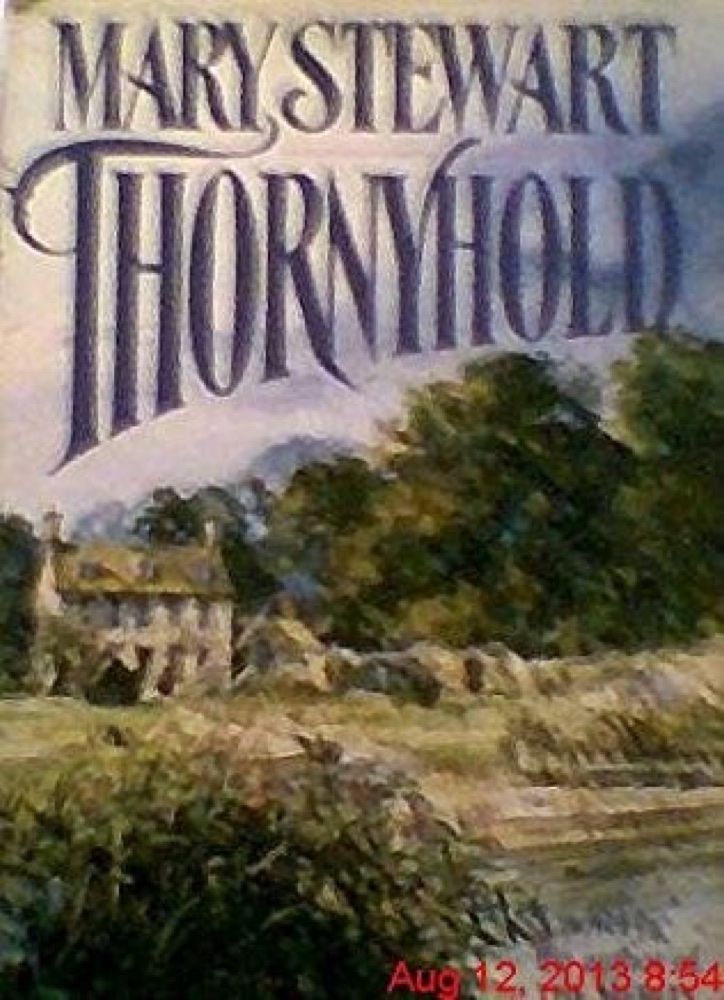

“You get no writing done at all if you sit at a table with a view. You'd spent the whole time watching the birds or thinking about what you would like to be doing out of doors, instead of flogging yourself to work out of sheer boredom.”
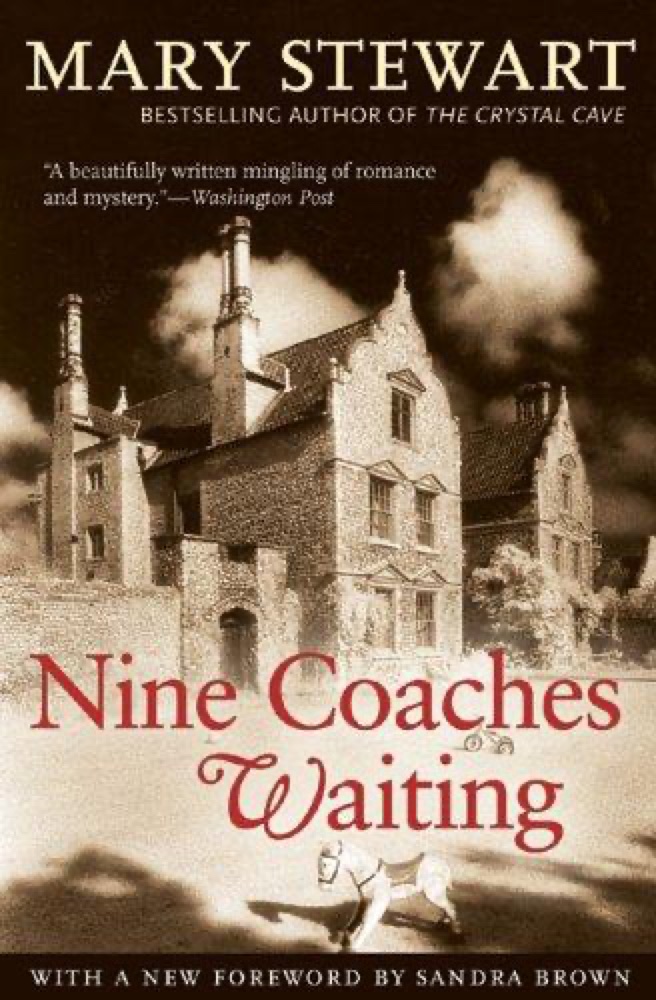
― Mary Stewart, quote from Thornyhold
“I suppose my mother could have been a witch if she had chosen to. But she met my father, who was a rather saintly clergyman, and he cancelled her out.”
― Mary Stewart, quote from Thornyhold
“I had always been content to know that there was more in the living world than we could hope to understand.”
― Mary Stewart, quote from Thornyhold
“Literature and fiction are full of femmes fatales, but there is also an homme fatal, an altogether rarer bird, and pity help the lonely and impressionable female who comes within range of him.”
― Mary Stewart, quote from Thornyhold
“William's mother, dead these six years. He spoke of her with love, but without grief. Six years, and whatever the loss, happiness steals back.”
― Mary Stewart, quote from Thornyhold
“I assure you, I've come to one of those natural breaks in the book, where one can walk away and let things go on working in the subconscious. It's true, don't look so unbelieving. It means I can afford to tear myself away from my view of the pigsties and go out on parole, as much as I like and you'll put up with.”
― Mary Stewart, quote from Thornyhold
“Memory - that fiend, that cruel enemy of comfort.”
― Paullina Simons, quote from Tatiana and Alexander
“We are always being pushed and squeezed down one road or another. We have no choice but to step forward, and then step forward again, and then step forward again; suddenly we find ourselves on a road we haven't chosen at all.”
― Lauren Oliver, quote from Requiem
“Forgetfulness heals everything and song is the most beautiful manner of forgetting, for in song man feels only what he loves.
So, in the kapia, between the skies, the river and the hills, generation after generation learnt not to mourn overmuch what the troubled waters had borne away. They entered there into the unconscious philosophy of the town; that life was an incomprehensible marvel, since it was incessantly wasted and spent, yet none the less it lasted and endured 'like the bridge on the Drina'.”
― Ivo Andrić, quote from The Bridge on the Drina
“Happy the writer who, passing by characters that are boring, disgusting, shocking in their mournful reality, approaches characters that manifest the lofty dignity of man, who from the great pool of daily whirling images has chosen only the rare exceptions, who has never once betrayed the exalted turning of his lyre, nor descended from his height to his poor, insignificant brethren, and, without touching the ground, has given the whole of himself to his elevated images so far removed from it. Twice enviable is his beautiful lot: he is among them as in his own family; and meanwhile his fame spreads loud and far. With entrancing smoke he has clouded people's eyes; he has flattered them wondrously, concealing what is mournful in life, showing them a beautiful man. Everything rushes after him, applauding, and flies off following his triumphal chariot. Great world poet they name him, soaring high above all other geniuses in the world, as the eagle soars above the other high fliers. At the mere mention of his name, young ardent hearts are filled with trembling, responsive tears shine in all eyes...No one equals him in power--he is God! But such is not the lot, and other is the destiny of the writer who has dared to call forth all that is before our eyes every moment and which our indifferent eyes do not see--all the stupendous mire of trivia in which our life in entangled, the whole depth of cold, fragmented, everyday characters that swarm over our often bitter and boring earthly path, and with the firm strength of his implacable chisel dares to present them roundly and vividly before the eyes of all people! It is not for him to win people's applause, not for him to behold the grateful tears and unanimous rapture of the souls he has stirred; no sixteen-year-old girl will come flying to meet him with her head in a whirl and heroic enthusiasm; it is not for him to forget himself in the sweet enchantment of sounds he himself has evoked; it is not for him, finally, to escape contemporary judgment, hypocritically callous contemporary judgment, which will call insignificant and mean the creations he has fostered, will allot him a contemptible corner in the ranks of writers who insult mankind, will ascribe to him the quality of the heroes he has portrayed, will deny him heart, and soul, and the divine flame of talent. For contemporary judgment does not recognize that equally wondrous are the glasses that observe the sun and those that look at the movement of inconspicuous insect; for contemporary judgment does not recognize that much depth of soul is needed to light up the picture drawn from contemptible life and elevate it into a pearl of creation; for contemporary judgment does not recognize that lofty ecstatic laughter is worthy to stand beside the lofty lyrical impulse, and that a whole abyss separates it from the antics of the street-fair clown! This contemporary judgment does not recognize; and will turn it all into a reproach and abuse of the unrecognized writer; with no sharing, no response, no sympathy, like a familyless wayfarer, he will be left alone in the middle of the road. Grim is his path, and bitterly he will feel his solitude.”
― Nikolai Gogol, quote from Dead Souls
“A giant octopus living way down deep at the bottom of the ocean. It has this tremendously powerful life force, a bunch of long, undulating legs, and it's heading somewhere, moving through the darkness of the ocean… It takes on all kinds of different shapes—sometimes it's 'the nation,' and sometimes it's 'the law,' and sometimes it takes on shapes that are more difficult and dangerous than that. You can try cutting off its legs, but they just keep growing back. Nobody can kill it. It's too strong, and it lives too far down in the ocean. Nobody knows where its heart is. What I felt then was a deep terror. And a kind of hopelessness, a feeling that I could never run away from this thing, no matter how far I went. And this creature, this thing doesn't give a damn that I'm me or you're you. In its presence, all human beings lose their names and their faces. We all turn into signs, into numbers.”
― Haruki Murakami, quote from After Dark
BookQuoters is a community of passionate readers who enjoy sharing the most meaningful, memorable and interesting quotes from great books. As the world communicates more and more via texts, memes and sound bytes, short but profound quotes from books have become more relevant and important. For some of us a quote becomes a mantra, a goal or a philosophy by which we live. For all of us, quotes are a great way to remember a book and to carry with us the author’s best ideas.
We thoughtfully gather quotes from our favorite books, both classic and current, and choose the ones that are most thought-provoking. Each quote represents a book that is interesting, well written and has potential to enhance the reader’s life. We also accept submissions from our visitors and will select the quotes we feel are most appealing to the BookQuoters community.
Founded in 2023, BookQuoters has quickly become a large and vibrant community of people who share an affinity for books. Books are seen by some as a throwback to a previous world; conversely, gleaning the main ideas of a book via a quote or a quick summary is typical of the Information Age but is a habit disdained by some diehard readers. We feel that we have the best of both worlds at BookQuoters; we read books cover-to-cover but offer you some of the highlights. We hope you’ll join us.