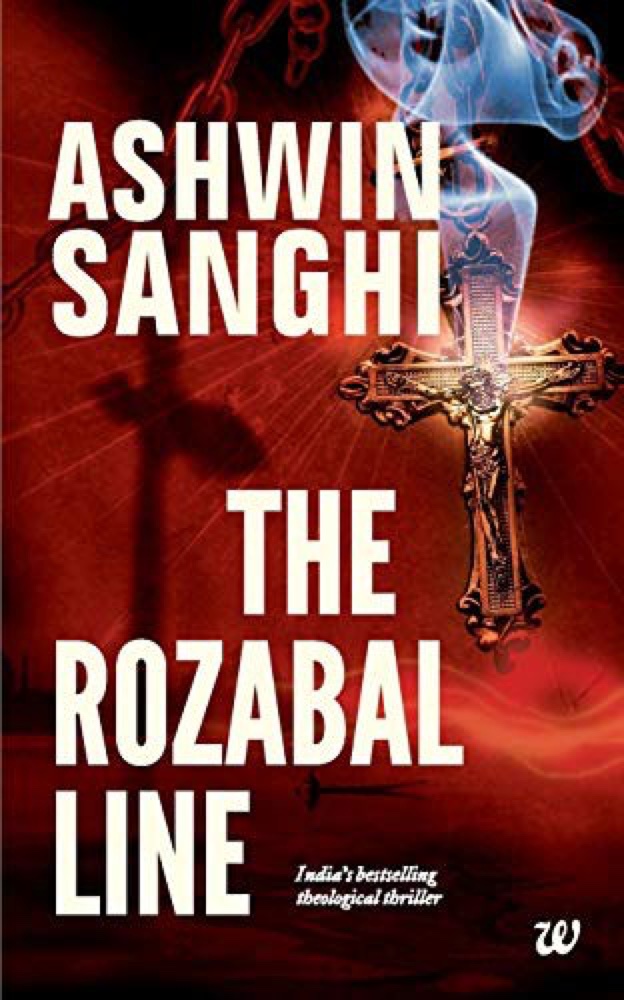

Quotes from The Rozabal Line

Ashwin Sanghi ·  278 pages

Rating: (6.1K votes)


“a sermon was meant to be like a woman’s skirt, long enough to cover the essentials and short enough to keep one interested!”
― Ashwin Sanghi, quote from The Rozabal Line


“Wer war der thor, wer weiser, bettler oder kaiser? Ob arm, ob reich, im tode gleich.”
― Ashwin Sanghi, quote from The Rozabal Line


“At the end of the day, all humans were merely skull and bones.”
― Ashwin Sanghi, quote from The Rozabal Line


“It’s important to let go of your guilt. Life puts us in situations so that we can learn from them. Once we have learned, it’s time to throw away the guilt and move on,”
― Ashwin Sanghi, quote from The Rozabal Line


“Anandamides are naturally occurring neurotransmitters in the brain whose chemical make-up is very similar to cannabis. The word ‘anandamide’ is derived from the Sanskrit word ananda,”
― Ashwin Sanghi, quote from The Rozabal Line


“One should never let sleeping dogs lie.”
― Ashwin Sanghi, quote from The Rozabal Line


“Man has free will and creates his destiny based upon his actions.”
― Ashwin Sanghi, quote from The Rozabal Line


“The child is not dead, but is asleep.”
― Ashwin Sanghi, quote from The Rozabal Line


Video

About the author

Ashwin Sanghi
Born place: in Mumbai, India
Born date January 25, 2018
See more on GoodReads

Popular quotes

“Dear Habicht, / Such a solemn air of silence has descended between us that I almost feel as if I am committing a sacrilege when I break it now with some inconsequential babble... / What are you up to, you frozen whale, you smoked, dried, canned piece of soul...?”
― Albert Einstein, quote from Relativity: The Special and the General Theory


“I cannot write myself. What, after all, is this "I" who would write himself? Even as he would enter into the writing, the writing would take the wind out of his sails, would render him null and void -- futile; a gradual dilapidation would occur, in which the other's image, too, would be gradually involved (to write on something is to outmode it), a disgust whose conclusion could only be: what's the use? what obstructs amorous writing is the illusion of expressivity: as a writer, or assuming myself to be one, I continue to fool myself as to the effects of language: I do not know that the word "suffering" expresses no suffering and that, consequently, to use it is not only to communicate nothing but even, and immediately, to annoy, to irritate (not to mention the absurdity). Someone would have to teach me that one cannot write without burying "sincerity" (always the Orpheus myth: not to turn back). What writing demands, and what any lover cannot grant it without laceration, is to sacrifice a little of his Image-repertoire, and to assure thereby, through his language, the assumption of a little reality. All I might produce, at best, is a writing of the Image-repertoire; and for that I would have to renounce the Image-repertoire of writing -- would have to let myself be subjugated by my language, submit to the injustices (the insults) it will not fail to inflict upon the double Image of the lover and of his other.
The language of the Image-repertoire would be precisely the utopia of language: an entirely original, paradisiac language, the language of Adam -- "natural, free of distortion or illusion, limpid mirror of our sense, a sensual language (die sensualische Sprache)": "In the sensual language, all minds converse together, they need no other language, for this is the language of nature.”
― Roland Barthes, quote from A Lover's Discourse: Fragments


“Landon . . . in the painting that is our lives, all we’ve been through together to this point is only the backdrop. Today—” she sucked in a deep breath—“this moment . . . is the first stroke, the beginning of the most beautiful picture. A picture even I can’t imagine.”
― Karen Kingsbury, quote from Reunion


“America's industrial success produced a roll call of financial magnificence: Rockefellers, Morgans, Astors, Mellons, Fricks, Carnegies, Goulds, du Ponts, Belmonts, Harrimans, Huntingtons, Vanderbilts, and many more based in dynastic wealth of essentially inexhaustible proportions. John D. Rockefeller made $1 billion a year, measured in today's money, and paid no income tax. No one did, for income tax did not yet exist in America. Congress tried to introduce an income tax of 2 percent on earnings of $4,000 in 1894, but the Supreme Court ruled it unconstitutional. Income tax wouldn't become a regular part of American Life until 1914. People would never be this rich again.
Spending all this wealth became for many a more or less full-time occupation. A kind of desperate, vulgar edge became attached to almost everything they did. At one New York dinner party, guests found the table heaped with sand and at each place a little gold spade; upon a signal, they were invited to dig in and search for diamonds and other costly glitter buried within. At another party - possibly the most preposterous ever staged - several dozen horses with padded hooves were led into the ballroom of Sherry's, a vast and esteemed eating establishment, and tethered around the tables so that the guests, dressed as cowboys and cowgirls, could enjoy the novel and sublimely pointless pleasure of dining in a New York ballroom on horseback.”
― Bill Bryson, quote from At Home: A Short History of Private Life


“Когато сутрин ставаш, помисли каква безценна привилегия имаш - да си жив, да милиш, да се наслаждаваш, да обичаш. /Марк Аврелий/”
― Terry Pratchett, quote from The Long Earth


Interesting books

Entangled
(5.8K)
Entangled
by Cat Clarke
Death's Mistress
(15.7K)
Death's Mistress
by Karen Chance
Jeremy Fink and the Meaning of Life
(17K)
Jeremy Fink and the...
by Wendy Mass
Secrets of a Summer Night
(40.5K)
Secrets of a Summer...
by Lisa Kleypas
Family Matters
(18.5K)
Family Matters
by Rohinton Mistry
Moonlight
(12K)
Moonlight
by Rachel Hawthorne

About BookQuoters

BookQuoters is a community of passionate readers who enjoy sharing the most meaningful, memorable and interesting quotes from great books. As the world communicates more and more via texts, memes and sound bytes, short but profound quotes from books have become more relevant and important. For some of us a quote becomes a mantra, a goal or a philosophy by which we live. For all of us, quotes are a great way to remember a book and to carry with us the author’s best ideas.

We thoughtfully gather quotes from our favorite books, both classic and current, and choose the ones that are most thought-provoking. Each quote represents a book that is interesting, well written and has potential to enhance the reader’s life. We also accept submissions from our visitors and will select the quotes we feel are most appealing to the BookQuoters community.

Founded in 2023, BookQuoters has quickly become a large and vibrant community of people who share an affinity for books. Books are seen by some as a throwback to a previous world; conversely, gleaning the main ideas of a book via a quote or a quick summary is typical of the Information Age but is a habit disdained by some diehard readers. We feel that we have the best of both worlds at BookQuoters; we read books cover-to-cover but offer you some of the highlights. We hope you’ll join us.