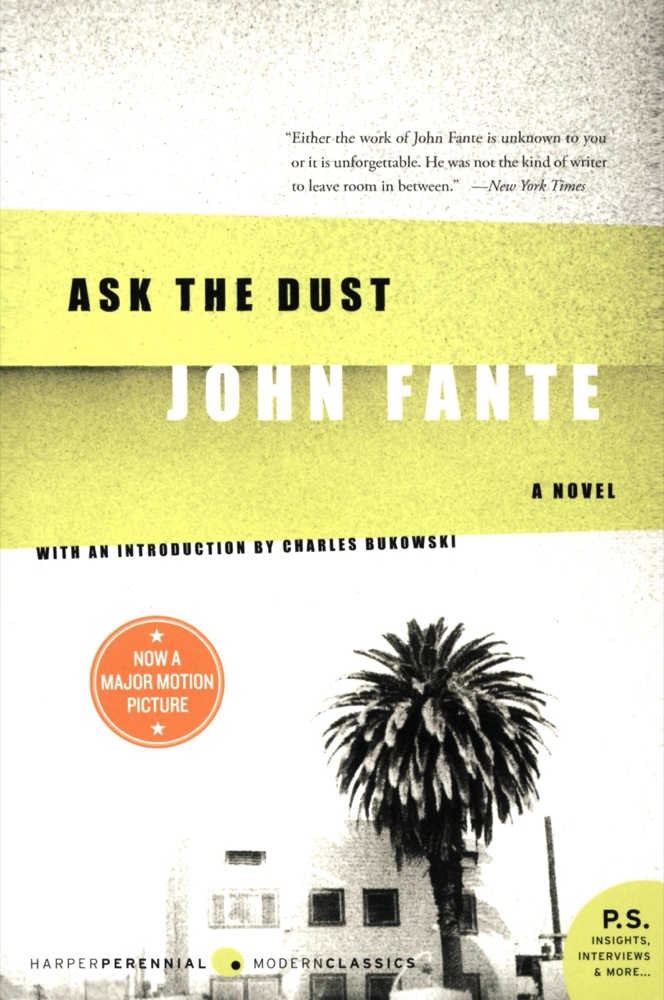
 Ask the Dust
Quotes from the Book
IT'S MORNING, TIME to get up, so get up, Arturo, and look for a job. Get out there and look for what you'll never find. You're a thief and you're a crab-killer and a lover of women in clothes closets. You'll never find a job! Every morning I got up feeling like that. Now I've got to find a job, damn it to hell. I ate breakfast, put a book under my arm, pencils in my pocket, and started out. Down the stairs I went, down the street, sometimes hot and sometimes cold, sometimes foggy and sometimes clear. It never mattered, with a book under my arm, looking for a job. What job, Arturo? Ho ho! A job for you? Think of what you are, my boy! A crab-killer. A thief. You look at naked women in clothes closets. And you expect to get a job! How funny! But there he goes, the idiot, with a big book. Where the devil are you going, Arturo? Why do you go up this street and not that? Why go east - why not go west? Answer me, you thief! Who'll give you a job, you swine - who? But there's a park across town, Arturo. It's called Banning Park. There are a lot of beautiful eucalyptus trees in it, and green lawns. What a place to read! Go there, Arturo. Read Nietzsche. Read Schopenhauer. Get into the company of the mighty. A job? fooey! Go sit under a eucalyptus tree reading a book looking for a job.
Dear Woman Who Gave Me Life: The callous vexations and perturbations of this night have subsequently resolved themselves to a state which precipitates me, Arturo Bandini, into a brobdingnagian and gargantuan decision. I inform you of this in no uncertain terms. Ergo, I now leave you and your ever charming daughter (my beloved sister Mona) and seek the fabulous usufructs of my incipient career in profound solitude. Which is to say, tonight I depart for the metropolis to the east — our own Los Angeles, the city of angels. I entrust you to the benign generosity of your brother, Frank Scarpi, who is, as the phrase has it, a good family man (sic!). I am penniless but I urge you in no uncertain terms to cease your cerebral anxiety about my destiny, for truly it lies in the palm of the immortal gods. I have made the lamentable discovery over a period of years that living with you and Mona is deleterious to the high and magnanimous purpose of Art, and I repeat to you in no uncertain terms that I am an artist, a creator beyond question. And, per se, the fumbling fulminations of cerebration and intellect find little fruition in the debauched, distorted hegemony that we poor mortals, for lack of a better and more concise terminology, call home. In no uncertain terms I give you my love and blessing, and I swear to my sincerity, when I say in no uncertain terms that I not only forgive you for what has ruefully transpired this night, but for all other nights. Ergo, I assume in no uncertain terms that you will reciprocate in kindred fashion. May I say in conclusion that I have much to thank you for, O woman who breathed the breath of life into my brain of destiny? Aye, it is, it is. Signed. Arturo Gabriel Bandini. Suitcase in hand, I walked down to the depot. There was a ten-minute wait for the midnight train for Los Angeles. I sat down and began to think about the new novel.
She was a hunchback with a sweet smile. She smiled sweetly at anything; she couldn't help it; the trees, me, the grass, anything. The basket pulled her down, dragging her toward the ground. She was such a tiny woman, with a hurt face, as if slapped forever. She wore a funny old hat, an absurd hat, a maddening hat, a hat to make me cry, a hat with faded red berries on the brim. And there she was, smiling at everything, struggling across the carpet with a heavy basket containing Lord knew what, wearing a plumed hat with red berries. I got up. It was so mysterious. There I was, like magic, standing up, my two feet on the ground, my eyes drenched. I said, "Let me help." She smiled again and gave me the basket. We began to walk. She led the way. Beyond the trees it was stifling. And she smiled. It was so sweet it nearly tore my head off. She talked, she told me things I never remembered. It didn't matter. In a« dream she held me, in a dream I followed under the blinding sun. For blocks we went forward. I hoped it would never end. Always she talked in a low voice made of human music. What words! What she said! I remembered nothing. I was only happy. But in my heart I was dying. It should have been so. We stepped from so many curbs, I wondered why she did not sit upon one and hold my head while I drifted away. It was the chance that never came again. That old woman with the bent back! Old woman, I feel so joyfully your pain. Ask me a favor, you old woman you! Anything. To die is easy. Make it that. To cry is easy, lift your skirt and let me cry and let my tears wash your feet to let you know I know what life has been for you, because my back is bent too, but my heart is whole, my tears are delicious, my love is yours, to give you joy where God has failed. To die is so easy and you may have my life if you wish it, you old woman, you hurt me so, you did, I will do anything for you, to die for you, the blood of my eighteen years flowing in the gutters of Wilmington and down to the sea for you, for you that you might find such joy as is now mine and stand erect without the horror of that twist. I left the old woman at her door. The trees shimmered. The clouds laughed. The blue sky took me up. Where am I? Is this Wilmington, California? Haven't I been here before? A melody moved my feet. The air soared with Arturo in it, puffing him in and out and making him something and nothing. My heart laughed and laughed. Goodbye to Nietzsche and Schopenhauer and all of you, you fools, I am much greater than all of you! Through my veins ran music of blood. Would it last? It could not last. I must hurry. But where? And I ran toward home. Now I am home. I left the book in the park. To hell with it. No more books for me. I kissed my mother. I clung to her passionately. On my knees I fell at her feet to kiss her feet and cling to her ankles until it must have hurt her and amazed her that it was I.
I told him, "The writing instinct has always lain dormant in me. Now it is in the process of metamorphosis. The era of transition has passed. I am on the threshold of expression." He said, "Balls.
I tell you I always tip. It's a matter of principle with me. I'm like Hemingway. I always do it second-nature.
Come on! Who wants to fight me?
The cricket was no more, but the power of love had found its way, and I was again myself and no longer a cricket, I was Arturo Bandini, and the elm tree yonder was Miss Hopkins, and I got to my knees and put my arms around the tree, kissing it for love everlasting, tearing the bark with my teeth and spitting it on the lawn.
I wasn't smart, but I always passed. Here was one: Arithmetic 70; History 80; Geography 70; Spelling 80; Religion 99; English 97. Never any trouble with religion or English for Arturo Bandini. And here was one of Mona's: Arithmetic 96; History 95; Geography 97; Spelling 94; Religion 90; English 90. She could beat me at other things, but never at English or religion. Ho! Very amusing, this. A great piece of anecdote for the biographers of Arturo Bandini. God's worst enemy making higher marks in religion than God's best friend, and both in the same family. A great irony. What a biography that would be! Ah Lord, to be alive and read it!
The celestial hypothesis is sheer propaganda formulated by the haves to delude the havenots.
Religion is the opium of the people.
It is the persistent delusion of an hoodwinked mankind.
The intelligent man makes certain reservations as to the choice of his listeners.
My mother said, "Arturo, stop that. Your sister's tired." "Oh Holy Ghost, Oh Holy inflated triple ego, get us out of the depression. Elect Roosevelt. Keep us on the gold standard. Take France off, but for Christ's sake keep us on!" "Arturo, stop that" "Oh Jehovah, in your infinite mutability see if you can't scrape up some coin for the Bandini family." My mother said, "Shame, Arturo. Shame." I got up on the divan and yelled, "I reject the hypothesis of God! Down with the decadence of a fraudulent Christianity! Religion is the opium of the people! All that we are or ever hope to be we owe to the devil and his bootleg apples!" My mother came after me with the broom.
Religion is the opium of the people!
Watch on YouTube
About John Fante
We have collected 62 quotes from 4 books by John Fante on BookQuoters.
More about the author →More by John Fante
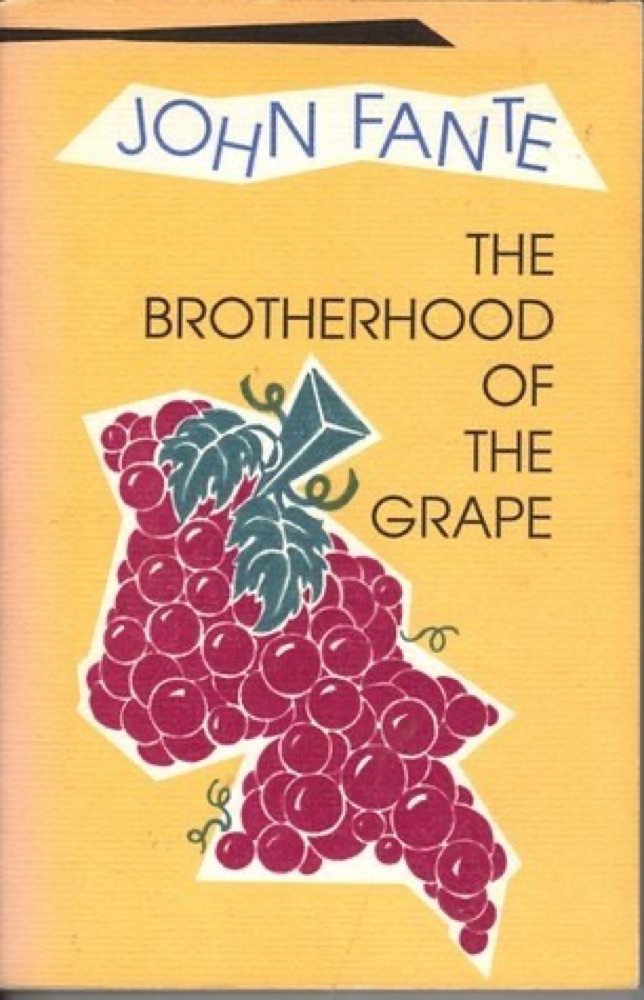
Book details
- Author
- John Fante
- Genre
- Classics
- Goodreads rating
- 3.78 (8k ratings) →
Keep reading
Ask the Dust
 Diary of a Drug Fiend
 Notes of a Dirty Old Man
 Sixty Stories
 Desolation Angels
 Portnoy's Complaint
 The Liar
 The Man Who Was Thursday
 Kim
Kim
 Henderson the Rain King
 Cocaine
 The Red and the Black
 Keep the Aspidistra Flying
 Mumbo Jumbo
 The Satyricon
 The Tunnel
 Hollywood
 Sexus
Sexus
 V.
V.
 Nine Stories
 Mother Night
 The Gadfly
 Faust
Faust
 Bridge of Birds
 Ulysses
 New Grub Street
 Jailbird
 Point Counter Point
 Angelmaker
 Fathers and Sons
 Coyote Blue
 I Am Pilgrim
 Sheever's Journal, Diary of a Poison Master
 Stranger in a Strange Land
 The Untouchable
 Under the Volcano
 Timequake
 Harassment Architecture
 The Horse's Mouth
 The Enchantress of Florence
 The Golden Notebook
 The Meursault Investigation
 The Napoleon of Notting Hill
 City of Thieves
 Skinny Legs and All
 Scaramouche
 Play the Piano Drunk Like a Percussion Instrument Until the Fingers Begin to Bleed a Bit
 Inherit the Wind
 I Have No Mouth & I Must Scream
 Hammered
 Take the Cannoli
 The Hour I First Believed
 Martin Eden
 Tropic of Cancer
 The Queen of the Damned
 Kingdom of Fear: Loathsome Secrets of a Star-Crossed Child in the Final Days of the American Century
 That Hideous Strength
 John Barleycorn: Alcoholic Memoirs
 The Magus