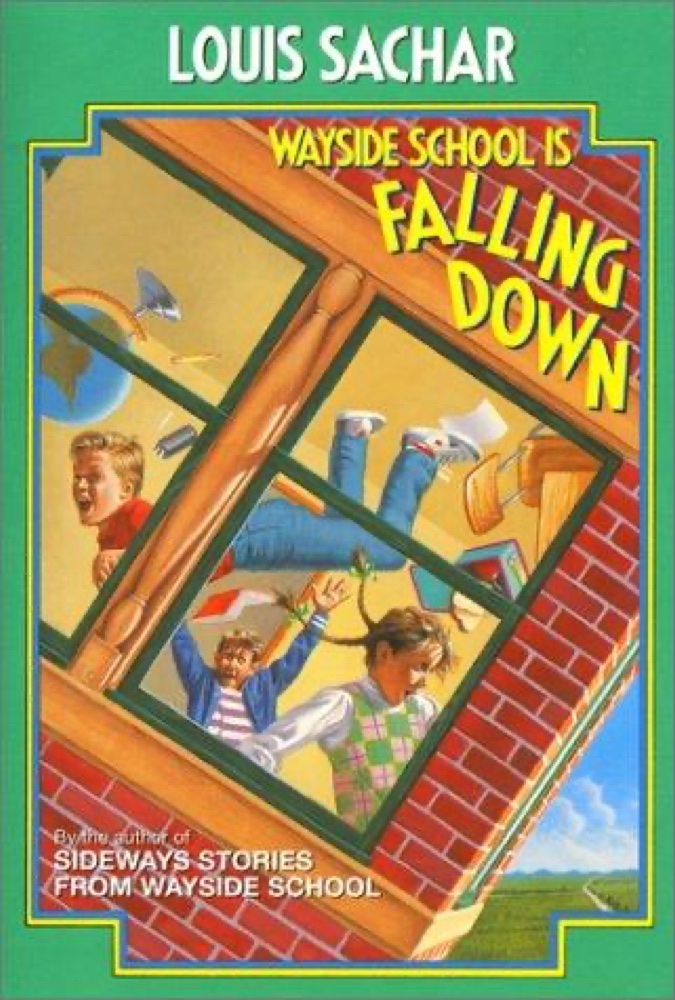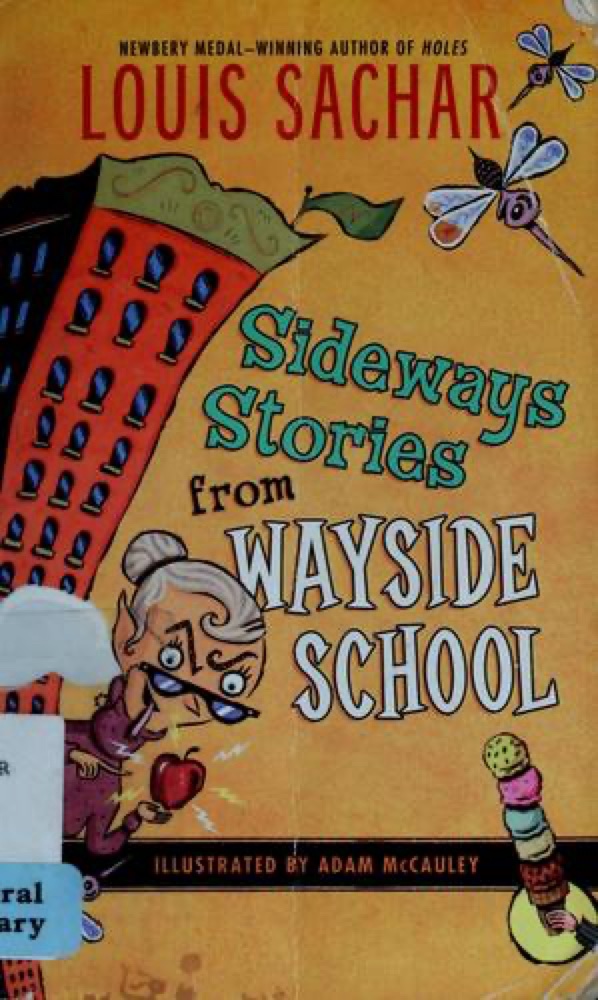

Louis Sachar · 144 pages
Rating: (81K votes)
“You need a reason to be sad. You don't need a reason to be happy.”
― Louis Sachar, quote from Sideways Stories from Wayside School
“It's funny how a person can be right all the time and still be wrong.”
― Louis Sachar, quote from Sideways Stories from Wayside School
“Dana had four beautiful eyes. She wore glasses. But her eyes were so beautiful that the glasses only made her prettier. With two eyes she was pretty. With four eyes she was beautiful. With six eyes she would have been even more beautiful. And if she had a hundred eyes, all over her face and her arms and her feet, why, she would have been the most beautiful creature in the world.”
― Louis Sachar, quote from Sideways Stories from Wayside School
“My dog, Pugsy, was hit by a car,”
― Louis Sachar, quote from Sideways Stories from Wayside School
“You need a reason to be sad. You don’t need a reason to be happy.”
― Louis Sachar, quote from Sideways Stories from Wayside School
“Dameon had hazel eyes with little black dots in the middle of each of them. The dots were called pupils.”
― Louis Sachar, quote from Sideways Stories from Wayside School
“Dex isn't a big guy by any means. He's on the short side and toned but still thin. But he has unpredictable pit-bull tactics and one hell of a lippy attitude with strangers. For heaven's sake, never give that man a shovel.”
― Karina Halle, quote from Lying Season
“I might not be able to hold my drink or my man, but what I can hold, is a tune. Point me in the right direction and give me a bloody mic.”
― Lindsey Kelk, quote from I Heart New York
“Someone sent me a letter that had one of the best quotes I've ever read. It said "What is to give light must endure burning." It's by a writer named Viktor Frankl. I've been turning that quote over and over in my head. The truth of it is absolutely awe-inspiring. In the end, I believe it's why we all suffer. It's the meaning we all look for behind the tragedies in our lives. The pain deepens us, burns away our impurities and petty selfishness. It makes us capable of empathy and sympathy. It makes us capable of love. The pain is the fire that allows us to rise from the ashes of what we were, and more fully realize what we can become. When you can step back and see the beauty of the process, it's amazing beyond words.”
― Damien Echols, quote from Life After Death
“Another obstacle was the stubbornness of the countries the pipeline had to cross, particularly Syria, all of which were demanding what seemed to be exorbitant transit fees. It was also the time when the partition of Palestine and the establishment of the state of Israel were aggravating American relations with the Arab countries. But the emergence of a Jewish state, along with the American recognition that followed, threatened more than transit rights for the pipeline. Ibn Saud was as outspoken and adamant against Zionism and Israel as any Arab leader. He said that Jews had been the enemies of Arabs since the seventh century. American support of a Jewish state, he told Truman, would be a death blow to American interests in the Arab world, and should a Jewish state come into existence, the Arabs “will lay siege to it until it dies of famine.” When Ibn Saud paid a visit to Aramco’s Dhahran headquarters in 1947, he praised the oranges he was served but then pointedly asked if they were from Palestine—that is, from a Jewish kibbutz. He was reassured; the oranges were from California. In his opposition to a Jewish state, Ibn Saud held what a British official called a “trump card”: He could punish the United States by canceling the Aramco concession. That possibility greatly alarmed not only the interested companies, but also, of course, the U.S. State and Defense departments. Yet the creation of Israel had its own momentum. In 1947, the United Nations Special Committee on Palestine recommended the partition of Palestine, which was accepted by the General Assembly and by the Jewish Agency, but rejected by the Arabs. An Arab “Liberation Army” seized the Galilee and attacked the Jewish section of Jerusalem. Violence gripped Palestine. In 1948, Britain, at wit’s end, gave up its mandate and withdrew its Army and administration, plunging Palestine into anarchy. On May 14, 1948, the Jewish National Council proclaimed the state of Israel. It was recognized almost instantly by the Soviet Union, followed quickly by the United States. The Arab League launched a full-scale attack. The first Arab-Israeli war had begun. A few days after Israel’s proclamation of statehood, James Terry Duce of Aramco passed word to Secretary of State Marshall that Ibn Saud had indicated that “he may be compelled, in certain circumstances, to apply sanctions against the American oil concessions… not because of his desire to do so but because the pressure upon him of Arab public opinion was so great that he could no longer resist it.” A hurriedly done State Department study, however, found that, despite the large reserves, the Middle East, excluding Iran, provided only 6 percent of free world oil supplies and that such a cut in consumption of that oil “could be achieved without substantial hardship to any group of consumers.”
― Daniel Yergin, quote from The Prize: The Epic Quest for Oil, Money, and Power
“Dưới âm ty người ta chẳng nhớ chiến tranh là cái trò gì nữa đâu. Chém giết là sự nghiệp của những thằng đang sống.”
― Bảo Ninh, quote from The Sorrow of War: A Novel of North Vietnam
BookQuoters is a community of passionate readers who enjoy sharing the most meaningful, memorable and interesting quotes from great books. As the world communicates more and more via texts, memes and sound bytes, short but profound quotes from books have become more relevant and important. For some of us a quote becomes a mantra, a goal or a philosophy by which we live. For all of us, quotes are a great way to remember a book and to carry with us the author’s best ideas.
We thoughtfully gather quotes from our favorite books, both classic and current, and choose the ones that are most thought-provoking. Each quote represents a book that is interesting, well written and has potential to enhance the reader’s life. We also accept submissions from our visitors and will select the quotes we feel are most appealing to the BookQuoters community.
Founded in 2023, BookQuoters has quickly become a large and vibrant community of people who share an affinity for books. Books are seen by some as a throwback to a previous world; conversely, gleaning the main ideas of a book via a quote or a quick summary is typical of the Information Age but is a habit disdained by some diehard readers. We feel that we have the best of both worlds at BookQuoters; we read books cover-to-cover but offer you some of the highlights. We hope you’ll join us.