
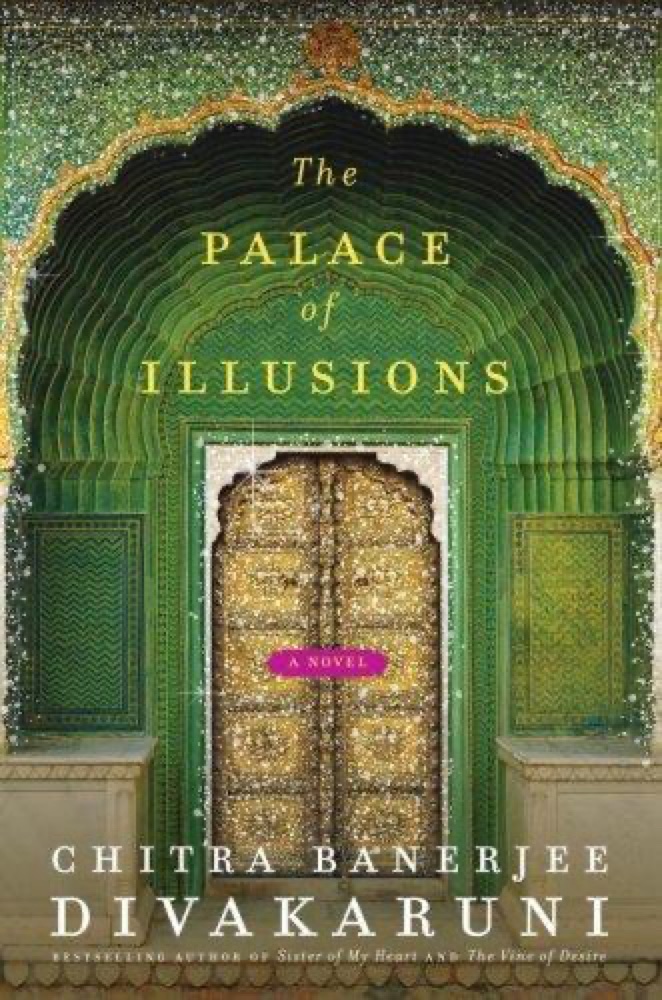
 The Palace of Illusions
Quotes from the Book
Words are tricky. Sometimes you need them to bring out the hurt festering inside. If you don't, it turns gangrenous and kills you. . . . But sometimes words can break a feeling into pieces.
Once I heard my mother say that each of us lives in a separate universe, one we have dreamed into being. We love pople when their dream coincides with ours, the way two cutout designs laid one on top of the other might match. But dream worlds are not static like cutouts; sooner or later they change shape, leading to misunderstanding, loneliness and loss of love.
In life, it's best not to take anything for free - unless it's from someone who wishes you well.
After the fire, when I'd tried to express my gratitude for their kindness to our customers, they'd been awkward, uncomfortable. My father had had to explain to me that giving thanks is not a common practice in India. 'Then how do you know if people appreciated what you did?' I'd asked. 'Do you really need to know?' my father had asked back.
The dream is not a drug but a way. Listen to where it can take you.
A dream is a telegram from the hidden world...Only a fool or an illiterate person ignores it.
Everyone breathes in air, but it's a wise person who knows when to use that air to speak and when to exhale in silence.
I liked his voice, rich and unself-conscious even when he forgot words and hummed to fill in the gap. What I didn't understand, I imagined, and thus it became a love song.
Or is this how humans survive, shrugging off history, immersing themselves in the moment?
I closed my eyes and willed my breath to slow, my conscious mind to fold itself inward. I could feel heat pulsing from my daughter's head, her frantic thoughts whirling like broken glass. I loosened my hold on my body and dropped into that whirlpool.
Rakhi likes the comfortable clutter of her life, the things she loves gathered around her like a shawl against the winterliness of the world.
The story hangs in the night air between them. It is very latem, and if father or daugther stepped to the window, tehyw ould see the Suktara, star of the impending dawn, hanging low in the sky. But they keep sitting at the table, each thinking of the story differently, as teller and listener always must. In the mind of each, different images swirl up and fall away, and each holds on to a different part of the story, thinking it the most important. And if each were to speak what it meant, they would say things so different you would not know it wa sthe same story they were speaking of.
Once I heard my mother say that each of us lives in a separate universe, one that we have dreamed into being. We love people when their dream coincides with ours, the way two cutout designs laid one on top of the other might match. But dream worlds are not static like cutouts; sooner or later they change shape, leading to misunderstanding, loneliness and loss of love.
Watch on YouTube
About Chitra Banerjee Divakaruni
We have collected 121 quotes from 6 books by Chitra Banerjee Divakaruni on BookQuoters.
More about the author →More by Chitra Banerjee Divakaruni
All books by Chitra Banerjee Divakaruni →


Book details
- Genre
- Fiction
- Goodreads rating
- 3.56 (3k ratings) →
Keep reading
 The Dream of Perpetual Motion
 Q & A
Q & A
 Muse of Nightmares
 A Room with a View
 The Memory Librarian: And Other Stories of Dirty Computer
 Blind Willow, Sleeping Woman
 The Stone Diaries
 The Enchanted
 The Grass Harp, Including A Tree of Night and Other Stories
 Swann's Way
 Hard-Boiled Wonderland and the End of the World
 Dream Count
 The Night Circus
 Animal Dreams
 The Color Master: Stories
 The Hundred Secret Senses
 The Illusion of Separateness
 The Wind-Up Bird Chronicle
 My Friends
The Palace of Illusions
My Friends
The Palace of Illusions
 The Book of Dreams
 The Sweet Far Thing
 When the World Tips Over
 Gods of Jade and Shadow
 Fragile Things: Short Fictions and Wonders
 The Ministry of Utmost Happiness
 Outline
 Doctor Zhivago
 Out of Oz
 Belong to Me
 Between the Lines
 The Tsar of Love and Techno
 The Love Song of Miss Queenie Hennessy
 Women in Love
 The Book of Koli
 A Sport and a Pastime
 Let the Great World Spin
 Sometimes I Lie
 The Inexplicable Logic of My Life
 Breath, Eyes, Memory
 Honey, Baby, Sweetheart
 The Glass Hotel
 Now Is the Time to Open Your Heart
 Bel Canto
 Too Much Happiness: Stories
 A Conjuring of Light
 A Tale for the Time Being
 If You Could See Me Now
 number9dream
 What I Loved
 The Love We Share Without Knowing
 Ship of Destiny
 Lighthousekeeping
 The Choice
 Sexing the Cherry
 The Song of the Lark
 The God of Small Things
 Perfect Ruin
 The New Couple in 5B