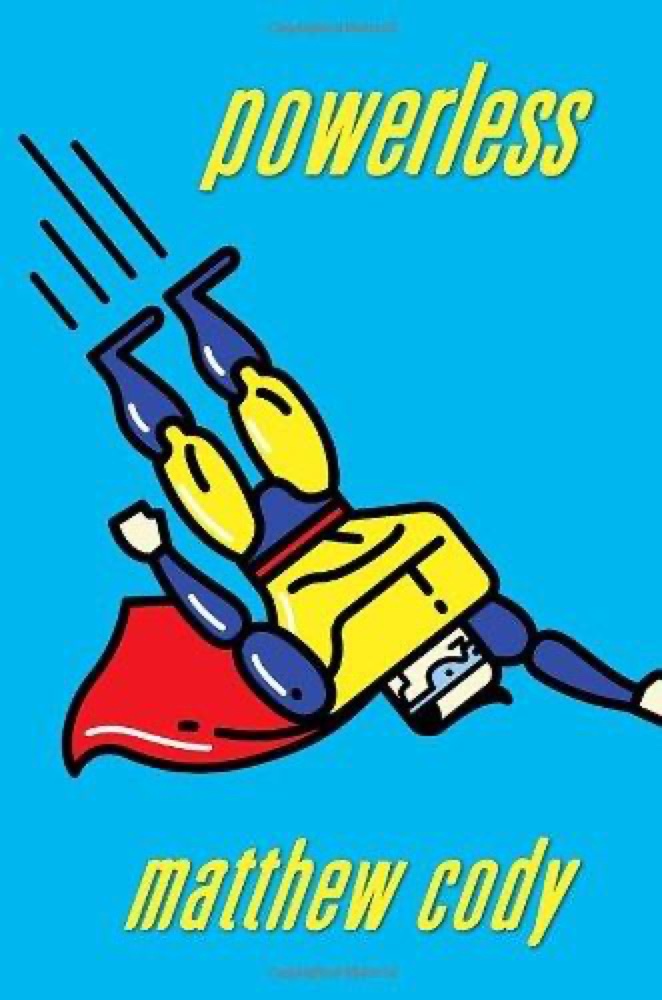

“Anyone up for a little breaking and entering?”
― Matthew Cody, quote from Powerless
“These days she always moved like that, as if she were made of glass in a house full of hard edges.”
― Matthew Cody, quote from Powerless
“You know, as you get older the gray matter starts to fail on you and your memories get all fuzzy—they disappear into mist.”
― Matthew Cody, quote from Powerless
“I don’t remember much from my childhood, but I do remember staring out that window and dreaming. I bet I had wonderful dreams….”
― Matthew Cody, quote from Powerless
“She might even have a doll hidden on her somewhere. Well,”
― Matthew Cody, quote from Powerless
“Interpretation first appears in the culture of late classical antiquity, when the power and credibility of myth had been broken by the “realistic” view of the world introduced by scientific enlightenment. Once the question that haunts post-mythic consciousness—that of the seemliness of religious symbols—had been asked, the ancient texts were, in their pristine form, no longer acceptable. Then interpretation was summoned, to reconcile the ancient texts to “modern” demands. Thus, the Stoics, to accord with their view that the gods had to be moral, allegorized away the rude features of Zeus and his boisterous clan in Homer’s epics. What Homer really designated by the adultery of Zeus with Leto, they explained, was the union between power and wisdom. In the same vein, Philo of Alexandria interpreted the literal historical narratives of the Hebrew Bible as spiritual paradigms. The story of the exodus from Egypt, the wandering in the desert for forty years, and the entry into the promised land, said Philo, was really an allegory of the individual soul’s emancipation, tribulations, and final deliverance. Interpretation thus presupposes a discrepancy between the clear meaning of the text and the demands of (later) readers. It seeks to resolve that discrepancy. The situation is that for some reason a text has become unacceptable; yet it cannot be discarded. Interpretation is a radical strategy for conserving an old text, which is thought too precious to repudiate, by revamping it. The interpreter, without actually erasing or rewriting the text, is altering it. But he can’t admit to doing this. He claims to be only making it intelligible, by disclosing its true meaning. However far the interpreters alter the text (another notorious example is the Rabbinic and Christian “spiritual” interpretations of the clearly erotic Song of Songs), they must claim to be reading off a sense that is already there.”
― Susan Sontag, quote from Against Interpretation and Other Essays
“What we have named as anger on the surface is the violent outer response to our own inner powerlessness, a powerlessness connected to such a profound sense of rawness and care that it can find no proper outer body or identity or voice, or way of life to hold it.”
― David Whyte, quote from Consolations: The Solace, Nourishment and Underlying Meaning of Everyday Words
“The rules are mine to set. What I don’t believe in is playing by other people’s rules.”
― Kyra Davis, quote from Just One Night
“The younger man’s build qualified him as an ectomorph—very”
― J.D. Horn, quote from The Source
“Many individuals are so constituted that their only thought is to obtain pleasure and shun responsibility. They would like, butterfly-like, to wing forever in a summer garden, flitting from flower to flower, and sipping honey for their sole delight. They have no feeling that any result which might flow from their action should concern them. They have no conception of the necessity of a well-organized society wherein all shall accept a certain quota of responsibility and all realize a reasonable amount of happiness. They think only of themselves because they have not yet been taught to think of society. For them pain and necessity are the great taskmasters. Laws are but the fences which circumscribe the sphere of their operations. When, after error, pain falls as a lash, they do not comprehend that their suffering is due to misbehavior. Many such an individual is so lashed by necessity and law that he falls fainting to the ground, dies hungry in the gutter or rotting in the jail and it never once flashes across his mind that he has been lashed only in so far as he has persisted in attempting to trespass the boundaries which necessity sets. A prisoner of fate, held enchained for his own delight, he does not know that the walls are tall, that the sentinels of life are forever pacing, musket in hand. He cannot perceive that all joy is within and not without. He must be for scaling the bounds of society, for overpowering the sentinel. When we hear the cries of the individual strung up by the thumbs, when we hear the ominous shot which marks the end of another victim who has thought to break loose, we may be sure that in another instance life has been misunderstood--we may be sure that society has been struggled against until death alone would stop the individual from contention and evil.”
― Theodore Dreiser, quote from Sister Carry
BookQuoters is a community of passionate readers who enjoy sharing the most meaningful, memorable and interesting quotes from great books. As the world communicates more and more via texts, memes and sound bytes, short but profound quotes from books have become more relevant and important. For some of us a quote becomes a mantra, a goal or a philosophy by which we live. For all of us, quotes are a great way to remember a book and to carry with us the author’s best ideas.
We thoughtfully gather quotes from our favorite books, both classic and current, and choose the ones that are most thought-provoking. Each quote represents a book that is interesting, well written and has potential to enhance the reader’s life. We also accept submissions from our visitors and will select the quotes we feel are most appealing to the BookQuoters community.
Founded in 2023, BookQuoters has quickly become a large and vibrant community of people who share an affinity for books. Books are seen by some as a throwback to a previous world; conversely, gleaning the main ideas of a book via a quote or a quick summary is typical of the Information Age but is a habit disdained by some diehard readers. We feel that we have the best of both worlds at BookQuoters; we read books cover-to-cover but offer you some of the highlights. We hope you’ll join us.