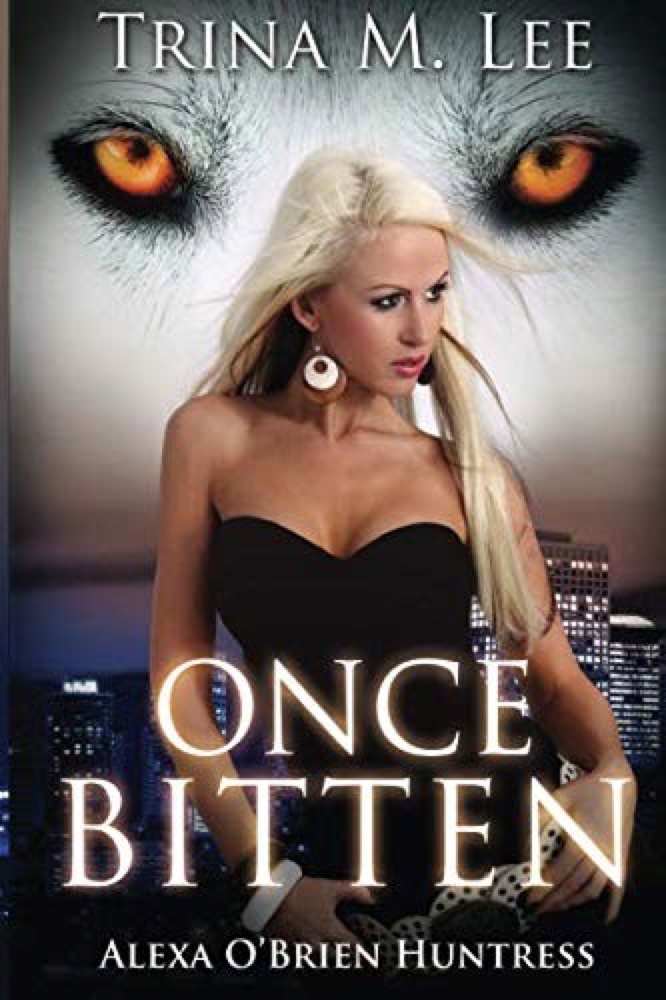

“It was starting to feel like a hair pulling, bitch slapping kind of fight.”
― Trina M. Lee, quote from Once Bitten
“It was starting to feel like a hair pulling, bitch slapping kind of fight. I needed to take it to the next level.”
― Trina M. Lee, quote from Once Bitten
“I might be five foot one and counting, but that doesn't mean shit when it comes to what really makes you tough.”
― Trina M. Lee, quote from Once Bitten
“Fucking bitch! I’m not going to beg.” “Good. It’s probably better if you don’t go out like a pussy.”
― Trina M. Lee, quote from Once Bitten
“You reek of lust,” Arys commented. The fresh energy rolled off him and tantalized my senses. “What have you been doing in here without me?”
― Trina M. Lee, quote from Once Bitten
“Piercings in his ears, nose and lip revealed his edgy nature. He was casual in faded blue jeans and a black t-shirt that hugged his well-muscled chest in all of the right places. His eyes were a deep, drowning blue. His hair was slightly spiky and bedroom messy with just a hint of the early Elvis style. To say that I found him attractive would be putting it lightly. He was absolutely gorgeous.”
― Trina M. Lee, quote from Once Bitten
“To be a wolf wasn’t hard. No, the hard part was to go back to being human afterward. In a world of noise, pollution and selfishness, I enjoyed the relief, the escape to something pure, natural and free.”
― Trina M. Lee, quote from Once Bitten
“As a creature with a dual nature, to deny one risked the other. Several shifters had chosen one side, human or wolf. Most of them had driven themselves into madness. The balance in-between was often hard to find, but it was always worth it.”
― Trina M. Lee, quote from Once Bitten
“one thing about crazy people, Raoul, sometimes they don’t want to come back. The brink of insanity suits them just fine.”
― Trina M. Lee, quote from Once Bitten
“I to właśnie wówczas, w ciemności, uświadomiłem sobie po raz pierwszy w życiu, że jedynie samotność jest w życiu człowieka stanem graniczącym z absolutnym spokojem wewnętrznym, z odzyskaniem indywidualności. Tylko w pochłaniającej wszystko pustce samotności, w ciemnościach zacierających kontury świata zewnętrznego można odczuć, że się jest sobą aż do granic zwątpienia, które uprzytamnia nagle własną nicość w rosnącym przeraźliwie ogromie wszechświata.”
― Gustaw Herling-Grudziński, quote from A World Apart
“From its creation in 1913, the most important Fed mandate has been to maintain the purchasing power of the dollar; however, since 1913 the dollar has lost over 95 percent of its value. Put differently, it takes twenty dollars today to buy what one dollar would buy in 1913.”
― James Rickards, quote from Currency Wars: The Making of the Next Global Crisis
“we have on earth exactly the amount of time that has been allotted to us, no more and no less. We really have precious little control.”
― Chris Bohjalian, quote from The Sandcastle Girls
“Perhaps the deepest indication of our slavery is the monetization of time. It is a phenomenon with roots deeper than our money system, for it depends on the prior quantification of time. An animal or a child has “all the time in the world.” The same was apparently true for Stone Age peoples, who usually had very loose concepts of time and rarely were in a hurry. Primitive languages often lacked tenses, and sometimes lacked even words for “yesterday” or “tomorrow.” The comparative nonchalance primitive people had toward time is still apparent today in rural, more traditional parts of the world. Life moves faster in the big city, where we are always in a hurry because time is scarce. But in the past, we experienced time as abundant. The more monetized society is, the more anxious and hurried its citizens. In parts of the world that are still somewhat outside the money economy, where subsistence farming still exists and where neighbors help each other, the pace of life is slower, less hurried. In rural Mexico, everything is done mañana. A Ladakhi peasant woman interviewed in Helena Norberg-Hodge’s film Ancient Futures sums it all up in describing her city-dwelling sister: “She has a rice cooker, a car, a telephone—all kinds of time-saving devices. Yet when I visit her, she is always so busy we barely have time to talk.” For the animal, child, or hunter-gatherer, time is essentially infinite. Today its monetization has subjected it, like the rest, to scarcity. Time is life. When we experience time as scarce, we experience life as short and poor. If you were born before adult schedules invaded childhood and children were rushed around from activity to activity, then perhaps you still remember the subjective eternity of childhood, the afternoons that stretched on forever, the timeless freedom of life before the tyranny of calendar and clocks. “Clocks,” writes John Zerzan, “make time scarce and life short.” Once quantified, time too could be bought and sold, and the scarcity of all money-linked commodities afflicted time as well. “Time is money,” the saying goes, an identity confirmed by the metaphor “I can’t afford the time.” If the material world”
― Charles Eisenstein, quote from Sacred Economics: Money, Gift, and Society in the Age of Transition
“her skin nearly transparent, as if her body was halfway to heaven already, with only her fierce, eaglelike gaze left behind.”
― Jennifer Bernard, quote from The Fireman Who Loved Me
BookQuoters is a community of passionate readers who enjoy sharing the most meaningful, memorable and interesting quotes from great books. As the world communicates more and more via texts, memes and sound bytes, short but profound quotes from books have become more relevant and important. For some of us a quote becomes a mantra, a goal or a philosophy by which we live. For all of us, quotes are a great way to remember a book and to carry with us the author’s best ideas.
We thoughtfully gather quotes from our favorite books, both classic and current, and choose the ones that are most thought-provoking. Each quote represents a book that is interesting, well written and has potential to enhance the reader’s life. We also accept submissions from our visitors and will select the quotes we feel are most appealing to the BookQuoters community.
Founded in 2023, BookQuoters has quickly become a large and vibrant community of people who share an affinity for books. Books are seen by some as a throwback to a previous world; conversely, gleaning the main ideas of a book via a quote or a quick summary is typical of the Information Age but is a habit disdained by some diehard readers. We feel that we have the best of both worlds at BookQuoters; we read books cover-to-cover but offer you some of the highlights. We hope you’ll join us.