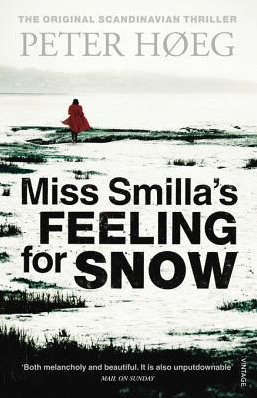
Peter Høeg · 416 pages
Rating: (34.1K votes)
“To want to understand is an attempt to recapture something we have lost.”
― Peter Høeg, quote from Miss Smilla's Feeling For Snow
“Do you know what the mathematical expression is for longing? ... The negative numbers. The formalization of the feeling that you are missing something.”
― Peter Høeg, quote from Miss Smilla's Feeling For Snow
“I feel the same way about solitude as some people feel about the blessing of the church. It's the light of grace for me. I never close my door behind me without the awareness that I am carrying out an act of mercy toward myself.”
― Peter Høeg, quote from Miss Smilla's Feeling For Snow
“When my mother didn't come back I realized that any moment could be the last. Nothing in life should simply be a passage from one place to another. Each walk should be taken as if it is the only thing you have left. You can demand something like this of yourself as an unattainable ideal. After that, you have to remind yourself about it every time you're sloppy about something. For me that means 250 times a day.”
― Peter Høeg, quote from Miss Smilla's Feeling For Snow
“Falling in love has been greatly overrated. Falling in love consists of 45 percent fear of not being accepted, 45 percent manic hope that this time the fear will be put to shame and a modest 10 percent frail awareness of the possibility of love.
I don't fall in love any more. Just like I don't get the mumps.”
― Peter Høeg, quote from Miss Smilla's Feeling For Snow

“There is one way to understand another culture. Living it. Move into it, ask to be tolerated as a guest, learn the language. At some point understanding may come. It will always be wordless. The moment you grasp what is foreign, you will lose the urge to explain it. To explain a phenomenon is to distance yourself from it.”
― Peter Høeg, quote from Miss Smilla's Feeling For Snow
“We think there are limits to the dimensions of fear. Until we encounter the unknown. Then we can all feel boundless amounts of terror.”
― Peter Høeg, quote from Miss Smilla's Feeling For Snow
“There's a look of mischief in his eyes. 'Smilla. Why is it that such an elegant and petite girl like you has such a rough voice.'
I'm sorry,' I say, 'if I give you the impression that it is only my mouth that's rough. I do my best to be rough all over.”
― Peter Høeg, quote from Miss Smilla's Feeling For Snow
“Confronted with people who have power, and who enjoy using it, I turn into a different person, a baser and meaner one.”
― Peter Høeg, quote from Miss Smilla's Feeling For Snow
“Some thoughts have glue on them.----Smilla”
― Peter Høeg, quote from Miss Smilla's Feeling For Snow
“There are mornings when it feels as if you rise up to the surface through a mud bath. With your feet stuck in a block of cement. When you know that you’ve expired in the night and have nothing to be happy about except the fact that at least you’ve already died so they can’t transplant your lifeless organs.”
― Peter Høeg, quote from Miss Smilla's Feeling For Snow
“Nothing corrupts like happiness. It makes us think that since we share this moment, we can also share the past.”
― Peter Høeg, quote from Miss Smilla's Feeling For Snow
“No one who has lived side by side with animals that have plenty of room can ever visit the zoo.”
― Peter Høeg, quote from Miss Smilla's Feeling For Snow
“Grief is a gift, something you have to earn.”
― Peter Høeg, quote from Miss Smilla's Feeling For Snow
“The body's pain is so paper-thin and insignificant compared to that of the mind.”
― Peter Høeg, quote from Miss Smilla's Feeling For Snow
“Whining is a virus, a lethal, infectious, epidemic disease.”
― Peter Høeg, quote from Miss Smilla's Feeling For Snow
“Es gibt nur eine Art und Weise, eine andere Kultur zu verstehen. Sie zu leben. In sie einzuziehen, darum zu bitten, als Gast geduldet zu werden, die Sprache zu lernen. Irgendwann kommt dann vielleicht das Verständnis. Es wird dann immer wortlos sein. In dem Moment, in dem man das Fremde begreift, verliert man den Drang, es zu erklären. Ein Phänomen erklären heißt, sich davon entfernen.”
― Peter Høeg, quote from Miss Smilla's Feeling For Snow
“With age I have voluntarily chosen certain limitations. I don't have the energy to start over again. To learn new skills or fight my own personality or figure out diesel engines.”
― Peter Høeg, quote from Miss Smilla's Feeling For Snow
“As far as I'm concerned, you could send all the cars in the world through a compactor and shoot them out through the stratosphere and put them in orbit around Mars. Except, of course, the taxis that have to be at my disposal when I need them.”
― Peter Høeg, quote from Miss Smilla's Feeling For Snow
“It's a phenomenon that I've often observed without understanding it. Inside someone another person can exist, a fully formed, generous, and trustworthy individual who never comes to light except in glimpses, because he is surrounded by a corrupt, dyed-in-the-wool, repeat offender.”
― Peter Høeg, quote from Miss Smilla's Feeling For Snow
“The cookies combine butter and spices in such a way that you could eat a hundred of them and only realize how sick you are after it's too late.”
― Peter Høeg, quote from Miss Smilla's Feeling For Snow
“Cantor illustrated the concept of infinity for his students by telling them that there was once a man who had a hotel with an infinite number of rooms, and the hotel was fully occupied. Then one more guest arrived. So the owner moved the guest in room number 1 into room number 2; the guest in room number 2 into number 3; the guest in 3 into room 4, and so on. In that way room number 1 became vacant for the new guest.
What delights me about this story is that everyone involved, the guests and the owner, accept it as perfectly natural to carry out an infinite number of operations so that one guest can have peace and quiet in a room of his own. That is a great tribute to solitude.”
― Peter Høeg, quote from Miss Smilla's Feeling For Snow
“Maybe I should give up and go back the way I came. But I stay. I detest fear. I hate being scared. There is only one path to fearlessness. It’s the one that leads into the mysterious center of the terror.”
― Peter Høeg, quote from Miss Smilla's Feeling For Snow
“Falling in love has been greatly overrated. Falling in love consists of forty-five per cent fear of not being accepted and forty-five per cent manic hope that this time the fear will be put to shame, and a modest ten per cent frail awareness of the possibility of love. [...]
Falling in love is a form of madness. Closely related to hatred, coldness, resentment, intoxication, and suicide.”
― Peter Høeg, quote from Miss Smilla's Feeling For Snow
“Влюбванията са силно преувеличени. Влюбванията се състоят от 45 процента ужас, че ще ни отхвърлят, 45 процента маниакална надежда, че точно този път ужасът ще излезе неоправдан, и още десет жалки процента призрачно чувство за възможна любов.”
― Peter Høeg, quote from Miss Smilla's Feeling For Snow
“I've had the privilege of learning foreign languages. Instead of merely speaking a watered-down form of my mother tongue, like most people, I'm also helpless in two or three other languages.”
― Peter Høeg, quote from Miss Smilla's Feeling For Snow
“If you consider all the unpleasantness you encounter while you're alive, it seems improbable that it would all come to an end simply because you're dead.”
― Peter Høeg, quote from Miss Smilla's Feeling For Snow
“Ако някой ме попита какво ме прави истински щастлива, ще отговоря: числата. Снегът, ледът и числата.
... системата на числата е като човешкият живот. Първо са естествените числа. Те са цели положителни. Числата на малките деца. Но човешкото съзнание се разширява. Детето открива тъгата, а знаеш ли какъв е математическият израз на тъгата?
Отрицателните числа. Усещането за нещо липсващо. Съзнанието се разширява безспирно и расте и детето открива празнините. Между камъните, между мъха по камъните, между хората. И между числата. И знаеш ли накъде води това?Към дробите. Целите числа плюс дробите дават рационалните числа. Но съзнанието не спира дотук. То иска да стигне отвъд здравия разум. Прибягва до толкова абсурдното действие като извличане на корен.
И получава ирационалните числа...
...Това е вид лудост. Защото ирационалните числа са безкрайни. Не може да се изпишат като отношение на цели числа. Те принуждават съзнанието да се стреми към безграничното. А прибавиш ли ирационалните числа към рационалните, получаваш реалните числа. И няма край. Няма никакви граници. Защото на сцената излиза разширяването на реалните числа с имагинерните, квадратните корени на отрицателните числа. Числа,които не можем да си представим, числа, които нормалното съзнание не може да обхване. А щом прибавим имагинерните числа към реалните, получаваме комплексните числа. Това е цифровата система, която прави възможно пълното изследване на формирането на ледените кристали. И е като огромна открита територия. Хоризонтите. Човек върви към тях, а те непрекъснато се отдалечават.
Такава е Гренландия, това е, без което не мога да живея!”
― Peter Høeg, quote from Miss Smilla's Feeling For Snow
Peter Høeg
Born place: in Copenhagen, Denmark
Born date May 7, 1957
See more on GoodReads
“would ride into fire. For Odysseus that whip was pride.”
― David Gemmell, quote from Shield of Thunder
“...Attempts at imitation would put the emphasis where it didn't belong. The goal was to improve the lives of others, not oneself.”
― Tracy Kidder, quote from Mountains Beyond Mountains: The Quest of Dr. Paul Farmer, A Man Who Would Cure the World
“All I want to know is why a party of Fey wanted to kill me,” I said
heatedly.
The beetle’s lips twisted enough to show fang. “Doesn’t everyone?”
Radu hustled me out the door before I could find out if the vamp’s plump
little carcass would fit into his overstuffed desk.”
― Karen Chance, quote from Midnight's Daughter
“Once the blinders are off, it's rather hard to go back to seeing things the way you used to.”
― Mercedes Lackey, quote from The Fairy Godmother
“We (men) would rather lose an arm out a city bus window than tell you simply, “You’re not the
one.” We are quite sure you will kill us or yourself or both—or even worse, cry and yell at us.”
― Greg Behrendt, quote from He's Just Not That Into You: The No-Excuses Truth to Understanding Guys

 Now You See Me
 The Art of Asking; o...
 The Hidden Kingdom

 Waking Up: A Guide t...
 The Goblin Emperor
BookQuoters is a community of passionate readers who enjoy sharing the most meaningful, memorable and interesting quotes from great books. As the world communicates more and more via texts, memes and sound bytes, short but profound quotes from books have become more relevant and important. For some of us a quote becomes a mantra, a goal or a philosophy by which we live. For all of us, quotes are a great way to remember a book and to carry with us the author’s best ideas.
We thoughtfully gather quotes from our favorite books, both classic and current, and choose the ones that are most thought-provoking. Each quote represents a book that is interesting, well written and has potential to enhance the reader’s life. We also accept submissions from our visitors and will select the quotes we feel are most appealing to the BookQuoters community.
Founded in 2023, BookQuoters has quickly become a large and vibrant community of people who share an affinity for books. Books are seen by some as a throwback to a previous world; conversely, gleaning the main ideas of a book via a quote or a quick summary is typical of the Information Age but is a habit disdained by some diehard readers. We feel that we have the best of both worlds at BookQuoters; we read books cover-to-cover but offer you some of the highlights. We hope you’ll join us.
