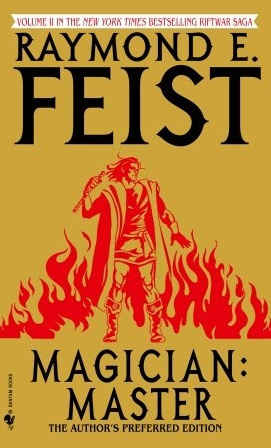
“But for the most part, love is a recognition, an opportunity to say, 'There is something about you I cherish.”
― Raymond E. Feist, quote from Magician: Master
“- Няма друго място като морето, господа. Тези, които цял живот изкарват на сушата, никога няма да го разберат. Морето е първично, понякога е жестоко, друг път - нежно, и никога - предсказуемо.”
― Raymond E. Feist, quote from Magician: Master
“There are many ways to love someone. Sometimes we want to love so much we're not too choosy about who we love. Other times we make love such a pure and noble thing no poor human can ever meet our vision. But for the most part, love is a recognition, an opportunity to say, 'There is something about you I cherish.' It doesn't entail marriage, or even physical love. There's love of parents, love of city or nation, love of life, and love of people. All different, all love.”
― Raymond E. Feist, quote from Magician: Master
“- Вземете който щете моряк, газил в дълбоки води и срещал смъртта толкова пъти, колкото мен, драснете го с нокът по кожата и отдолу ще намерите философ. Засуканите думи ще са му чужди, гарантирам ви, но ще намерите дълбок и траен усет за мястото му в света.”
― Raymond E. Feist, quote from Magician: Master
“- Като дете изпитвах същото по клоните на големите дървета. Да стоиш прилепен до един ствол, толкова древен, че и най-древната човешка памет бледнее пред него, ти внушава същото чувство за място в света.”
― Raymond E. Feist, quote from Magician: Master

“Ишап, морето е голямо, а лодката ми - малка. Имай милост към мен.”
― Raymond E. Feist, quote from Magician: Master
“Dok su prilazili vratima kolibe, Pag reče: "Čogana, hvala ti. Ali zanima me jedno: pomenuo si neprijatelja na vrhu kule. Možeš li mi ga opisati?"
Čogana se nasmeja i klimnu glavom. "Oh da, video sam ga." On krenu uz stepenice prema kolibi, i dalje se kikoćući. "To je najstrašniji neprijatelj svakog čoveka." Suženim očima osmotri Paga. "Bio si to ti.”
― Raymond E. Feist, quote from Magician: Master
“Vidiš, veoma je malo stvarnih ogreničenja. Sve čemu te uče je korisno, ali nikad ne prihvataj tvrdnju da je neko rešenje *jedino* rešenje samo ako uspe da reši problem.”
― Raymond E. Feist, quote from Magician: Master
“Stvorili ste čoveka sa snažnim osećanjem dužnosti, koji nije omekšan ljubavlju prema tome čemu duguje vernost.”
― Raymond E. Feist, quote from Magician: Master
“Moćnicima je važnije sopstveno blagostanje nego dobrobit Carstva. A kako su sami oni slika Carstva za bilo koje neupućeno oko, ta činjenica se lako propušta."
"Kako to misliš?" - upita stariji čarobnjak.
"Kad pomisliš na Carstvo, šta zamišljaš? Istoriju armija koje ratuju po zemlji? Ili uspon Sabora? Možda se setiš vladarskih hronika. Šta god bilo, jedna najočiglednija istina se previđa. Carstvo čine svi oni koji žive unutar njegovih granica, od vlastelina do najnižih slugu, čak i robova koji obrađuju zemlju. Ono se mora posmatrati kao jedinstvena celina, i pogrešno je smatrati neki mali ali vidljiv deo, poput ratnog vođe ili Visokog saveta, njegovoim otelotvorenjem. Shvataš li to?”
― Raymond E. Feist, quote from Magician: Master

“There’s power in the touch of another person’s hand. We acknowledge it in little ways, all the time. There’s a reason human beings shake hands, hold hands, slap hands, bump hands.
“It comes from our very earliest memories, when we all come into the world blinded by light and color, deafened by riotous sound, flailing in a suddenly cavernous space without any way of orienting ourselves, shuddering with cold, emptied with hunger, and justifiably frightened and confused. And what changes that first horror, that original state of terror?
“The touch of another person’s hands.
“Hands that wrap us in warmth, that hold us close. Hands that guide us to shelter, to comfort, to food. Hands that hold and touch and reassure us through our very first crisis, and guide us into our very first shelter from pain. The first thing we ever learn is that the touch of someone else’s hand can ease pain and make things better.
“That’s power. That’s power so fundamental that most people never even realize it exists.”
― Jim Butcher, quote from Skin Game
“We are the people birthed from this land. For the first time I can seem something I've not fully understood before, not until now as these pale creatures from somewhere far away stare down at us in wonder, trying to makes sense of what they see. We are this place. This place is us.”
― Joseph Boyden, quote from The Orenda
“Being a hero means ignoring how silly you feel.”
― Diana Wynne Jones, quote from Fire and Hemlock
“Studentdom, he felt, must pass its own Examinations and define its own Commencement--a slow, most painful process, made the more anguishing by bloody intelligences like the Bonifacists of Siegfrieder College. Yet however it seemed at times that men got nowhere, but only repeated class by class the mistakes of their predecessors, two crucial facts about them were at once their hope and the limitation of their possibility, so he believed. One was their historicity: the campus was young, the student race even younger, and by contrast with the whole of past time, the great collegiate cultures had been born only yesterday. The other had to do with comparative cyclology, a field of systematic speculation he could not review for me just then, but whose present relevance lay in the correspondency he held to obtain between the life-history of individuals and the history of studentdom in general. As the embryologists maintained that ontogeny repeats phylogeny, so, Max claimed, the race itself--and on a smaller scale, West-Campus culture--followed demonstrably--in capital letters, as it were, or slow motion--the life-pattern of its least new freshman. This was the basis of Spielman's Law--ontogeny repeats cosmogeny--and there was much more to it and to the science of cyclology whereof it was first principle. The important thing for now was that, by his calculations, West-Campus as a whole was in mid-adolescence...
'Look how we been acting,' he invited me, referring to intercollegiate political squabbles; 'the colleges are spoilt kids, and the whole University a mindless baby, ja? Okay: so weren't we all once, Enos Enoch too? And we got to admit that the University's a precocious kid. If the history of life on campus hadn't been so childish, we couldn't hope it'll reach maturity.' Studentdom had passed already, he asserted, from a disorganized, pre-literate infancy (of which Croaker was a modern representative, nothing ever being entirely lost) through a rather brilliant early childhood ('...ancient Lykeion, Remus, T'ang...') which formed its basic and somewhat contradictory character; it had undergone a period of naive general faith in parental authority (by which he meant early Founderism) and survived critical spells of disillusionment, skepticism, rationalism, willfulness, self-criticism, violence, disorientation, despair, and the like--all characteristic of pre-adolescence and adolescence, at least in their West-Campus form. I even recognized some of those stages in my own recent past; indeed, Max's description of the present state of West-Campus studentdom reminded me uncomfortably of my behavior in the Lady-Creamhair period: capricious, at odds with itself, perverse, hard to live with. Its schisms, as manifested in the Quiet Riot, had been aggravated and rendered dangerous by the access of unwonted power--as when, in the space of a few semesters, a boy finds himself suddenly muscular, deep-voiced, aware of his failings, proud of his strengths, capable of truly potent love and hatred--and on his own. What hope there was that such an adolescent would reach maturity (not to say Commencement) without destroying himself was precisely the hope of the University.”
― John Barth, quote from Giles Goat-Boy
“The first thing you notice about New Orleans are the burying grounds - the cemeteries - and they're a cold proposition, one of the best things there are here. Going by, you try to be as quiet as possible, better to let them sleep. Greek, Roman, sepulchres- palatial mausoleums made to order, phantomesque, signs and symbols of hidden decay - ghosts of women and men who have sinned and who've died and are now living in tombs. The past doesn't pass away so quickly here. You could be dead for a long time.
The ghosts race towards the light, you can almost hear the heavy breathing spirits, all determined to get somewhere. New Orleans, unlike a lot of those places you go back to and that don't have the magic anymore, still has got it. Night can swallow you up, yet none of it touches you. Around any corner, there's a promise of something daring and ideal and things are just getting going. There's something obscenely joyful behind every door, either that or somebody crying with their head in their hands. A lazy rhythm looms in the dreamy air and the atmosphere pulsates with bygone duels, past-life romance, comrades requesting comrades to aid them in some way. You can't see it, but you know it's here. Somebody is always sinking. Everyone seems to be from some very old Southern families. Either that or a foreigner. I like the way it is.
There are a lot of places I like, but I like New Orleans better. There's a thousand different angles at any moment. At any time you could run into a ritual honoring some vaguely known queen. Bluebloods, titled persons like crazy drunks, lean weakly against the walls and drag themselves through the gutter. Even they seem to have insights you might want to listen to. No action seems inappropriate here. The city is one very long poem. Gardens full of pansies, pink petunias, opiates. Flower-bedecked shrines, white myrtles, bougainvillea and purple oleander stimulate your senses, make you feel cool and clear inside.
Everything in New Orleans is a good idea. Bijou temple-type cottages and lyric cathedrals side by side. Houses and mansions, structures of wild grace. Italianate, Gothic, Romanesque, Greek Revival standing in a long line in the rain. Roman Catholic art. Sweeping front porches, turrets, cast-iron balconies, colonnades- 30-foot columns, gloriously beautiful- double pitched roofs, all the architecture of the whole wide world and it doesn't move. All that and a town square where public executions took place. In New Orleans you could almost see other dimensions. There's only one day at a time here, then it's tonight and then tomorrow will be today again. Chronic melancholia hanging from the trees. You never get tired of it. After a while you start to feel like a ghost from one of the tombs, like you're in a wax museum below crimson clouds. Spirit empire. Wealthy empire. One of Napoleon's generals, Lallemaud, was said to have come here to check it out, looking for a place for his commander to seek refuge after Waterloo. He scouted around and left, said that here the devil is damned, just like everybody else, only worse. The devil comes here and sighs. New Orleans. Exquisite, old-fashioned. A great place to live vicariously. Nothing makes any difference and you never feel hurt, a great place to really hit on things. Somebody puts something in front of you here and you might as well drink it. Great place to be intimate or do nothing. A place to come and hope you'll get smart - to feed pigeons looking for handouts”
― Bob Dylan, quote from Chronicles, Volume One
BookQuoters is a community of passionate readers who enjoy sharing the most meaningful, memorable and interesting quotes from great books. As the world communicates more and more via texts, memes and sound bytes, short but profound quotes from books have become more relevant and important. For some of us a quote becomes a mantra, a goal or a philosophy by which we live. For all of us, quotes are a great way to remember a book and to carry with us the author’s best ideas.
We thoughtfully gather quotes from our favorite books, both classic and current, and choose the ones that are most thought-provoking. Each quote represents a book that is interesting, well written and has potential to enhance the reader’s life. We also accept submissions from our visitors and will select the quotes we feel are most appealing to the BookQuoters community.
Founded in 2023, BookQuoters has quickly become a large and vibrant community of people who share an affinity for books. Books are seen by some as a throwback to a previous world; conversely, gleaning the main ideas of a book via a quote or a quick summary is typical of the Information Age but is a habit disdained by some diehard readers. We feel that we have the best of both worlds at BookQuoters; we read books cover-to-cover but offer you some of the highlights. We hope you’ll join us.