
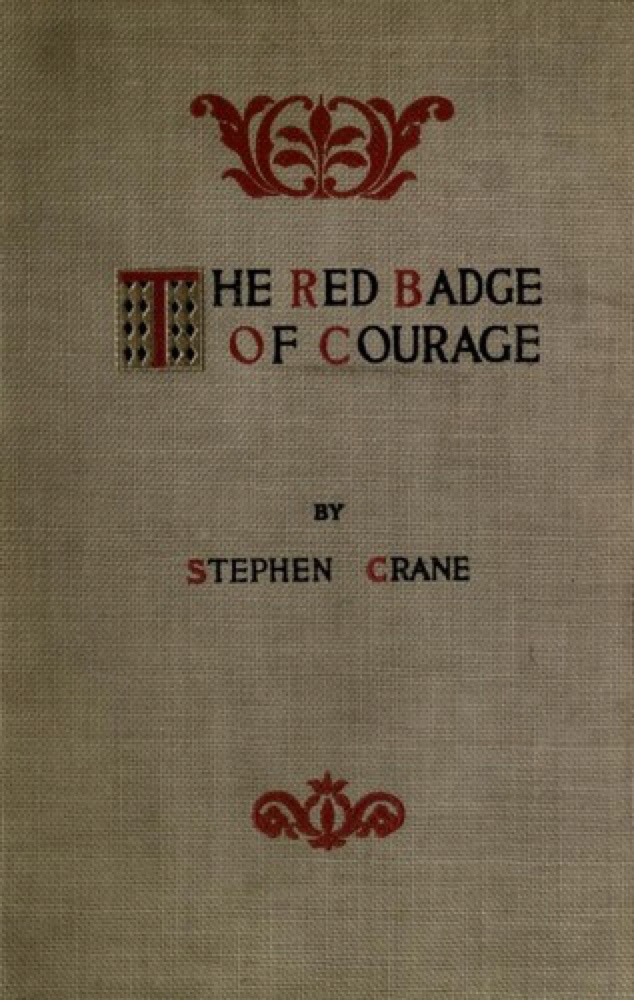
Stephen Crane · 92 pages
Rating: (6.5K votes)
“The man had arrived at that stage of drunkenness where affection is felt for the universe.”
― Stephen Crane, quote from Maggie: A Girl of the Streets
“The girl, Maggie, blossomed in a mud puddle.”
― Stephen Crane, quote from Maggie: A Girl of the Streets
“To her the earth was composed of hardships and insults. She felt instant admiration for a man who openly defied it. She thought that if the grim angel of death should clutch his heart, Pete would shrug his shoulders and say, "Oh, ev'ryt'ing goes."
She anticipated that he would come again shortly. She spent some of her week's pay in the purchase of flowered cretonne for a lambrequin. She made it with infinite care, and hung it to the slightly careening mantel over the stove in the kitchen. She studied it with painful anxiety from different points in the room. She wanted it to look well on Sunday night when, perhaps, Jimmie's friend would come. On Sunday night, however, Pete did not appear.
Afterwards the girl looked at it with a sense of humiliation. She was now convinced that Pete was superior to admiration for lambrequins.”
― Stephen Crane, quote from Maggie: A Girl of the Streets
“Nevertheless, he had, on a certain star-lit evening, said wonderingly and quite reverently: "Deh moon looks like hell, don't it?”
― Stephen Crane, quote from Maggie: A Girl of the Streets
“She thinks my name is Freddie, you know, but of course it ain't. I
always tell these people some name like that, because if they got onto
your right name they might use it sometime. Understand?”
― Stephen Crane, quote from Maggie: A Girl of the Streets
“Formidable women, with uncombed hair and disordered dress, gossiped while leaning on railings, or screamed in frantic quarrels.”
― Stephen Crane, quote from Maggie: A Girl of the Streets
“As long as human beings are regarded as "bad", zero is a good goal. But to be less bad is to accept things as they are, to believe that poorly designed, dishonorable, destructive systems are the best humans can do. This is the ultimate failure of the "be less bad" approach: a failure of the imagination. From our perspective, this is a depressing vision of our species' roles in the world. What about an entirely different model? What would it mean to be 100 percent good?”
― William McDonough, quote from Cradle to Cradle: Remaking the Way We Make Things
“ls the Conjugial Angel stone
That here he stands with heavy head
The backward-looking pillared dead
Inert, moss-covered, aIl alone?
The Holy Ghost trawls ln the Void,
With fleshly Sophy on His Hook
The Sons of God crowd round to look
At plumpy limbs to be enjoyed
The Greater Man casts out the line
With dangling Sophy as the lure
Who howls around the Heavens' colure
To clasp the Human Form Divine
Rose-petals fall from fallen hair
That in the clay is redolent
Of liquid oozings and the scent
Of the dark Pit, the Beastly lair
And is my Love become the beast
That was, and is not, and yet is,
Who stretches scarlet holes to kiss
And clasps with claws the fleshly feast
Sweet Rosamund, adult'rous Rose
May lie inside her urn and stink
Whlle Alfred's tears tum into ink
And drop into her quelque-chose
The Angel spreads his golden wings
And raises high his golden cock
And man and wife together lock
Into one corpse that moans and sings”
― A.S. Byatt, quote from Angels and Insects
“Flushed with the explosive shit of a sumo wrestler who ate Mexican food.”
― Hillary Frank, quote from I Can't Tell You
“Pay attention to everything the dying person says. You might want to keep pens and a spiral notebook beside the bed so that anyone can jot down notes about gestures, conversations, or anything out of the ordinary said by the dying person. Talk with one another about these comments and gestures. • Remember that there may be important messages in any communication, however vague or garbled. Not every statement made by a dying person has significance, but heed them all so as not to miss the ones that do. • Watch for key signs: a glassy-eyed look; the appearance of staring through you; distractedness or secretiveness; seemingly inappropriate smiles or gestures, such as pointing, reaching toward someone or something unseen, or waving when no one is there; efforts to pick at the covers or get out of bed for no apparent reason; agitation or distress at your inability to comprehend something the dying person has tried to say. • Respond to anything you don’t understand with gentle inquiries. “Can you tell me what’s happening?” is sometimes a helpful way to initiate this kind of conversation. You might also try saying, “You seem different today. Can you tell me why?” • Pose questions in open-ended, encouraging terms. For example, if a dying person whose mother is long dead says, “My mother’s waiting for me,” turn that comment into a question: “Mother’s waiting for you?” or “I’m so glad she’s close to you. Can you tell me about it?” • Accept and validate what the dying person tells you. If he says, “I see a beautiful place!” say, “That’s wonderful! Can you tell me more about it?” or “I’m so pleased. I can see that it makes you happy,” or “I’m so glad you’re telling me this. I really want to understand what’s happening to you. Can you tell me more?” • Don’t argue or challenge. By saying something like “You couldn’t possibly have seen Mother, she’s been dead for ten years,” you could increase the dying person’s frustration and isolation, and run the risk of putting an end to further attempts at communicating. • Remember that a dying person may employ images from life experiences like work or hobbies. A pilot may talk about getting ready to go for a flight; carry the metaphor forward: “Do you know when it leaves?” or “Is there anyone on the plane you know?” or “Is there anything I can do to help you get ready for takeoff?” • Be honest about having trouble understanding. One way is to say, “I think you’re trying to tell me something important and I’m trying very hard, but I’m just not getting it. I’ll keep on trying. Please don’t give up on me.” • Don’t push. Let the dying control the breadth and depth of the conversation—they may not be able to put their experiences into words; insisting on more talk may frustrate or overwhelm them. • Avoid instilling a sense of failure in the dying person. If the information is garbled or the delivery impossibly vague, show that you appreciate the effort by saying, “I can see that this is hard for you; I appreciate your trying to share it with me,” or “I can see you’re getting tired/angry/frustrated. Would it be easier if we talked about this later?” or “Don’t worry. We’ll keep trying and maybe it will come.” • If you don’t know what to say, don’t say anything. Sometimes the best response is simply to touch the dying person’s hand, or smile and stroke his or her forehead. Touching gives the very important message “I’m with you.” Or you could say, “That’s interesting, let me think about it.” • Remember that sometimes the one dying picks an unlikely confidant. Dying people often try to communicate important information to someone who makes them feel safe—who won’t get upset or be taken aback by such confidences. If you’re an outsider chosen for this role, share the information as gently and completely as possible with the appropriate family members or friends. They may be more familiar with innuendos in a message because they know the person well.”
― quote from Final Gifts: Understanding the Special Awareness, Needs, and Communications of the Dying
“There's nothing worse than a label to cement people's loyalties.”
― Greg Egan, quote from Schild's Ladder
BookQuoters is a community of passionate readers who enjoy sharing the most meaningful, memorable and interesting quotes from great books. As the world communicates more and more via texts, memes and sound bytes, short but profound quotes from books have become more relevant and important. For some of us a quote becomes a mantra, a goal or a philosophy by which we live. For all of us, quotes are a great way to remember a book and to carry with us the author’s best ideas.
We thoughtfully gather quotes from our favorite books, both classic and current, and choose the ones that are most thought-provoking. Each quote represents a book that is interesting, well written and has potential to enhance the reader’s life. We also accept submissions from our visitors and will select the quotes we feel are most appealing to the BookQuoters community.
Founded in 2023, BookQuoters has quickly become a large and vibrant community of people who share an affinity for books. Books are seen by some as a throwback to a previous world; conversely, gleaning the main ideas of a book via a quote or a quick summary is typical of the Information Age but is a habit disdained by some diehard readers. We feel that we have the best of both worlds at BookQuoters; we read books cover-to-cover but offer you some of the highlights. We hope you’ll join us.