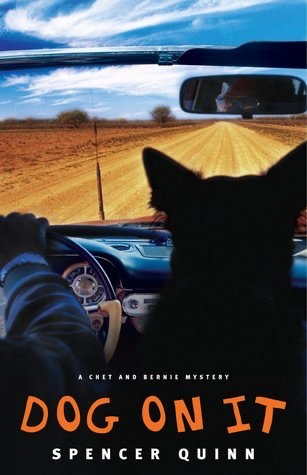
“Chet! What are you eating?”
Nothing. It was true. The eating part was over.”
― Spencer Quinn, quote from Dog on It
“I’d been the best leaper in K-9 class, which had led to all the trouble in a way I couldn’t remember exactly, although blood was involved.”
― Spencer Quinn, quote from Dog on It
“Often, maybe even usually, Bernie ended up being the smartest human in the room. Tonight was different.”
― Spencer Quinn, quote from Dog on It
“A wild-goose chase! I’d heard that expression so many times but never been on one. It sounded like the most exciting thing in the whole world. Yes, I wanted to go on a wild-goose chase, and if that meant Vegas, so be it.”
― Spencer Quinn, quote from Dog on It
“Snacks taste better when you’re hungry, but do they ever actually taste bad? I ask you.”
― Spencer Quinn, quote from Dog on It
“The cat saw me at once, of course, and every hair on his body stood straight up, and he made a sound like the mountain lion's roar but much tinier. That's all cats are - midget lions. I'm nobody's midget, baby.”
― Spencer Quinn, quote from Dog on It
“Is there some rule that says a young man can't be a handsome prince and a terrible bore all at the same time?”
― Cameron Dokey, quote from Before Midnight: A Retelling of "Cinderella"
“All great, simple images reveal a psychic state. The house, even more than the landscape, is a "psychic state," and even when reproduced as it appears from the outside, it bespeaks intimacy. Psychologists generally, and Francoise Minkowska in particular, together with those whom she has succeeded interesting in the subject, have studied the drawing of houses made by children, and even used them for testing. Indeed, the house-test has the advantage of welcoming spontaneity, for many children draw a house spontaneously while dreaming over their paper and pencil. To quote Anne Balif: "Asking a child to draw his house is asking him to reveal the deepest dream shelter he has found for his happiness. If he is happy, he will succeed in drawing a snug, protected house which is well built on deeply-rooted foundations." It will have the right shape, and nearly always there will be some indication of its inner strength. In certain drawings, quite obviously, to quote Mme. Balif, "it is warm indoors, and there is a fire burning, such a big fire, in fact, that it can be seen coming out of the chimney." When the house is happy, soft smoke rises in gay rings above the roof.
If the child is unhappy, however, the house bears traces of his distress. In this connection, I recall that Francoise Minkowska organized an unusually moving exhibition of drawings by Polish and Jewish children who had suffered the cruelties of the German occupation during the last war. One child, who had been hidden in a closet every time there was an alert, continued to draw narrow, cold, closed houses long after those evil times were over. These are what Mme. Minkowska calls "motionless" houses, houses that have become motionless in their rigidity. "This rigidity and motionlessness are present in the smoke as well as in the window curtains. The surrounding trees are quite straight and give the impression of standing guard over the house". Mme. Minkowska knows that a live house is not really "motionless," that, particularly, it integrates the movements by means of which one accedes to the door. Thus the path that leads to the house is often a climbing one. At times, even, it is inviting. In any case, it always possesses certain kinesthetic features. If we were making a Rorschach test, we should say that the house has "K."
Often a simple detail suffices for Mme. Minkowska, a distinguished psychologist, to recognize the way the house functions. In one house, drawn by an eight-year-old child, she notes that there is " a knob on the door; people go in the house, they live there." It is not merely a constructed house, it is also a house that is "lived-in." Quite obviously the door-knob has a functional significance. This is the kinesthetic sign, so frequently forgotten in the drawings of "tense" children.
Naturally, too, the door-knob could hardly be drawn in scale with the house, its function taking precedence over any question of size. For it expresses the function of opening, and only a logical mind could object that it is used to close as well as to open the door. In the domain of values, on the other hand, a key closes more often than it opens, whereas the door-knob opens more often than it closes. And the gesture of closing is always sharper, firmer, and briefer than that of opening. It is by weighing such fine points as these that, like Francoise Minkowska, one becomes a psychologist of houses.”
― Gaston Bachelard, quote from The Poetics of Space
“While the nature of this radiation will give no information whatsoever on what fell into the black hole,”
― Lawrence M. Krauss, quote from The Physics of Star Trek
“Few things are more discouraging or dishonoring to such men than a congregation inattentive to the Word of God. Faithful men flourish at the fertile reception of the preached Word. They’re made all the more bold when their people give ear to the Lord’s voice and give evidence of being shaped by it. As church members, we can care for our pastors and teachers and help to prevent unnecessary discouragement and fatigue by cultivating the habit of expositional listening.”
― Thabiti M. Anyabwile, quote from What Is a Healthy Church Member?
“1945 Elsie, I hope this letter finds its way to your good hands. Tobias and I are among friends in Zurich. The news of the Allied invasion of Garmisch is bittersweet. Though we are German, our Fatherland is no longer a welcoming place. The Jewish families I hid for over a year—the Mailers and the Zuckermanns—lost nearly all their extended family members over the course of these wretched years. Thanks to your engagement ring, we were able to bribe the SS guards and smuggle Nanette Mailer, her friend, and the Zuckermanns’ niece, Tabita, from KZ Dachau before the march. Unfortunately, Tobias’s sister, Cecile, succumbed to”
― Sarah McCoy, quote from The Baker's Daughter
BookQuoters is a community of passionate readers who enjoy sharing the most meaningful, memorable and interesting quotes from great books. As the world communicates more and more via texts, memes and sound bytes, short but profound quotes from books have become more relevant and important. For some of us a quote becomes a mantra, a goal or a philosophy by which we live. For all of us, quotes are a great way to remember a book and to carry with us the author’s best ideas.
We thoughtfully gather quotes from our favorite books, both classic and current, and choose the ones that are most thought-provoking. Each quote represents a book that is interesting, well written and has potential to enhance the reader’s life. We also accept submissions from our visitors and will select the quotes we feel are most appealing to the BookQuoters community.
Founded in 2023, BookQuoters has quickly become a large and vibrant community of people who share an affinity for books. Books are seen by some as a throwback to a previous world; conversely, gleaning the main ideas of a book via a quote or a quick summary is typical of the Information Age but is a habit disdained by some diehard readers. We feel that we have the best of both worlds at BookQuoters; we read books cover-to-cover but offer you some of the highlights. We hope you’ll join us.